
Family : Orchidaceae

Text © Prof. Pietro Pavone

English translation by Mario Beltramini
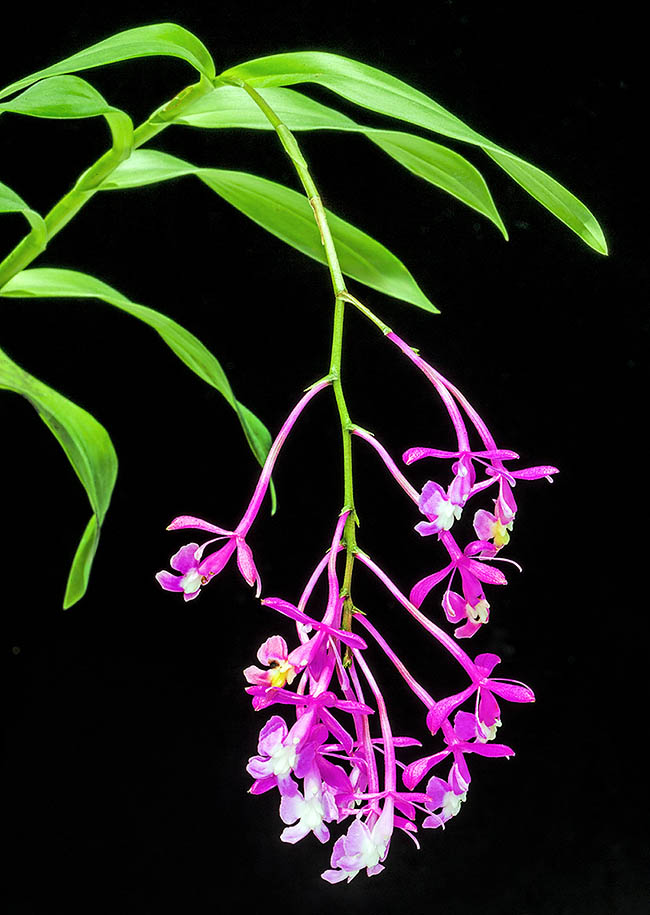
Epidendrum porphyreum is a 50-130 cm epiphytic or terricolous orchid, cespitose, native to the humid mountain forests of west Andes, from south Colombia to central Ecuador from 1500 to 3300 m of altitude © Dr. Giuseppe Mazza
Epidendrum porphyreum Lindl. 1841 is a species belonging to the family Orchidaceae, subfamily
Epidendroideae, tribe Epidendreae, subtribe Laeliinae.
Placed in the group Pseudepidendrum being a species characterized by caespitose plants, cane-shaped stems, sharp to pointed leaves, apical inflorescence, filiform petals and usually trilobed labellum, with three parallel fleshy keels and “at bird’s wing type” pollinia. Moreover it is included in the subgroup Porphyreum because of the reddish orange, intense purple or pink-lilac flowers and usually prominent calli.
The species has been found in the woods on the western side of the volcano Pichincha by prof. William Jameson (1796-1873), Scottish botanist and professor at the Central University of Ecuador in Quito. But it has been formally described by John Lindley (1799-1865), British botanist and horticulturist, on the Sir W. J. Hooker’s magazine “The Journal of Botany” (J. Bot. Hooker 3: 86, 1841).
Epidendrum porphyreum is presently found in the humid mountain forests of the western slopes of the Andes, from southern Colombia to central Ecuador, at 1500-3300 m of altitude.
The name of the genus comes from the Greek επί, epi (over) and δένδρον, (tree), “on the trees” referring to the epiphytic posture. The specific epithet comes from the Greek πορφυρεος, porfyreos, violet, purple due to the colour of its flowers.
It is an epiphytic or terricolous herbaceous plant, caespitose, 50-130 cm tall with fleshy basal roots, 3-4 mm thick. It has stems, similar to canes, simple, with circular sections at the base and flattened towards the apex, erect, 40-100 x 0,3-1,2 cm. Normally the stems are covered in the basal half by scarious and fibrous sheaths, 2-4,5 cm long.
In the apical half of the stem are present the leaves, in number of 7-20, alternate, erect with finely striated tubular sheaths. The lamina has an entire margin and is strictly elliptic, sharp to briefly pointed, sub coriaceous, 8-17,5 x 1,5-4 cm.
The inflorescence is apical, panicle-like, erect to slightly arcuate, dense, 9-35 cm long, with 40-150 flowers. The floral peduncle of each inflorescence is thin, straight, 7-16 cm long covered by 2-7 tubular, scarious pointed bracts, partially imbricated. The main axis of the inflorescence (rachis) has a circular section and bears 6-8 short, expanded racemes.
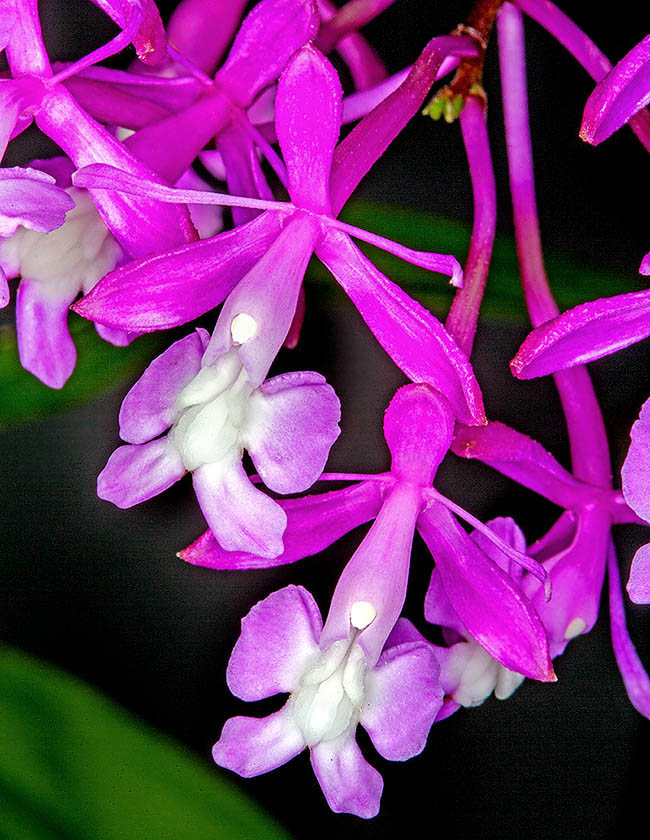
The apical panicle-like inflorescence bears up to 40-150 flowers resupinate and odourless opening together. It’s highly sought by collectors who consider it rightly a very attractive species due to its rich blooming © G. Mazza
The ovary is cylindrical, thin, 20-45 mm long.
The flowers open simultaneously and are resupinate and odourless, of purple colour with white disk.
The sepals are free, fleshy, papillose on the back, obovate-lanceolate, slightly concave, 7-veined and the entire margin. The lateral ones are oblique.
The petals are free, linear-oblanceolate, rounded, with an entire margin, 13 x 1,5 mm. The labellum is merged to the column, 3-lobed, cordate at the base, with an entire margin, 13,5-15 x 15-16 mm, with two prominent, laminar calli. The disk has three parallel keels, fleshy, the central is slightly longer. The lateral jobes, 6-8 x 8,5-10 mm, are ovate shaped like an axe (dolabriform). The median lobe, in its turn forms two triangular lobes, slightly spread apart. The column is thin, straight, with the apex having a couple of short lateral wings. The anther is obovoid, 4-locular, truncated at the apex.
The pollinia are four, shaped like a bird’s wing, strongly compressed laterally. The rostellum is subapical and fissured. The nectarium, in the form of a cuniculus, develops inside half the ovary.
This plant blooms all year round.
Epidendrum porphyreum is suitable for the cultivation being an orchid very attractive due to its rich blooming.
It may be cultivated in baskets or in pots with well draining loam bark and perlite based.
It is a cool-cold climate species and the best temperature must be between 12 °C and 25 °C with night decline serving to stimulate the blooming. Humidity must be very high, over 70-80% but must be guaranteed a good air circulation in order to prevent fungal rot. During the active growth, it is good to water frequently and abundantly because the substratum must constantly remain humid but without stagnation of water.
To favour the growth it is suggested the use of a balanced fertilizer for orchids (type 20-20-20) every two weeks, except for the winter period. Repotting must be done every 1-2 years as soon as the new roots do sprout.
Epidendrum porphyreum is a protected species, like all orchids, by the international legislation (CITES Status: Appendix II) to prevent the threats arising from the loss of habitat and from the wild harvesting.