
Family : Fabaceae

Text © Prof. Pietro Pavone

English translation by Mario Beltramini
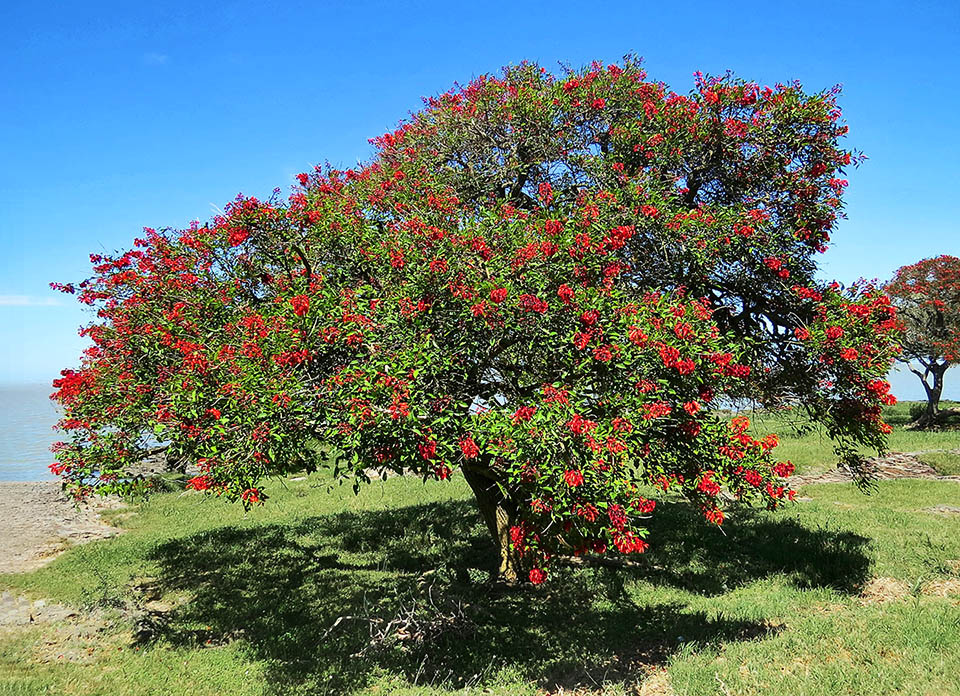
Erythrina crista-galli is a pioneer species native to eastern South America. Semi-deciduous small tree may reach 5-8 m in height © Rafael Tosi
Erythrina crista-galli L. belongs to the family Fabaceae, subfamily Faboideae, tribe Phaseoleae.
The species was described by Carl Linnaeus in “Mantissa Plantarum”, work published in 1767 on a specimen collected in Brazil by the Italian botanist Domenico Agostino vandelli (1735-1816). Vandelli founded the Botanical Garden of Coimbra, Portugal and played a key rôle in the creation of the Lisbon Academy of Sciences. He allowed to catalog hundreds of new South-American species, many of which still bear his name like the genus Vandellia L.
Erythrina crista-galli is a species native to Brazil, Argentina, Paraguay and Uruguay, where it spontaneously grows along the river banks. Presently is naturalized in various regions of the world, among which Bolivia, India, eastern Australia and southern USA.
It is a pioneer plant that can colonize poor or very humid lands even if degraded. In southern Brazil, due to this capacity it has, it is frequently found in the areas used for agricultural activities, especially those intended for the cultivation of rice and of soy.
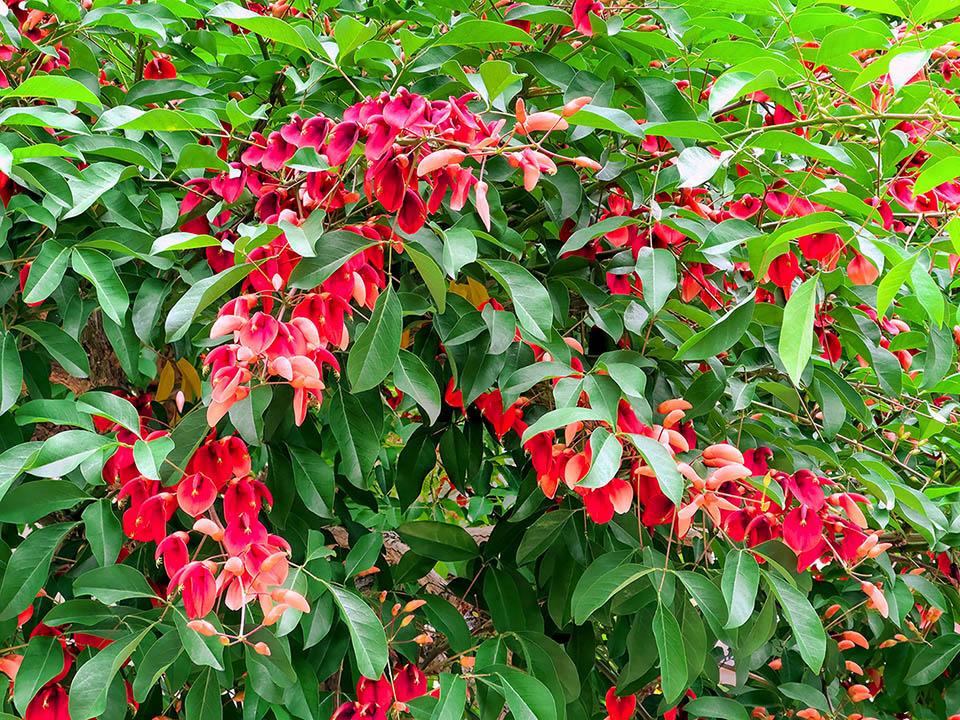
Has trifoliate compound leaves and coral red flowers, in up to 25-30 m long showy terminal racemes. Persistent calyx and papilionaceous corolla with big cordiform vexillum © Giuseppe Mazza
Human activities and the climate changes are damaging the habitats of the wild populations. In fact, it is estimated that, if no protective measures are taken, this species may become extinct in the native places in a few hundred years.
However, due to its diffusion in the world, it has been evaluated by the IUCN Red List of the species endangered as (Least Concern).
The generic term comes from the Greek “ἐρυθρός” (erythrós), red, referring to the colour of the flowers. The specific term crista-galli alludes to the particular morphology of the flowers that recalls the rooster’s crest. Commonly this plant is known as “Cockspur coral tree” due to its showy clusters of red flowers; but it is also called “Cry-baby tree” due to the abundant nectar that at times drips from the flowers or “Fireman’s cap” due to the shape of the flowers.
In the areas of Spanish origin it’s called “ceibo”, “seibo” or “bucaré” and in the Portuguese ones , “corticeira”.
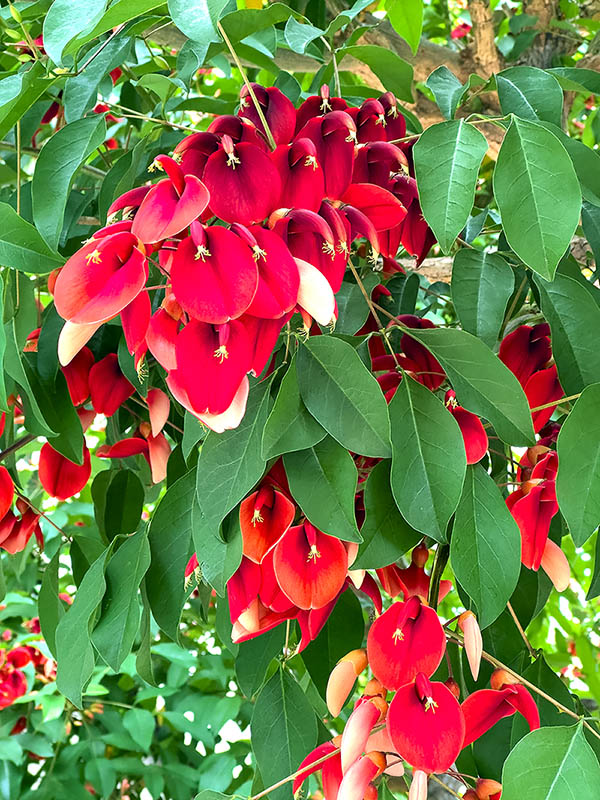
Inflorescences, very rich in nectar, attract bees and various insects, also passerines and hummingbirds © Giuseppe Mazza
The plant represents the national tree of Argentina and its flower is the emblem of Peru and of Uruguay.
Erythrina crista-galli is a shrub or a semi-deciduous small tree up to 5-8 m tall. It has a semi-climbing posture, with long thorny and very ramified stems.
It has a long, tapering root with nodules produced by nitrogen-fixing bacteria that live in symbiosis making it easier for the plant to absorb the nitrogen and getting in exchange organic substances it needs.
The leaves, carried by long thorny petioles, are composite, alternate, trifoliate, with numerous leaflets of oval or oval-lanceolate shape, sub-obtuse at the apex, rather glaucescent in the lower pagina, usually deciduous in cold climates.
The flowers, rich in nectar and of red-dark colour, are merged in showy terminal racemes up to 25-30 cm long. The flowers measure up to 5 cm of breadth. The calyx is persistent, trilobate and the corolla is irregular, papilionaceous, with sickle-shaped keel, reduced wings and ample cordiform vexillum.
The stamens are 10 (9 merged and 1 free), wrapped, together with the ovary, by the keel. Blooming occurs during the dry season between October and April in austral America and between June and October in the northern hemisphere.
The fruits are blackish legumes tha inside enclose the red-brown seeds.
A study on the reproductive biology of the natural populations, done in Argentina and in Uruguay, has highlighted that only th 6% of the flowers ripens fertile seeds, even if the 93% of the observed flowers has received visits by pollinators.
The bees are the most frequent visitors. The stingless bee Trigona spinipes (Fabricius, 1793) has been observed at all hours of the day. The flowers have been visited also by passerine birds (roosting birds) and, to a lesser extent, by hummingbirds, like the hummingbird Chlorostilbon lucidus (Shaw, 1812), and small insects like flies, ants, wasps and cockroaches.
Erythrina crista-galli is autocompatible, that is, in condition to produce fertile seeds through self-pollination but the fruit set is greater in the flowers where the cross-fertilization has occurred.
The wood is porous, not very durable, utilized for carving and molding works and for the production of cellulose pulp.
It is a plant utilized in the popular medicine of various locations of austral America. In Argentina infusions and decoctions of the branches are utilized as astringents, narcotics and sedatives. The bark is astringent, anti-asthmatic and anti-hemorrhoidal. The leaves are sedative, the flowers are expectorant and anti-cough. The seeds extracts are sedative, hypotensive, laxative and diuretic. These properties have been all validated by pharmacological investigations.
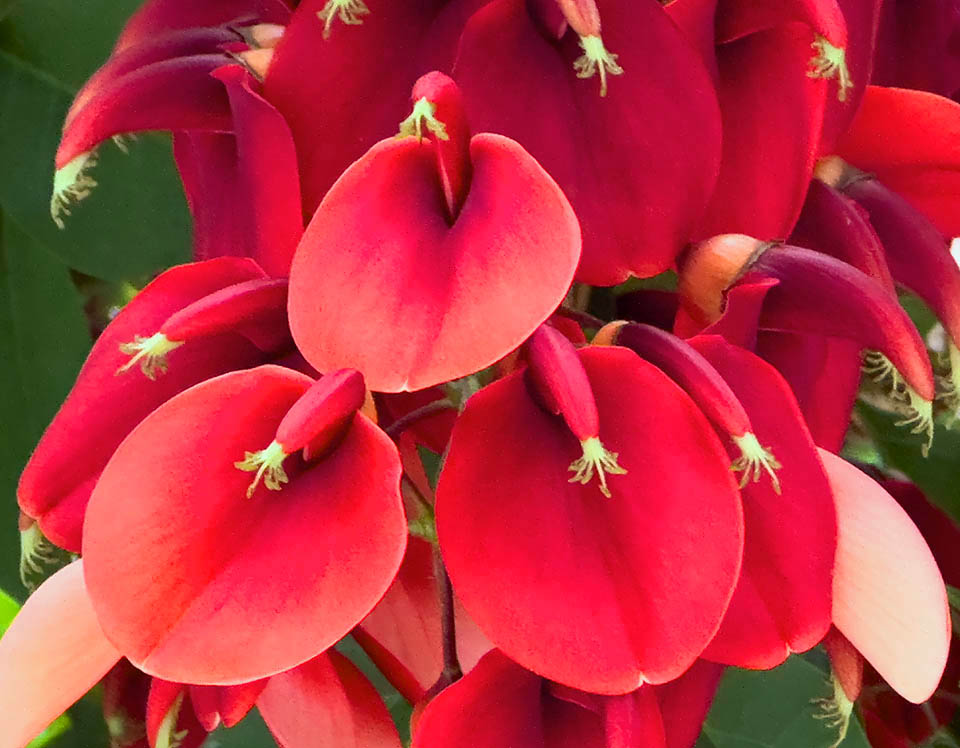
The flowers, surely catchy, are the floral emblem of Argentina and Uruguay. In America they open in October to April, in the austral hemisphere from June to October © Giuseppe Mazza
In Brazil an extract of the bark is used as powerful soporific, also as mouthwash for sore throat and in the treatement of cuts, rheumatism and hepatitis. The seed contains the alkaloid beta-erythroidine. In the rats has been reported a curare-like action by the seeds.
Studies on its chemical composition have highlighted the presence of several flavonoid and alkaloid compounds, that the plant uses as defense from the attacks of the pathogens and that have anti tumor, antioxidant, antiviral and antimalarial activities. The acetonic extract of the young branches has antibacterial action on Bacillus brevis and Bacillus subtilis. The presence of alkaloids renders the plant poisonous, in particular the leaves and the seeds in ingested.
Erythrina crista-galli is grown as an ornamental plant, especially for its abundant flowering. In the regions with mild climate it grows well outdoors but prefers sunny expositions. The winter cold may damage the youngest branches, therefore, it is good to eliminate them with pruning in early spring in order to reinvigorate the plant with new branches.
The plant reproduces by seed, usually in spring, and by semi-mature wood cuttings in spring-summer.
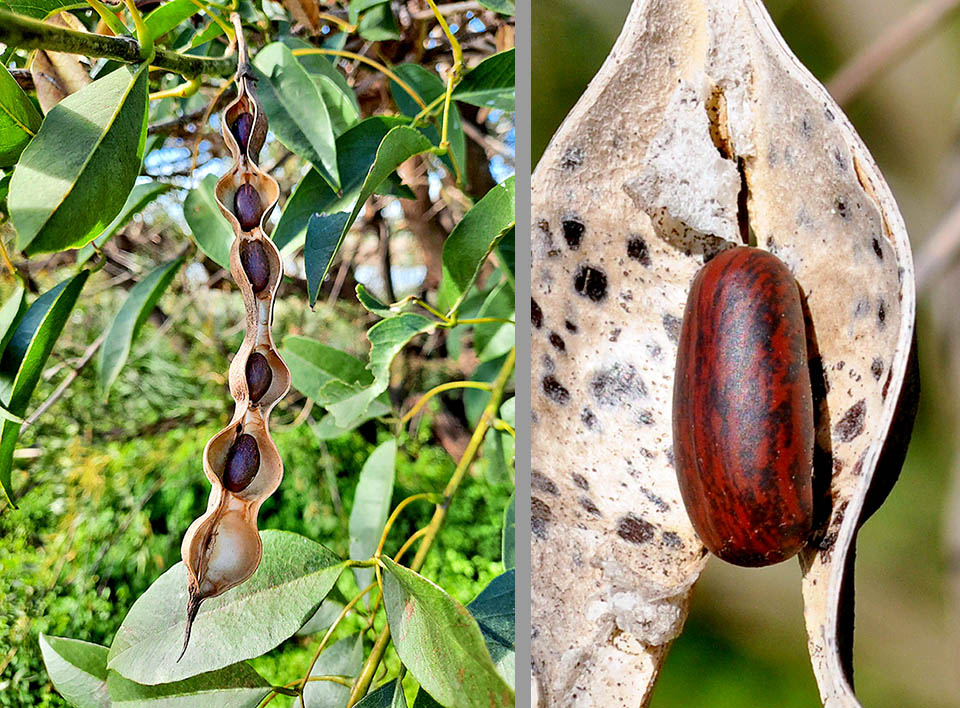
The dark brown ripe fruits have an almost woody consistency. The reniform seeds, toxic like leaves, display medicinal virtues © Margarita Cervio (left) © vinicius_s_domingues (right)
The seeds, after staying in warm water for a few fours, must be buried and placed in a luminous and warm location, at a temperature between 20 °C and 25 °C. It is suggested to keep the soil humid, but not wet. The germination will occur two to four weeks later. In spring it is suggested to place the cultivation container in a warm and sunny place. During the growth phase can be administered some liquid fertilizer every two weeks, whilst during the blooming, that occurs after about four years from the sowing, once a week.
This species may be subject to mite nematodes, thrips and scale insect infestations, easily removable with insecticides of natural origin too.
Synonyms: Corallodendron crista-galli (L.) Kuntze; Micropteryx crista-galli (L.) Walp.; Erythrina compacta W.Bull; Erythrina crista-galli var. corallina N.F.Mattos; Erythrina crista-galli var. hasskarlii Backer; Erythrina crista-galli var. leucochlora Lombardo; Erythrina crista-galli var. longiflora M.A.Zapater & E.C.Lozano; Erythrina fasciculata Benth.; Erythrina graefferi Tineo; Erythrina laurifolia Jacq. ; Erythrina pulcherrima Tod.; Erythrina speciosa Tod. nom. illeg.; Micropteryx fasciculata (Benth.) Walp.; Micropteryx laurifolia (Jacq.) Walp.
→ To appreciate the biodiversity within the family of FABACEAE please click here.