
Family : Grammatidae

Text © Dr. Giuseppe Mazza

English translation by Mario Beltramini
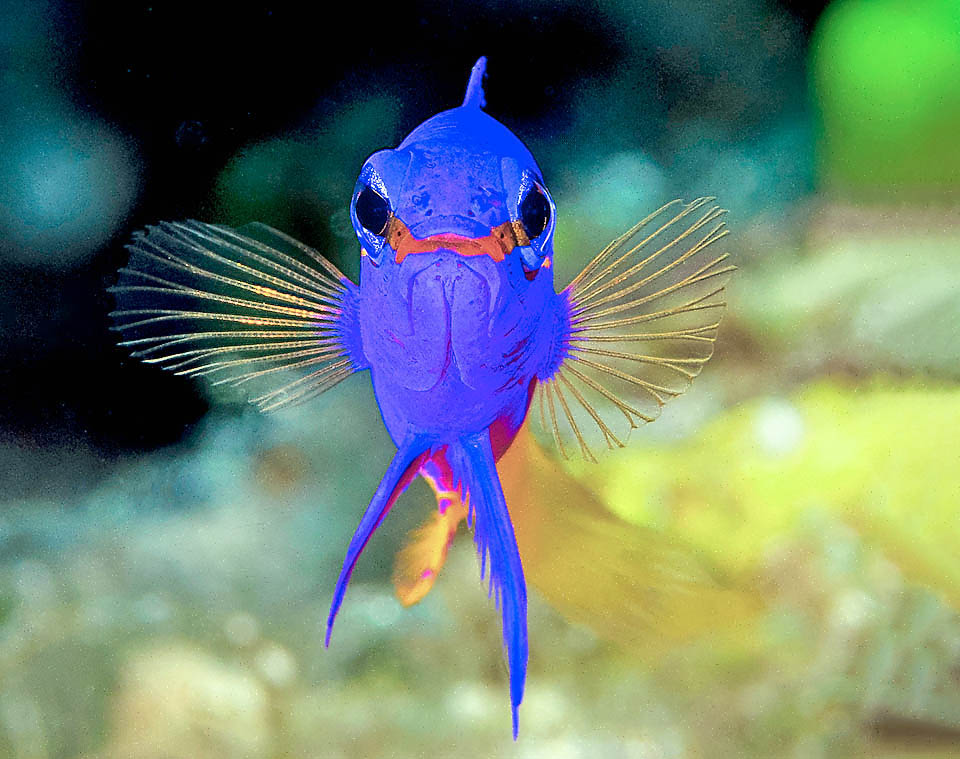
At most 8 cm long, Gramma loreto is native to Caribbean, from Bermuda, Bahamas and Gulf of Mexico up to Colombia and Venezuela coasts © Rafi Amar
Gramma loreto Poey, 1868, commonly known due to its elegant yellow and violet livery as Royal gramma, belongs to the class of the of the Actinopterygii, the ray-finned fish, to the big order of the Perciformes, and to the family of the Grammatidae that counts only two genera, Gramma and Lipogramma, with about a twenty species. They are all modest-sized fishes, less than 10 cm, characterized by an interrupted or absent lateral line. The genus Gramma, in fact, from the Greek “γράμμα”, mark, with reference to the broken lateral line. that almost reachest the last ray of the dorsal fin and that then resumes, less evident, on the caudal peduncle.
Even if the Latin name lacks the usual genitive, the specific term loreto is a homage to the Lady Loreto Martinez who seized the type specimen for the description in Matanzas Bay, Cuba, where she lived in contact with various museums, but could very well be, as some hastily suggest, also a reference in Spanish to the multicoloured livery of this species that evokes a parakeet.
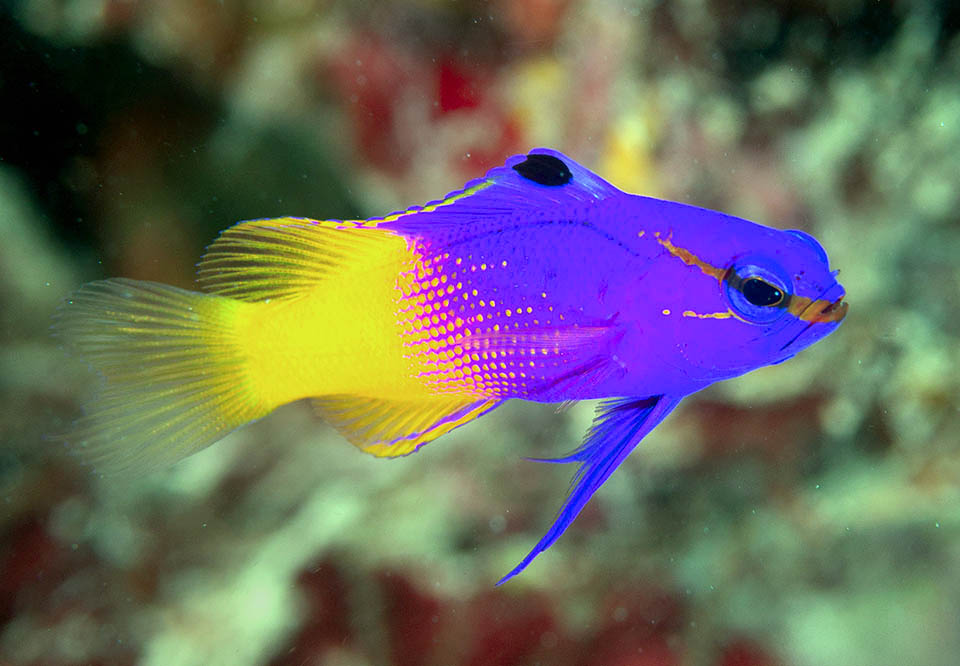
The genus’ name comes from the broken lateral line that reaches the rays of the dorsal fin and then goes on, less evident, on the caudal peduncle © Tim Cameron
Zoogeography
Gramma loreto is a central-western Atlantic fish, present from Bermuda, Bahamas and Gulf of Mexico in all Caribbean up to the coasts of Colombia and Venezuela.
Ecology-Habitat
Demersal, it lives between 1 and 60 m in depth, in waters having temperatures from 22 and 27 °C, rarely under 40 m. It mainly frequents shady zones, like the entry to grottoes, reefs, ravines and ledges where it always moves with the belly facing the substratum often giving the impression of swimming upside down. It can form small schools of 10-100 individuals, mainly females and juveniles, organized hierarchically under the authority of a big adult male, at times two, who defends the territory from other groups.
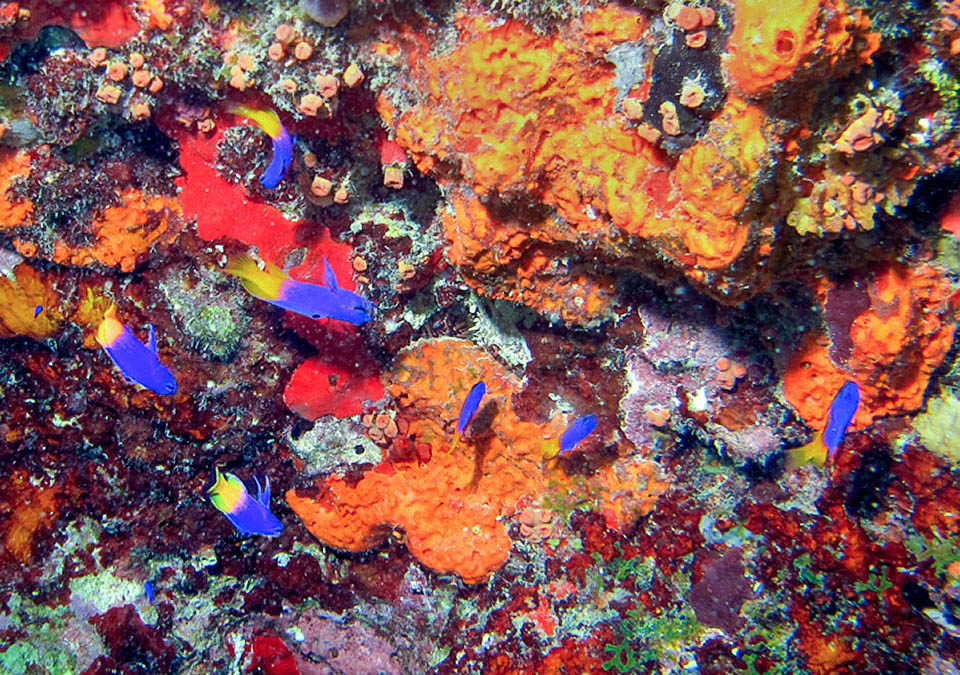
It is often seen swimming on the coralligenous in small groups hierarchically organized under the authority of a big adult male who defends its own territory © Pauline Walsh Jacobson
Morphophysiology
Gramma loreto can be 8 cm long.
The head has well developed jaws that evoke those of the Serranidae, with fleshy lips and small teeth present also in the fore and lateral side of the palate. The body, fusiform, displays a sparkling livery, purple-violet blue livery in its first part and orange yellow in the second, after a characteristic transition zone between the two colours.
The big eyeball is masked by an oblique dark line that then continues yellowish on the body pointing up towards the back and up to reach the leaps below.
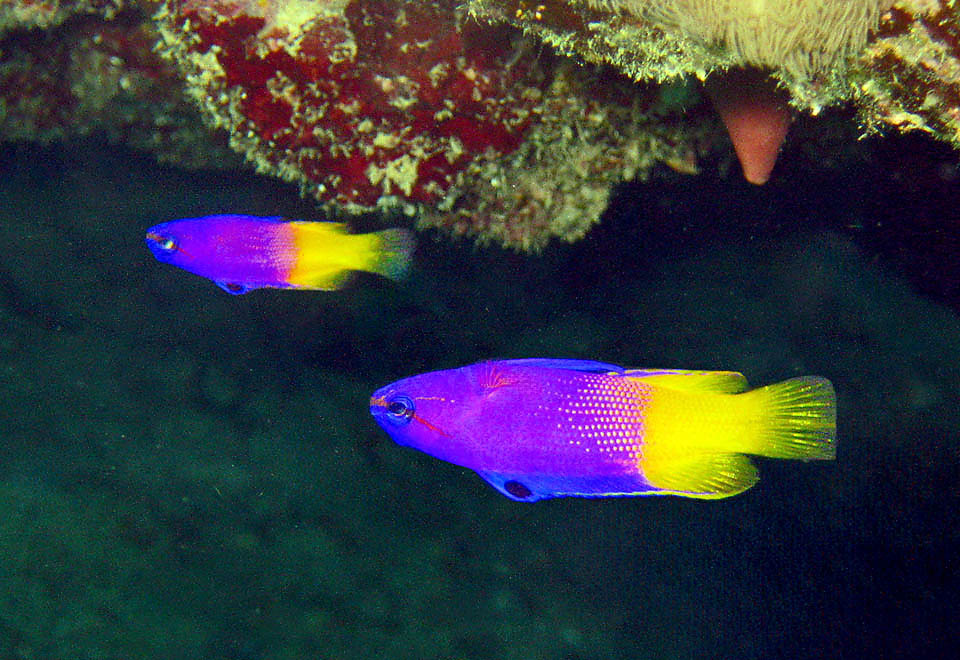
It always swims with belly facing substratum, and following the reef ledges giving the impression to swim upside down © Micaela Neal
Close to the eye we also note a short and similar horizontal line.
The dorsal fin, with a showy black spot in the first part, has 12 spiny rays and 10 soft; the anal 3 spiny and 6-10 unarmed, the pelvic ones 1 elongated spiny ray that at times exceeds the base of the anal fin and 5 soft; the rounded pectoral have 14-17 rays and the tail appears almost truncated. The preoperculum is serrated and the operculum has two flat short spines.
It distinguishes from Lipogramma klayi Randall, 1963, living below 40 m in depth in the same range, for the celar break it shows between the two colour, without prejudice to this winning colour combination we find in South America in the analogous sister species Gramma brasiliensis Sazima, Gasparini & Moura, 1998, and in Pseudochromis pacagnellae Axelrod, 1973, living very far away, in the Indo Pacific, giving us an example of evolutionary convergence.
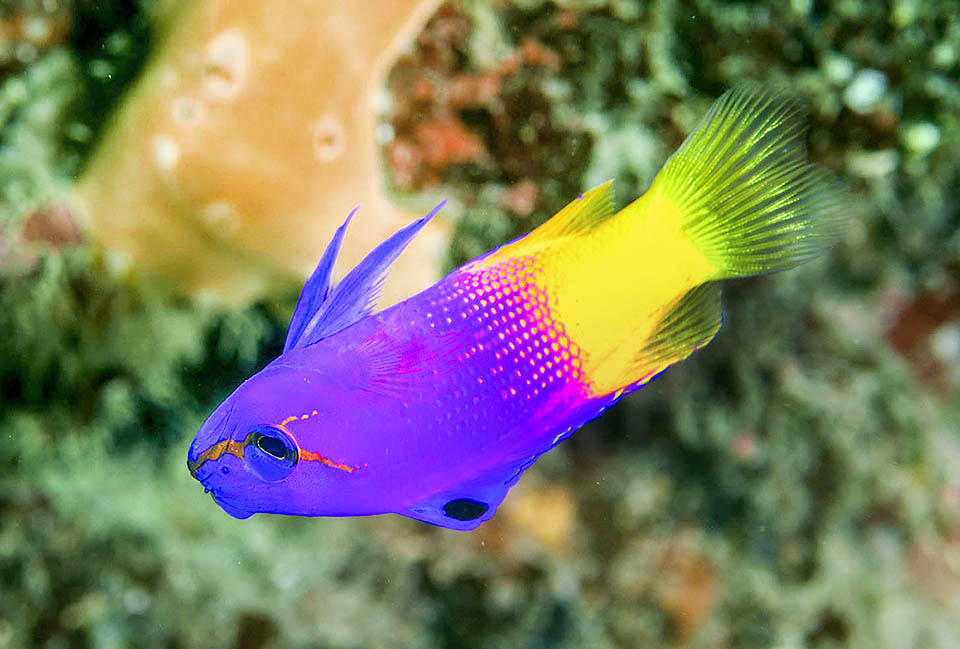
Colourful and funny for its acrobatics, easy to feed and respectful of other guests, well adapts to the domestic aquaria and easily reproduces in captivity © Frank Krasovec
Ethology-Reproductive Biology
Gramma loreto feeds on plankton, and sporadically on the ectoparasites present on the fishes that frequent the cleaning stations.
It is mostly preyed upon by the West Atlantic trumpetfish (Aulostomus maculatus), by the Bar jack (Caranx ruber), by the Yellowtail snapper (Ocyurus chrysurus) and by various groupers like Cephalopholis cruentata, Cephalopholis fulva and the juveniles of Epinephelus striatus, but especially by the voracious Graysby (Pterois volitans) carelessly introduced in the Caribbean.
This species in fact feeds on less than 15 cm preys that go swimming over the seabeds and when it makes out a small school of Royal grammas massacres juveniles and adults.
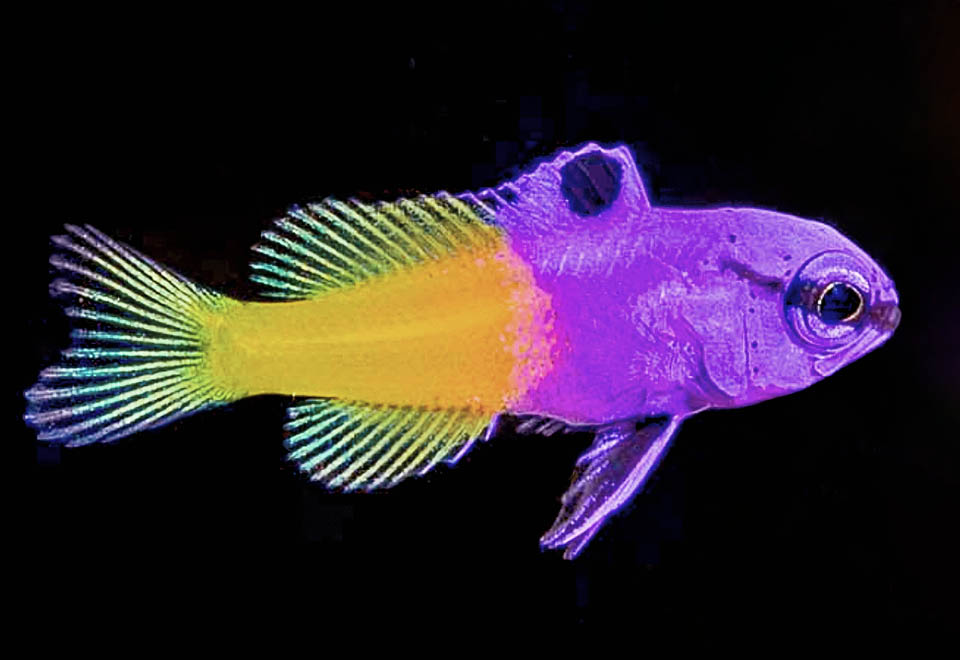
Here a juvenile. Farming has reduced collections in nature and Gramma loreto is not now considered an endangered species © www.carlosestape.photoshelter.com
Gramma loreto reaches sexual maturity when about 3 cm and reproduces in couples with eggs laid into a nest.
The male carefully cleans up a small cavity in the location judged safe by himself, beautifying its entrance with weeds and debris in order to entice its partner to lay. Then it surveys the brood for 10-11 days, ventilating and cleaning the eggs until their hatching that will free 3-4 mm larvae.
Gramma loreto has successfully reproduced also in the small home aquaria and its farming has reduced the collecting in nature thus filling the strong market demand.
Since 2011 therefore it appears as “LC, Least Concern” in the IUCN Red List of the endangered species.
→ For general information about FISH please click here.
→ For general information about BONY FISH please click here
→ For general information about CARTILAGINOUS FISH please click here.
→ To appreciate the BIODIVERSITY of BONY FISH please click here.
→ To appreciate the BIODIVERSITY of CARTILAGINOUS FISH please click here.