
Family : Accipitridae

Text © Dr. Gianfranco Colombo

English translation by Mario Beltramini
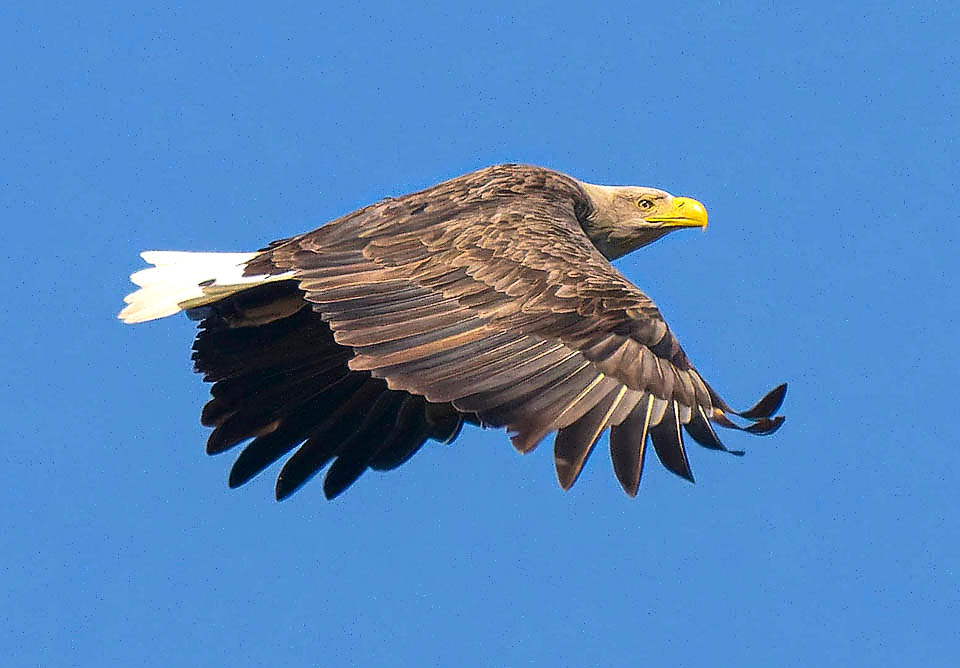
Due to its very black pupil with yellow or pearly iris, Haliaeetus albicilla has a terrifying look and no enemy as its huge beak can tear apart any prey © Wolfgang Bettighofer
Among the numerous common names given to this immense and mighty eagle, one is particularly fascinating and in the meantime romantic: Queen of the mists (in Italian, Regina delle nebbie).
Actually, to see this big eagle suddenly emerging from the mist, with its spectacular vigorous and heavy flight and with its such disproportionate beak habitually wide open as if it wanted to attack anyone who happened to be on its path, is an image that could have influenced those who gave it this nickname.
However, the origin has nothing poetic or strange about it, but is simply due to the habitat this bird frequents, a continental environment, cold and humid, with perennial waterways and vast lakes where fog and mist are at home.
The Sea eagle or White-tailed sea-eagle or also Gray sea eagle (Haliaeetus albicilla Linnaeus, 1758) belongs to the order of the Accipitriformes and to the family of the Accipitridae and in the European continent is considered as the largest eagle.
Just a little bigger, as size, than the most elegant and known Golden eagle (Aquila chrysaetos) in the Palearctic is overcome by the Steller’s sea eagle (Haliaeetus pelagicus) and in the Nearctic is equalled by the Bald eagle (Haliaeetus leucocephalus) the heavyweights in this family.
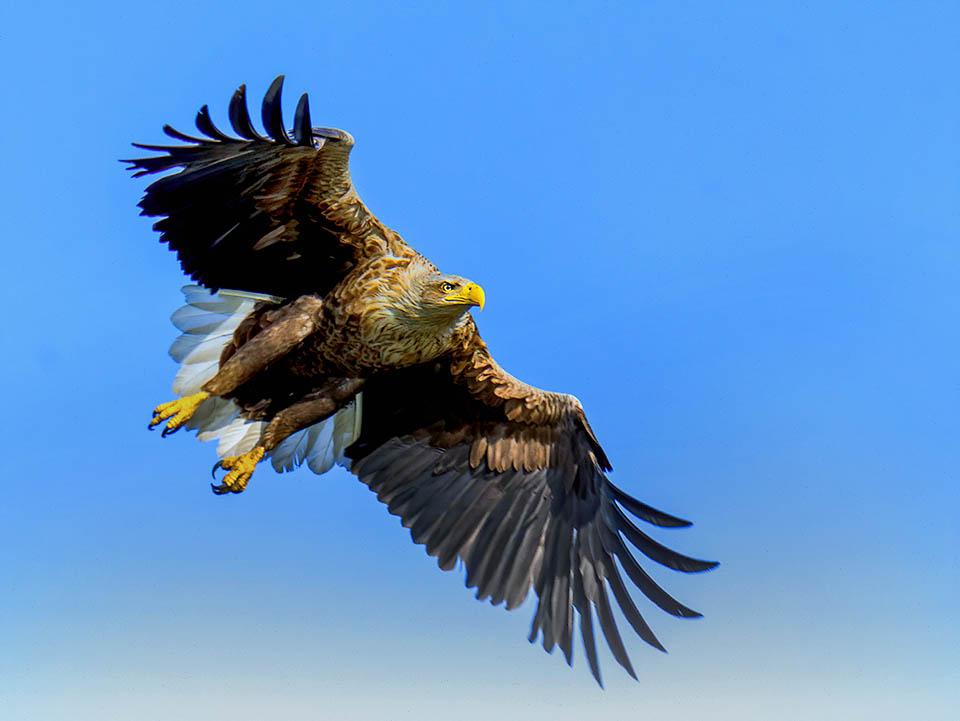
To live needs at least half a kilo of meat per day, and where the food is not missing it can reach even 7 kg with 240 cm of wingspan © Mikhail Ezdakov
In the past centuries it was generically called Pygarg, from the Latin “pygargus” and derived from the Greek term “pugargos” from the union of the names “puge”, arse, and “argos”, white, shining, a vulgar name until now remained in some common European names.
The etymology of the scientific binomen originates from Greek and Latin terms.
The genus Haliaeetus from the Greek “hah”, sea, and “actos”, eagle, whilst the species albicilla from the Latin “albi”, white and “cilla”, tail.
As even the most knowledgeable ornithologists know, it is often not easy to quickly remember the scientific names of the species present in our world especially when we are facing a multitude of varieties which we do not always have the opportunity to meet. In the ornithological nomenclature the accipitriformes do not represent a very vast order but this groups inside its three families even 72 genera and 250 species of birds.
Among these stand the traditional eagles (Aquila spp.) and many other genera that in taxonomy have resumed the Greek term “aetos-aetus”, eagle, even if including species not properly considered as such.
A taxonomic curiosity that facilitates in broad terms the ornithologists in a fast and sure positioning of an eagle into the right genus of belonging is that of relying on the habits or the morphology of the species being analyzed.
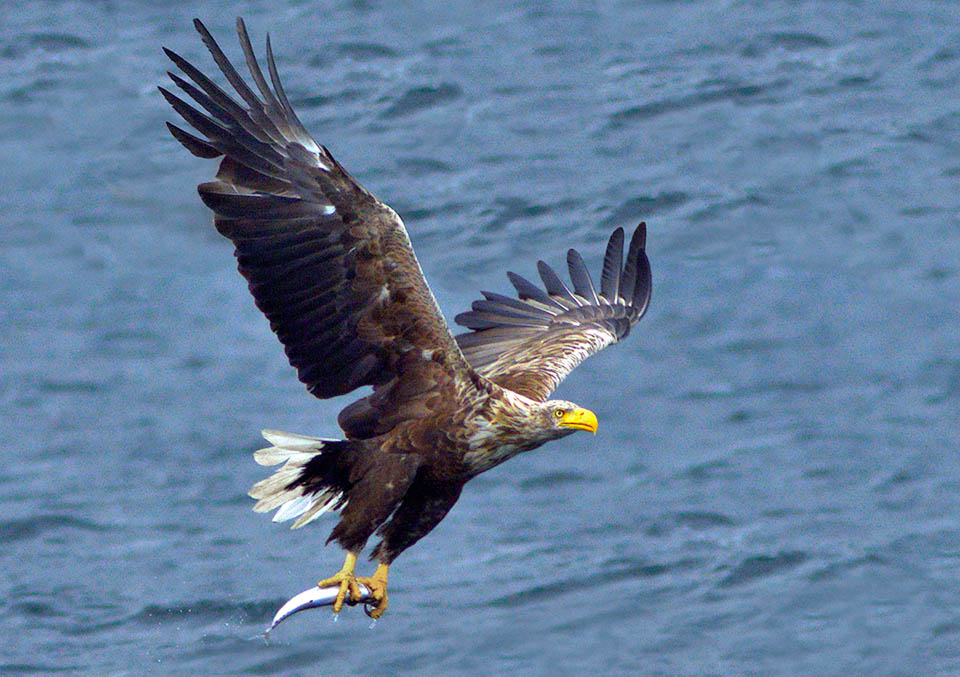
It feeds on birds, mammals, reptiles, carrions but especially fishes seized in surface, being a master of fly fishing © Jacob Spinks
So it happens that if an eagle wears the crest it is usually placed in the genus Lophaetus like Lophaetus occipitalis, a crown it’s a Stephanoaetus, if it is slim like a big hawk a Hieraaetus, for instance the Bonelli’s eagle (Hieraeetus fasciatus), if relevant to a sparrowhawk a Nisaetus, if to a hawk-eagle Spizaetus, if it mainly feeds on fish a Ichtinaetus, if it is powerful and martial a Polemaetus like Polemaetus bellicosus and if frequents the seas a Haliaeetus like the African fish eagle (Haliaeetus vocifer) and our Queen of the mists, even if, to be honest, the sea occupies actually only a small portion of its habitat.
In Europe it is called White-tailed Eagle in English, Seeadler in German, Pigargo Europeo in Spanish, Pygargue à queue blanche in French, Águia-rabalva in Portuguese and Regina delle nebbie in Italian.
Zoogeography
The White-tailed Eagle does not belong to the Italian avifauna and even less to the south-western European one apart from rare and sparse appearances over time.
It is totally absent in the Mediterranean area and in Africa. It nests throughout the Palearctic, from the Scandinavian Peninsula up to the Pacific Ocean coasts occupying all of Siberia and the central-northern part of Asia in an ample belt that, touching only partially the coasts of the Arctic Ocean, descends on average to the 45th parallel.
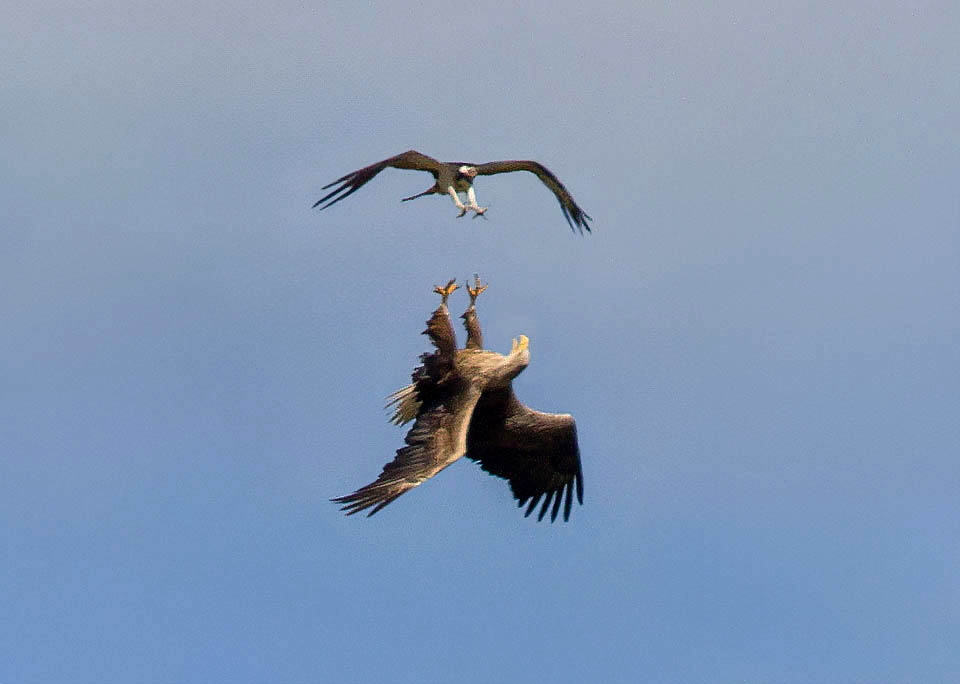
Valid competitor for the fly fishing is the Osprey (Pandion haliaetus) and consequently often occur territorial disputes © Tobias S. Radmer
Small colonies are present also in Iceland, in Greenland, in the Baltic area, in the plains around the Caspian Sea and, apart, in some Balkan regions even if in quantitative terms, these last represent only a minimal percentage of the world population.
Living in very hostile environments, during the Arctic winter much of the northernmost populations winters at more temperate latitudes, touching the European coasts of the North Sea, the Persian Gulf, the Indus River basin, the coasts of the Indian Ocean and in the extreme Asian south-east, the eastern coasts of China up to the Gulf of Tonkin and in Japan.
On the verge of extinction, some decades ago, the populations of this eagle have recovered throughout the occupied range, consolidating the old positions and in some instances conquering new territories.
It coexists in some Far East areas with the diant Steller’s sea eagle, species, however, well distinguishable due to the head, the neck and most of the body totally white.
Haliaeetus albicilla is considered a monotypic species but some consider the populations typical of Greenland, a separate subspecies, classifying it as Haliaeetus albicilla groenlandicus.
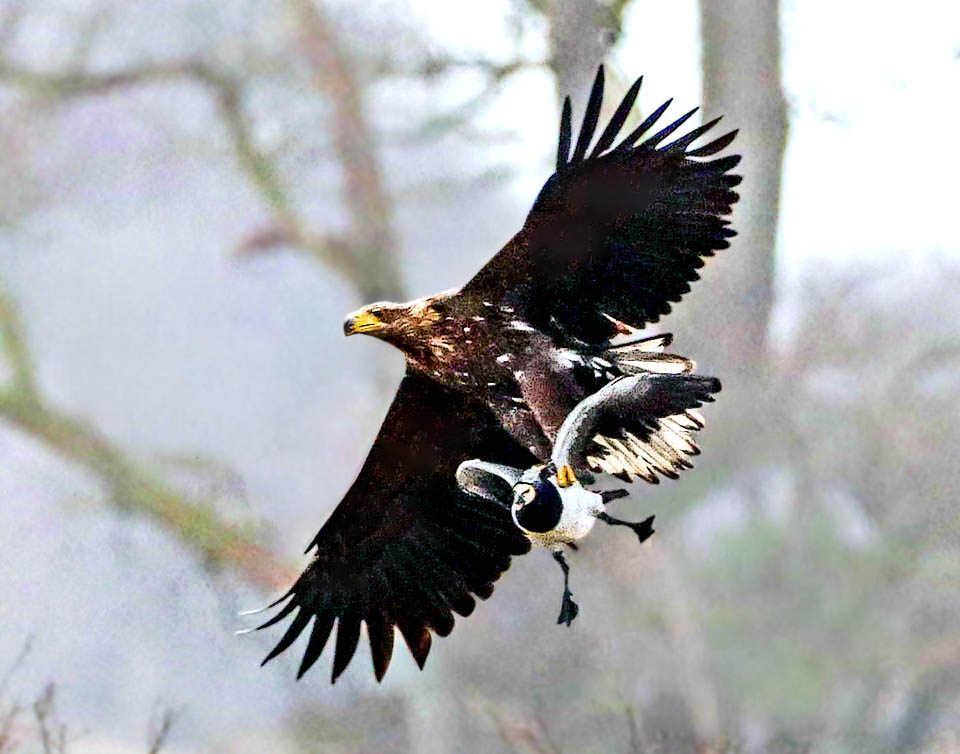
Here has caught a Barnacle goose (Branta leucopsis), but it’s just the aperitif and hunt practically goes on the whole day © MrStaggerLee
Ecology-Habitat
Although generically called sea eagle, its main habitat does not contemplate only the sea but rather lakes, vast swamps, large rivers, estuaries, lagoons, valleys covered by even thick forests but dotted in turn by ample open clearings, where to move in complete freedom.
Perhaps the exasperation of these habitats is the Hungarian puszta, notoriously a very vast grassy plain, without any obstacles whatsoever, with unlimited horizons and dotted by oak groves or by occasional poplar groves, places it will choose to nest. Also all Asian populations live in territories well far away from any sea.
Despite this, in the coastal lands, it actually becomes a sea eagle with a purely pelagic activity that involves it in continuous overflights of the steep and wild coasts, of the woody islands and of the cliffs to the sea, looking for prey and in defense of its territory.
In any case most of the population often has never seen a sea and consequently does not know this habitat.
Morphophysiology
Haliaeetus albicilla is easy to recognize a sea eagle.
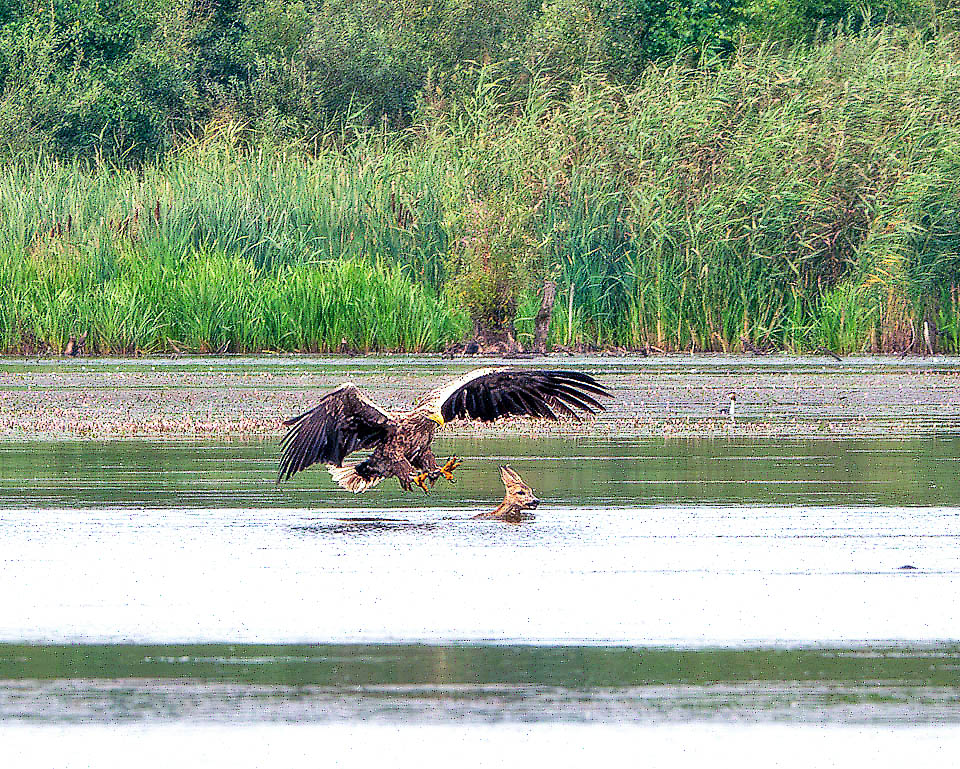
A swimming deer in difficulty could be a big prey, and unfurling its sharp claws that reach even 4 cm this Haliaeetus albicilla tries the shock © mari4971
A wingspan that in the adult specimens usually exceeds two metres, up to 240 cm, particularly broad wings along their entire length so much so that some have compared them, when flying, to a “flying carpet” or, as the imaginative English ornithologists say, to a “barn door”.
The beating of the wings is heavy and powerful, maybe also somewhat awkward.
A disproportionate, very pronounced, yellow beak, almost abnomal if compared to the head, accentuated by a broad culmen having the same colour that enhances even more its already exceptional size. The height of the beak is almost the same as the one of the cranium and its length is even superior.
The beak is very hooked, with a three centimeters rostrum getting down like a dagger perpendicularly to the upper jaw, a weapon that can tear apart any type of prey.
To this, terrible, adds a terrifying look, chilling as a whole, with big eyes with yellow at times pearly iris, with pupil so much black and accentuated to be visible even from afar. To all this we must add the habit of flying, when hunting, with a half-closed or even totally wide-open beak, just to add more grit to its progress.
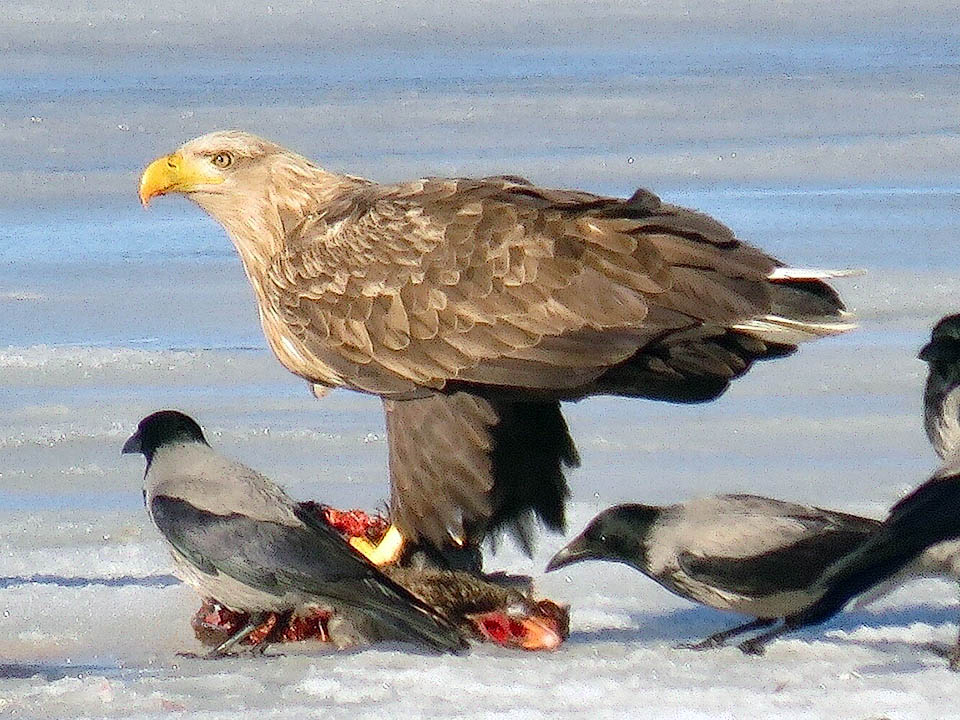
Much easier is to steal food to these hoodies (Corvus cornix) busy at their meal © Ulf Teghammar
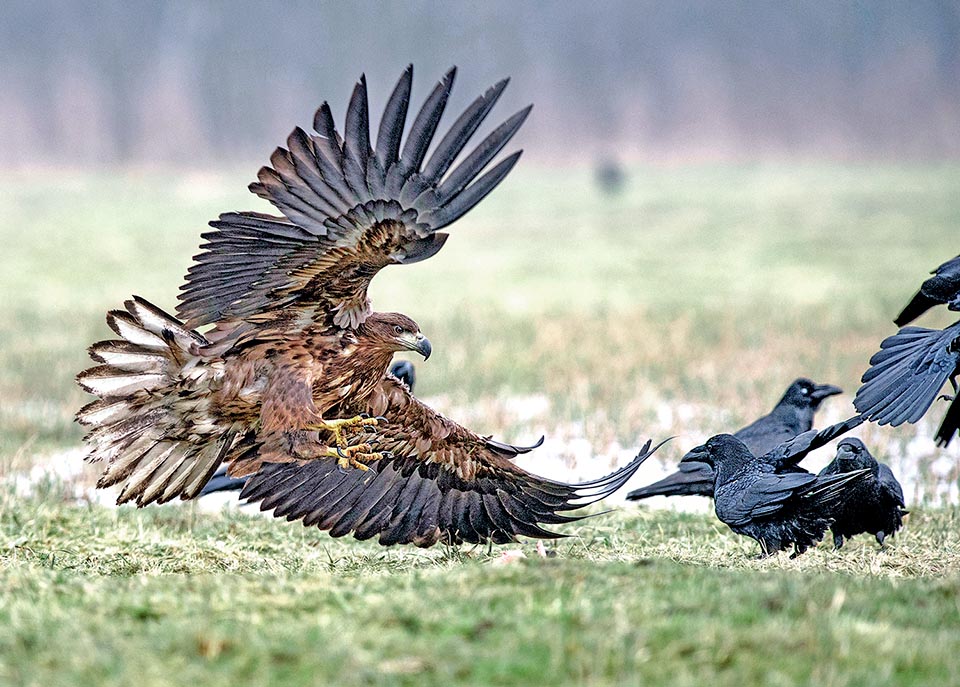
Same tactics with crows (Corvus corax), but both these birds are strong in number and are particularly annoying © Gianfranco Colombo
The legs and the toes, yellow too, are powerful and equipped with big and sharp claws that may exceed four centimetres in length, very hooked and sharp, typical tools of the fishing birds of prey.
The livery of this eagle is not particularly exciting and by sure is the one less elegant among the congeners who conversely display the head or the body or the wings variegated with large white bands.
Our sea eagle has a uniform grey brown plumage all over the body, dusted with light grey feathers, in particular on the head and on the neck and accompanied, only when maturity is reached, by a white tail whence has come the scientific name of the species.
The rectrices, even if exceeding 30 cm, are not as long as those of the congeners, therefore the tail contributes to a lesser extent in forming the total length of this species, although, overall, has much larger dimensions than its similars.
The tail has a well-defined cuneiform shape, characteristic that renders it unmistakable when it’s flying.
It is 70 to 90 cm long and reaches 3 to 7 kg of weight, mainly conditioned by the food availability. The female is slightly bigger than the male.
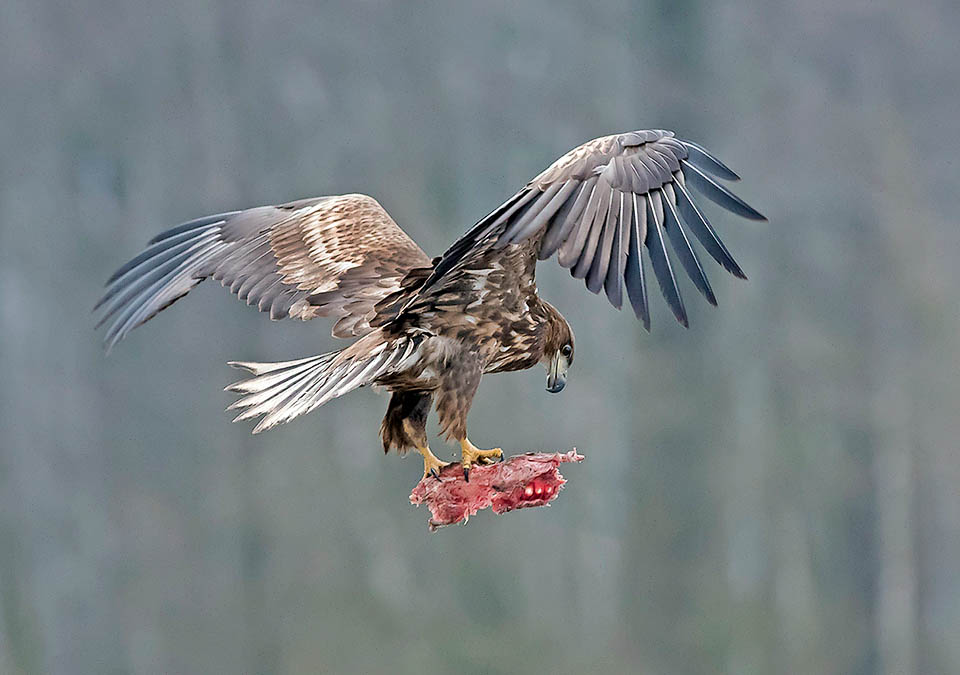
Then better to grab the loot and fly away to savour it calmly elsewhere © Gianfranco Colombo
There is no sexual dimorphism in the plumage and only the juveniles display a pronounced speckling on the wings and on the sides that make them vaguely resemble the two species of Spotted eagles (Clanga sp.) with which it often coexists, even if smaller in size and with a remarkably different beak.
During their early teays the juveniles display beak and legs of dark colour that will turn yellow upon reaching maturity by the fourth year.
Ethology-Reproductive Biology
Such a robust and heavy body requires about 500 grams of food per day, consequently this eagle must dedicate most of its time to getting enough to survive.
It does this feeding on every possible prey it meets while hunting, easily switching from fly fishing, proudly like a real sea eagle, with amazing glides and nosedives on the water to catch big fishes or big mammals, reptiles and birds.
It does not miss out on feeding itself on carrions, in whatever season of the year, a food that often covers most of its diet.
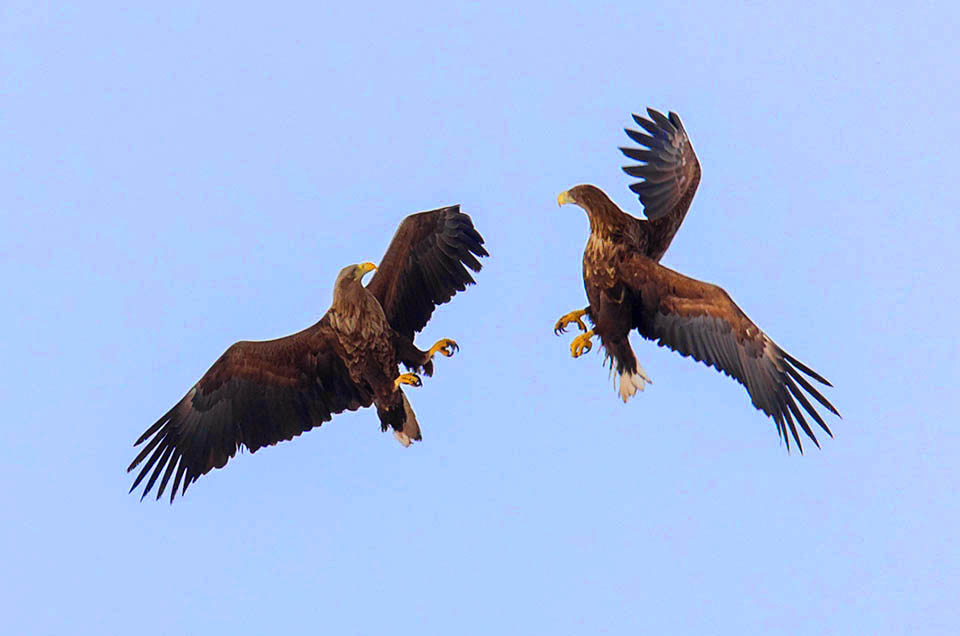
In the good season, couples reform occupying the same areas of previous years. The courting, with strong vocalizations, audible very far away, consists in hover over own territory and spectacular performances including the free fall of the two partners clinging to each other with their claws, in reckless and long twists © Вячеслав Ложкин
Its size allows it to face and also push away many necrophagous carnivores, making use of its power and recklessness. Effectively, only the wolves and the bears can compete in the fight. However, it is very shy and hesitant when it finds itself fighting around a carcass in particular with the omnipresent corvids.
Though taking a predominant position in access to food, making its way among every other competitor, this eagle poorly tolerates the constant harassment and the little subterfuges that these birds, although insignificant in size, bravely act as diversion to keep it away from prey.
They stand right next to it, closely surrounding it, stretching out its neck every now and then, pecking at some remnants left just a few centimetres away from its terrible beak, flutter a few centimetres away from its body, but they have even more fun pulling its tail feathers, irritating it to the point of often obliging it to move away with a simple piece of the conquered carrion.
Also the cranes themselves, when already present on their potential nesting territory, do not hesitate in facing it.
The couple is monogamous and the union is indissoluble until the death of one partner, in which case a new couple is formed.
Probably also during the bad season the partners don’t lose sight of each other and reach the same winter quarters even if showing a partial distancing and that interspecific winter strength necessary for their survival.
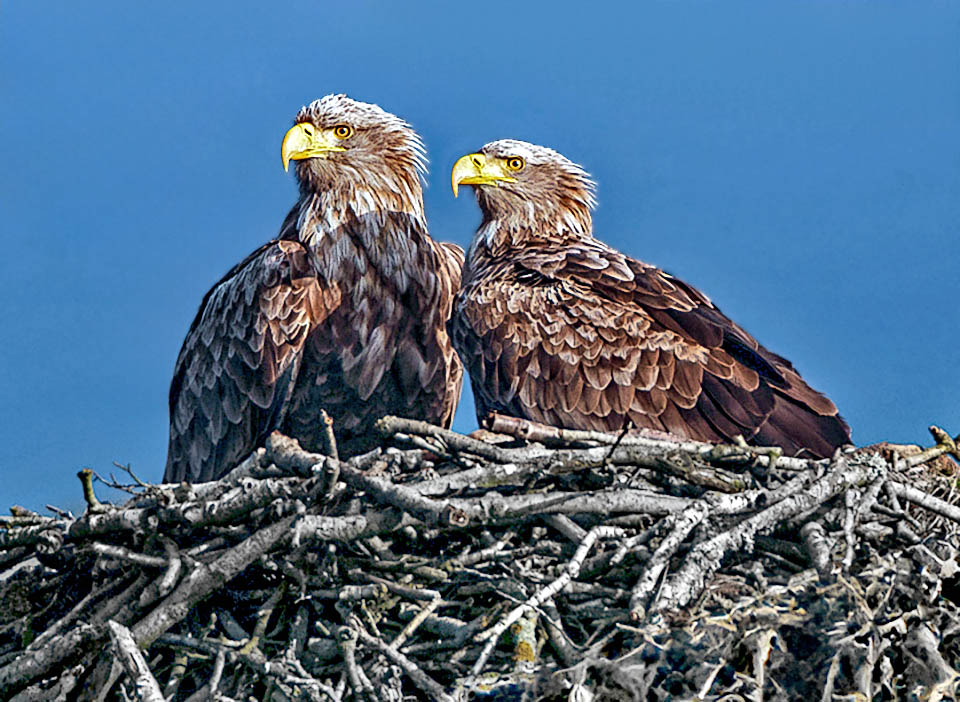
Here two on the nest, placed on rocks overlooking the sea or big trees at often remarkable heights. Enriched with branches, its volume increases yearly, at times to collapse © Alexis Tinker-Tsavalas
In the right season, variable according to latitudes, the couples reform occupying the same ranges of the previous years, rather large and variable territories according to the availability of food and that may include entire valleys, or swampy territories or part of marine coasts.
The courting is that typical to some eagles and other raptors and consists in various somersaults on its own territory and spectacular exhibitions among which the free fall of the two partners, clinging to each other with their claws, in long and reckless twists.
The courting is accompanied by many vocalizations audible from considerable distances.
When on the coasts, the nest is placed on rocky ledges overlooking the sea or when in hinterland, on big trees, usually at remarkable heights. However, in some areas where the trees do not reach the usual heights, it does not disdain to place it on low branches a few metres from the ground. On the other hand they do not practically have any foe wherever they live in the world.
A mass of large branches piled up year after year until over time they reach impressive heights that collapse on themselves or even break the branches on which it is placed.
Being a bird very faithful to its own territory and boasting a lifespan of at least a pair of decades, moreover added to the habit of the new couples to exploit the nests previously built by others, here is the reason explained of such big nests.
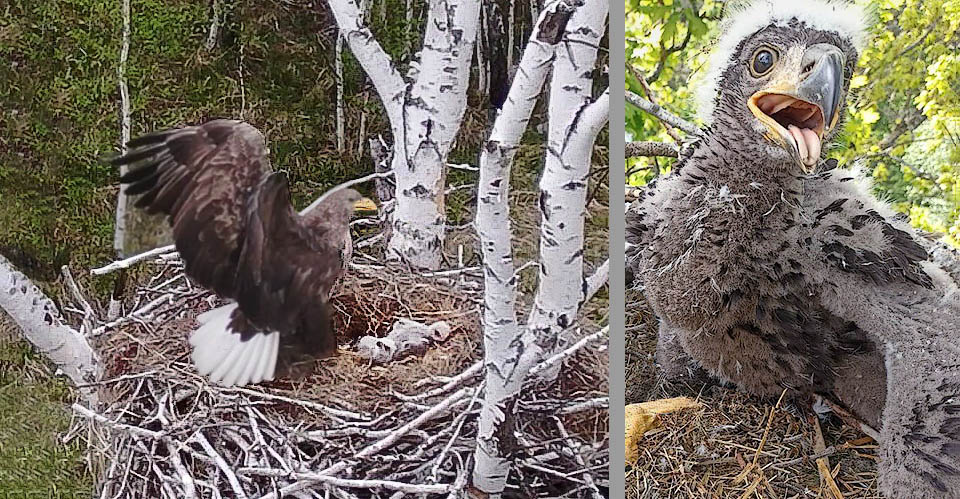
Up to three eggs are laid incubated in turns for about 6 weeks by both parents. Here, left, a nest with three babies and, right, a hungry growing chick © Владимир Тарасов (left) and © Юрий Янкевич (right)
Up to three eggs of cream white colour are laid, incubated for about six weeks by both partners.
Unlike other eagles, in this species we do not witness the traditional siblicide between the nestlings, therefore generally all chicks will take flight if no other difficulties occur.
The chicks will remain in the nest for a long time as they do not have that strong necessity of leaving a shelter that often avers unsure for other species and only after about 70/80 days they will be able to fly.
The fledged eaglets will be however followed by the parents for a long time to come until they will be ready to face their life alone.
Haliaeetus albicilla during the last century has gone through a rather delicate period.
Despite being at the top of the chain of predators having virtually no natural enemies, it has disappeared in many historically occupied areas and has seen a worrying and widespread decline of the populations, in particular in some peripheral areas of the European range.
It is likely that its primary position did not protect it from pesticides and poisonings but also from illegal drawings and from a merciless hunt done by breeders and by trophy hunters.
Ireland, Norway, Scotland, Holland and south Europe were gradually abandoned and the already small communities present, disappeared in a few decades. Reintegration programs were therefore considered in the attempt to restore those historical populations and in some instances the attempts led to good results.
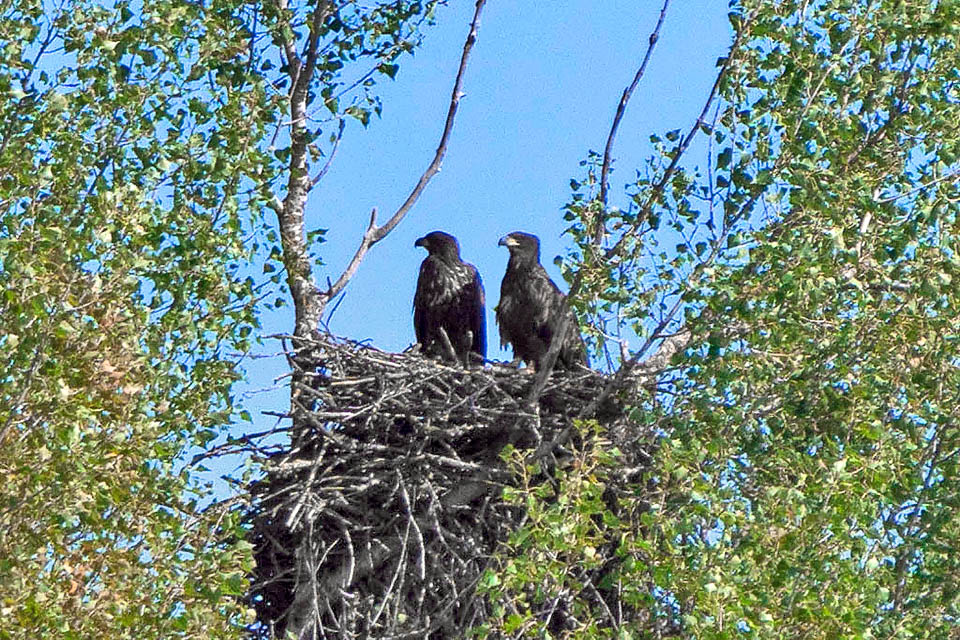
Two juveniles, now grown, are about to leave the nest. Haliaeetus albicilla lives well in captivity and is not presently considered an endangered species © Ilya Burylov
So Ireland saw again its “Iolar mara”, sea eagle, and Scotland its “Iolair suile na greine”, eagle with the eyes illuminated by the sun, but southern Europe did not succeed in reconstituting the sparse pre-existing populations and only in the Balkan peninsula groups able to support themselves reformed.
This eagle is still now highly endangered in some peripheral areas of its vast territory and in the isolated colonies but looks well established throughout the rest of the area. Haliaeetus albicilla is easily held in captivity and many zoos and nature parks preserve its domesticated specimens.
Like many species of birds displaying particular morphologies or distinct behavioural peculiarities, also the Sea eagle has been adopted by heraldry and in the symbolism of many countries. It appears in the coats of arms of Poland, of Serbia but also the legends and the Celtic traditions often recall this bird.
At that time they reported that after the battles these birds fed on the corpses of the soldiers, others recall the use of the fat of this eagle as pharmaceutical panacea against all ills but it is evident that in the past centuries the man, still unable to find remedies for any of his afflictions, has always turned to nature to find unlikely and imaginative solutions to his unsolvable problems of love, of health and of strength.
It is considered a vulnerable species even if globally, since 2021, Haliaeetus albicilla appears as “LC, Least Concern” in the IUCN Red List of the endangered species.
Synonyms
Falco albicilla Linnaeus, 1759.
→ To appreciate the biodiversity within the birds of prey and find other species please click here.