
Family : Orchidaceae

Text © Prof. Pietro Pavone

English translation by Mario Beltramini
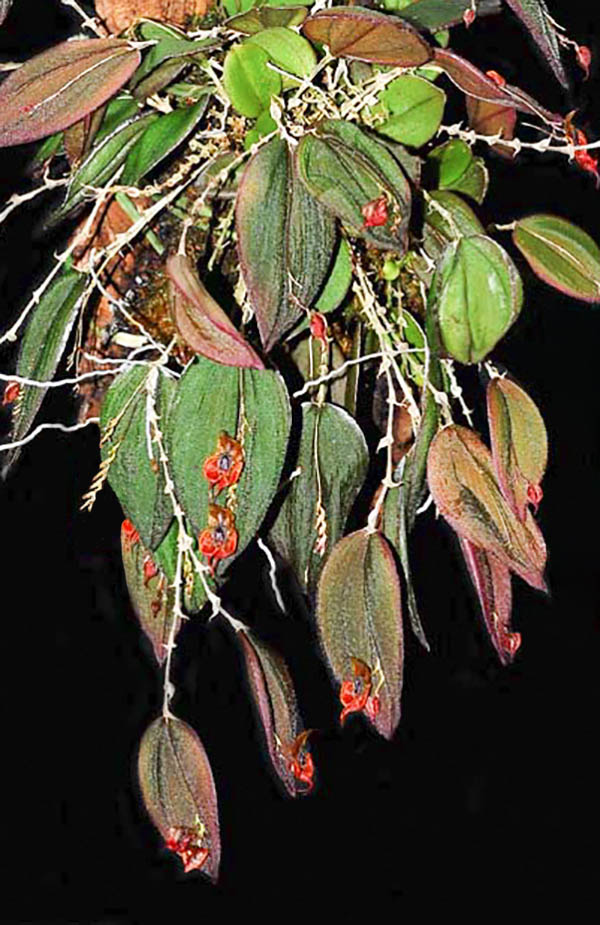
Lepanthes gargoyla is an epiphyte endemic to Ecuador misty forests from 900 to 1300 m of altitude © Eerika Schulz
Lepanthes gargoyla Luer & Hirtz is a species belonging to the family Orchidaceae and to the subfamily Epidendroideae, tribe Epidendreae, subtribe Pleurothallidinae, subgenus Lepanthes, section Lepanthes, subsection Lepanthes.
The genus Lepanthes was described by Olof Peter Swartz (1760-1818), professor at the Royal Swedish Academy of Sciences, known for his taxonomic studies on the weeds, fungi, bryophytes, pteridophytes and spermatophytes. In 1783 he went to northern America, and to the West Indies (Jamaica and Hispaniola), for floral collections. His rich collection consisting in 6000 exsiccata is kept in the Swedish Natural History Museum. He described as many as 1664 taxa.
Lepanthes is one of the richest genera in species, more than 1200, distributed from southern Mexico to Bolivia. Some species grow up from the sea level on the Caribbean islands, others up to touch the Andean snows.
Some are endemic to relatively small areas others are found in very vast geographic areas.
Lepanthes gargoyla was described by Luer Carlyle August (1922-2019) and Hirtz Alexander Charls (1951-2024) in the magazine “Die Orchidee” (Orchidee, Hamburg 39,2: 59, 1988).
The description was made on a specimen collected on March 27th, 1985 in Ecuador, province of Zamora-Chinchipe, in a hazy forest at an altitude of about 900 metres.
The original specimen (holotype) is conserved in the herbarium of the Missouri Botanical Garden (Saint Louis, Missouri).
The name of the genus comes from two Latinized Greek words: λεπίς, λεπίδος (lepis) that means “scale”; and άνθος, άνθεος (anthos) meaning “flower” referring to the shape of the flowers and to the consistency of the labellum.
The specific epithet gargoyla owes its name to the resemblance of the flower with a gargoyle or gargouille, that is the terminal part of the draining of the gutters, often decorated with animal, fantastic or monstrous, figures.
In fact, the flowers of this species that appear menacing due to the dark curved intricate sepals, often tinged with purple, and the petals with their contrasting colours, often greenish, recalling, rightly, the grotesque stone figures of the Gothic art, peculiar to many Christian churches and cathedrals, but also to civil buildings of the medieval period. It is commonly called “Gargoyle Lepanthes”.
Lepanthes gargoyla is endemic to Ecuador and lives in the misty forests as an epiphyte at altitudes between 900 and 1300 metres.
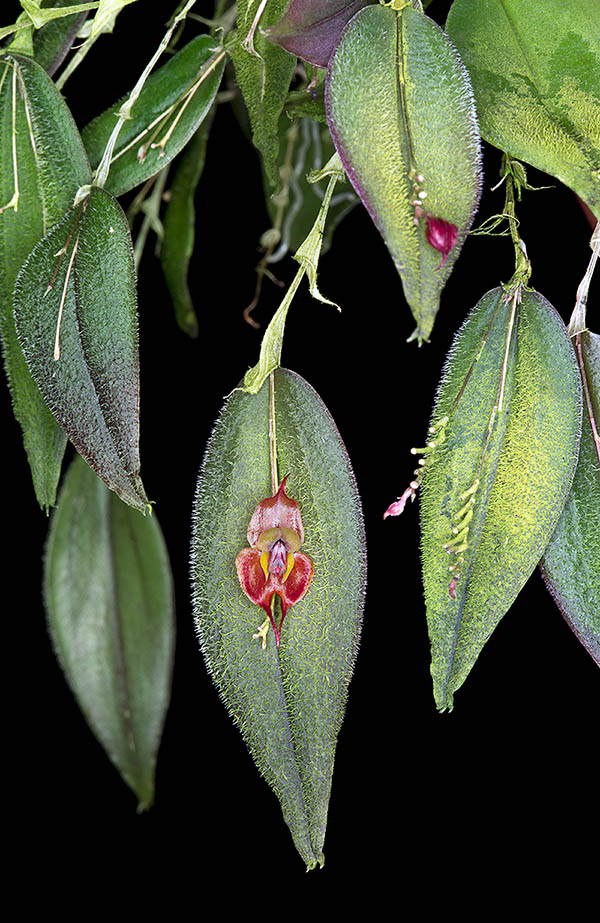
Placed on the lower side of the leaves, the flower attracts the Sciaridae family males due to shape and smell © Dr. Giuseppe Mazza
The plant measures between 5 and 8 centimetres in height and from the rhizome form thin and erect, 7 to 10 cm, long ramicauls, wrapped at the base by thin, glabrous sheaths, and bearing one single apical leaf, about 5 cm long and 3 cm broad,coriaceous, suffused with purple, ovate, with curved margins, acute apex and restricted base in the petiole.
The inflorescences get form from the apex of the ramicaul, at the foliar base. They are racemose, 2-5 cm long, close to the lower pagina of the leaf. Each inflorescence has several small flowers, about 45, opening in succession. The flowers are translucent of brown-reddish colour with dark green labellum, mainly violet in the centre.
Each flower remains open for about 5-10 days. As the floral stems may produce flowers for months, the plant appears always in bloom with the starting period in spring.
The sepals are about 1 cm long, characterized by wavy margins and with the extremities elongated “tail-shaped”. The lateral sepals have folded apices, that are doubled lengthwise, that make them of “grotesque” appearance. The petals, usually green, are very small, often not very visible to the naked eye.
As most species of Lepanthes display a similar floral structure, in accordance with observations on other species it is thought that the pollination occurs through sexual deception (pseudocopulation).
The morphology of the flower, that forms on the lower pagina of the leaf, looks suitable for attracting the gnats of the male fungi (Sciaridae) as pollinators. In fact, the females of these insects, to be more protected, land on the lower pagina of the leaves and attract the males with pheromones.
The labellum, with a small appendix located at the base close to the column, and the petals, seem to imitate exactly a female gnat.
The attraction is also olfactory because the flower emits the same scent produced by the females.
As documented on Lepanthes glicensteinii Luer, the male gnat, after having landed on a flower, folds its abdomen under the labellum and grips the appendix placed at the base with its genital claws, then turns to get away.
With this rotation manoeuvre the pollinarium adheres to its abdomen therefore during a subsequent visit to another flower, the pollen masses will be deposited on the stigma of the latter, carrying out the pollination. After the fecundation, the floral peduncles get longer during the ripening of the fruit, probably to favour the dispersion of the very small seeds through the wind.
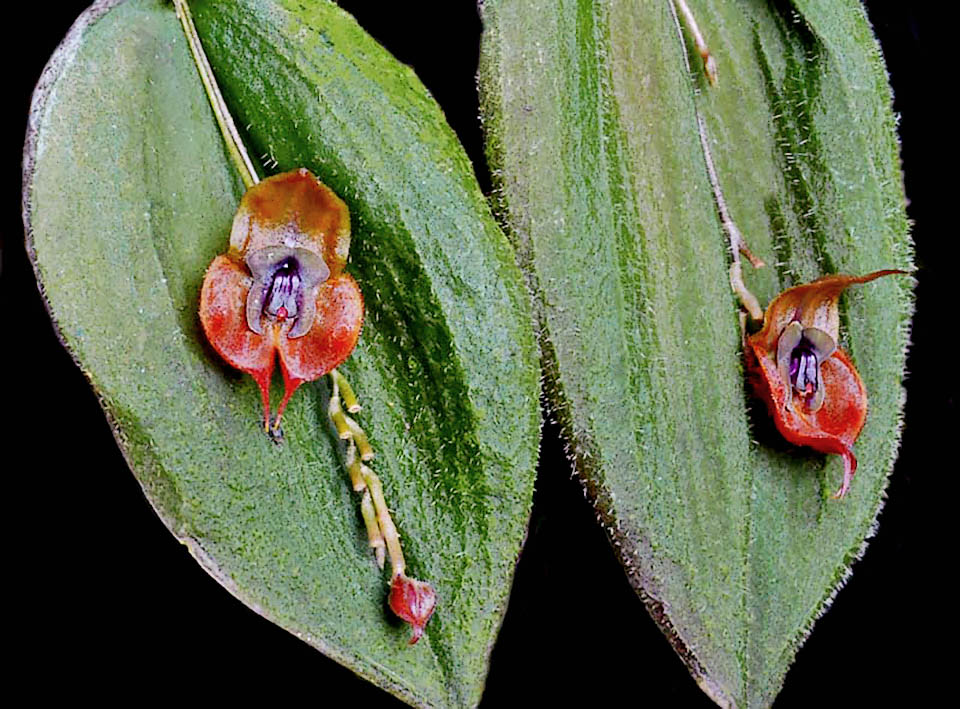
They are fungi gnats that then leave for another flower after the usual rotation maneuver sticking the pollinarium on their abdomen © Eerika Schulz
The small size of the plants, the relatively short life in nature (1,7-7 years half-life observed in some species), their capacity to colonize different habitats and the pseudocopulation are factors that have led to the great biodiversity in Lepanthes. In fact, are sufficient small changes in the morphology of the flower and in the chemical signals (pheromones), if the visitor is attracted and does the pollination, immediately occurs the reproductive isolation from the other species, even if they coexist in the same environment. In this way the birth of a new species happens which adds to those pre-existing in the genus.
The huge number of species of this genus is the outcome of the combination of ecological, geographical and reproductive factors.
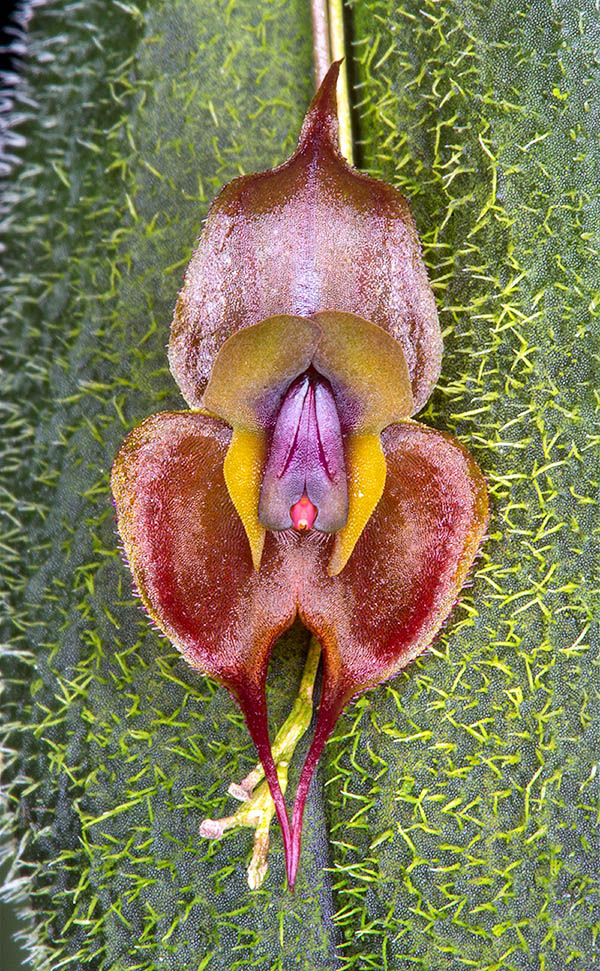
We note here in centre the violet labellum and below a red appendix imitating their females abdomen © Dr. Giuseppe Mazza
Phylogenetic studies indicate that the genus had a relatively recent origin, from 10 to 5 million years ago, but its high speciation rates have allowed the colonization of manifold environments inside its vast range.
Lepanthes gargoyla is a species present in the Appendix II of the CITES that regulates the international trade for preventing the overexploitation of the wild specimens. In fact, international trade is allowed only if accompanied by export permits intended to ensure the survival of the species in the wild.
It is sought after by the collectors due to its small size, the characteristic gargoyle-like flowers and the continuous blooming.
This mini-orchid can be cultivated on rafts of wrinkled wood or of cork, a method imitating its natural environment of epiphyte. Between the roots and the substratum it is good to place a small layer of sphagnum in order to keep a constant hydration.
The plant must be tied to the raft with a nylon thread until the roots cling to the support on their own. If the roots remain exposed to the air, they need to be watered often, sometimes daily, by nebulization or immersion, to avoid that the support dries up. However, if the domestic environment is too dry, the raft can be hung inside a large jar open on the top in order to create a humid microclimate.
These plants can be grown also on an about 2,5 cm layer made of expanded clay, lapilli or gravel, to avoid water stagnation. The direct sun must be avoided but they must be maintained with a diffused luminosity. The plants require cool-intermediate temperatures (between 14 °C and 24 °C).
Also a good ventilation is essential to circulate air and avoid leaf rot caused by fungal attacks. The humidity must be around 80% and 95%. It is good to provide a specific, but very diluted, fertilizer for orchids.
Artificial hybrids of these mini orchids do exist, quite appreciated by the collectors for their blooming and lasting. Among these we mention the hybrid obtained by cross between Lepanthes gargoyla and Lepanthes horrida, marketed by specialized nurseries like Ecuagenera. It is a compact, very floriferous, hybrid that combines the “monstrous” appearance of Lepanthes gargoyla with the distinctive features of Lepanthes horrida that has brightly coloured flowers and up to 8 cm long inflorescences.
On the market are found also forms or cultivars of this species with flowers that may differ in their chromatic colours. One of these, registered at RHS, is Lepanthes gargoyla ‘Kenneth Cawthorne’ very sought after by the collectors due to its flowers having dark red blood hues (bordeaux), often with yellow or orange dots and an odd shape recalling the monsters of the gargoyles.