
Family : Orchidaceae

Text © Prof. Pietro Pavone

English translation by Mario Beltramini
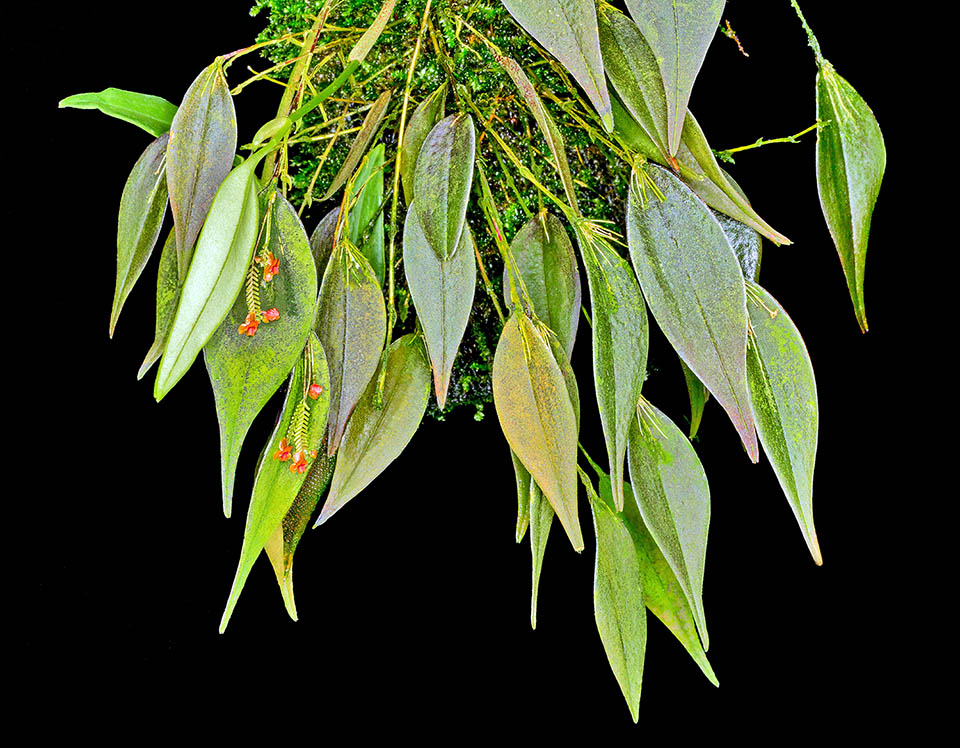
Lepanthes lappacea is a small epiphyte endemic to Costa Rica from 400 to 800 m of altitude. Grows in warm or temperate-warm habitats at high and constant humidity © Dr. Giuseppe Mazza
Lepanthes lappacea Luer is a species of the subgenus Lepanthes, section Lepanthes, subsection Lepanthes, belonging to the family Orchidaceae, subfamily Epidendroideae, tribe Epidendreae, subtribe Pleurothallidinae.
The genus Lepanthes has been described by Olof Peter Swartz (1760-1818), professor at the Royal Swedish Academy of Sciences, known for his taxonomic studies on the weeds, fungi, bryophytes, pteridophytes and spermatophytes.
The genus Lepanthes includes 1211 accepted species. It is second only to the genus Stelis that counts 1339 of them.
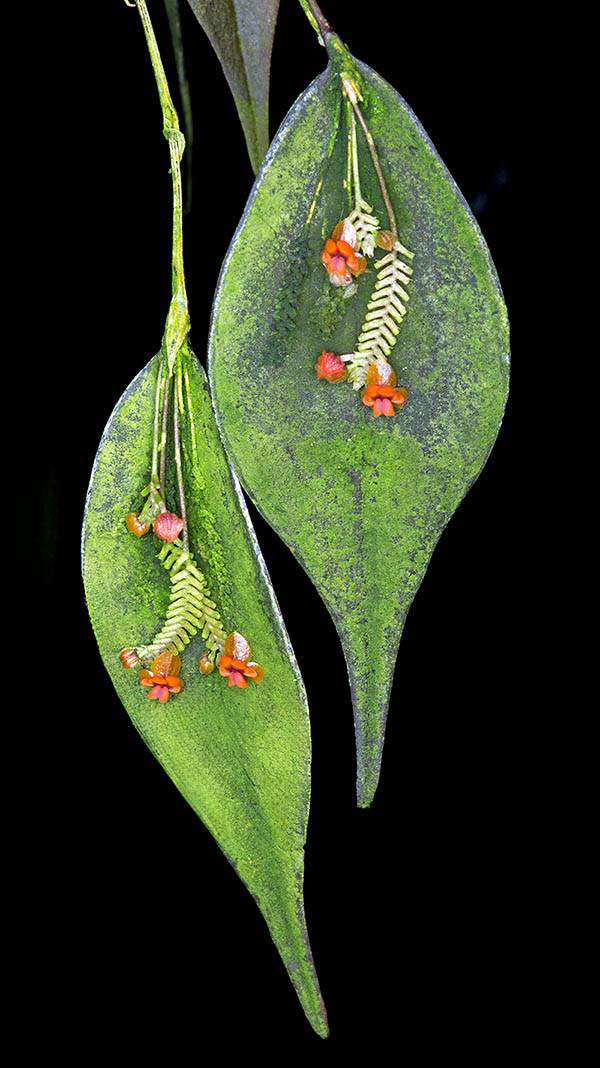
Ramicauls have only one 4-5 x 1,6 cm coriaceous, ovate and acute apical leaf, slightly sharp © G. Mazza
The range of Lepanthes extends from the southern part of Florida, across Central America up to Bolivia, southwards, Antilles included.
Some species grow from the level of the sea on the Caribbean islands, others up to the snows of the Andes.
The largest number of these species are endemic with a very restricted distribution. Ecuador and Colombia count the largest number, Brazil has few of them.
The salient characteristics of the species of Lepanthes are given by ramicauli enclosed by sheaths, by raceme inflorescences with many small flowers with a graded opening, by membranous and delicate sepals and usually transversely bilobed petals. Usually the labellum is trilobed with thickened lateral lobes and with the median reduced to a small “appendix” often with glands and tufts of hair. Although the appendix may vary in the shape, it is typically pushed under the column.
Moreover the labellum and the petals emit scents due to the presence of papillae. The appendix plays an important role in the pollination process that occurs through sexual deception (pseudocopulation).
The first specimen of Lepanthes lappacea was collected in August of 1977 at Coto Brus, close to Las Cruces, in the province of Puntarenas (Costa Rica) by Cordelia Head of the Connecticut J&L Orchids nursery.
The specimen did flower on 1995, May 10th, and was formally described by Carlyle August Luer (1922-2019) in Lindleyana 11:61 (1996), scientific magazine of the American Orchid Society. The holotype is kept in the herbarium of the Missouri Botanical Garden (MO).
Lepanthes lappacea is endemic to Costa Rica and is found in altitudes between 400 and 800 metres as small epiphyte in warm and temperate-warm environments, often associated with rainforests where humidity is high and constant.
The name of the genus comes from two latinized Greek words: λεπίς, λεπίδος (lepis) that means “scale”; and άνθος, άνθεος (anthos) meaning “flower” with reference to the shape of the flowers and to the consistency of the labellum.
The specific epithet comes from the Latin lappa that means “burdock”, hence lappaceus, “similar to a burdock”, due to the big appendix of the labellum of ovoidal shape and pubescent that recalls in shape and consistency the small hooked fruits (achenes) of the great burdock (Arctium lappa L.) called “burdocks”.
This species is an epiphytic plant, tufted with thin roots. From the rhizome originate thin, 7-9,5 cm long ramicauls wrapped by 10-12 adherent sheaths, microscopically scabrous.
Each ramicaul produces only one apical leaf, coriaceous, ovate, acute, slightly sharp, 4-5 x 1,6 cm, with cuneate base in an about 1 mm petiole. From the apex of the ramicaul get off 2 to 3 filiform inflorescences (racemes) placed over the petiolate base of the leaf, 4,6 to 4,8 cm long, including the 8 to 10 mm long peduncle.
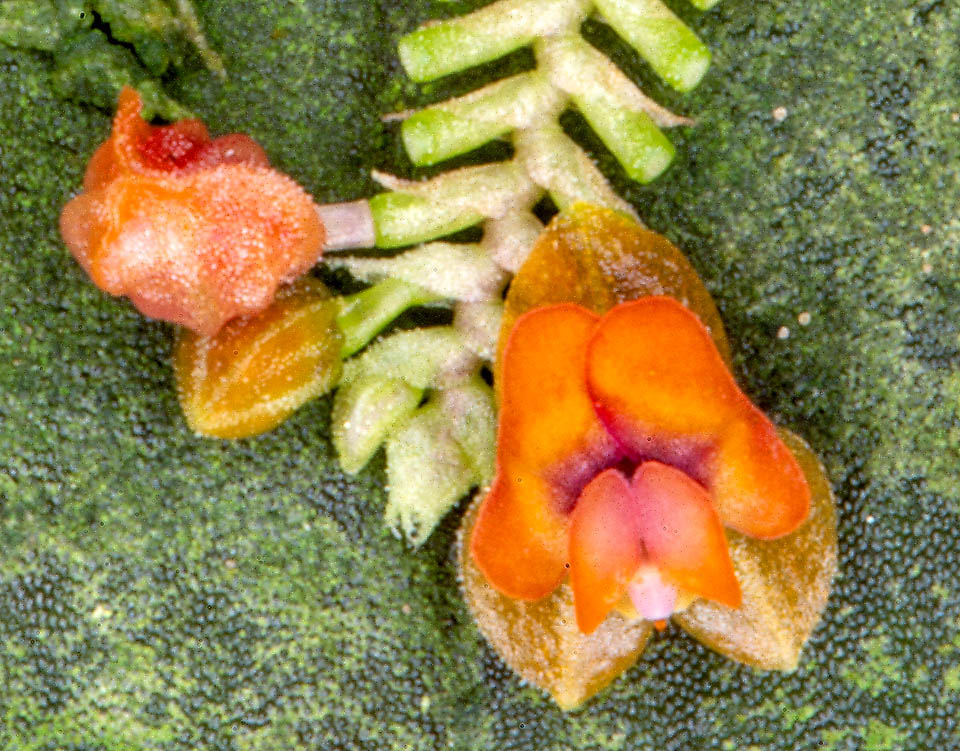
The tiny flowers have orange petals, obliquely bilobed, 0,75 mm long and 2 mm wide, with only one central vein and with oblong-ovate lobes © Dr. Giuseppe Mazza
The flowers have 1 mm scabrous floral bracts and 1 floral peduncle. The ovary is 1,25 mm long. The sepals, yellow, are minutely denticulated, ovate. The dorsal sepal is 2 mm long and 1,75 mm wide, connate to the lateral sepalsper 0,5 mm that are oblique, 1,75 mm long, 1,3 mm wide. The orange petals are microscopically pubescent, obliquely bilobed, 0,75 mm long and 2 mm broad, with only one central vein and with oblong-ovate lobes. The labellum is of purple colour, microscopically pubescent, with 1,1 mm oblong lobes and with rounded extremities and slightly divergent apices. The median lobe is reduced to a small pubescent appendix, long and ovoidal, similar to a burdock. The column is clavate, 1 mm long, with apical anther and ventral stigma.
The pollination takes place through a very specialized mechanism called “pseudocopulation”. In fact, the flower deceives the males of small fungus gnats (family Sciaridae, genus Bradysia) simulating the appearance and the smell of the female of their species.
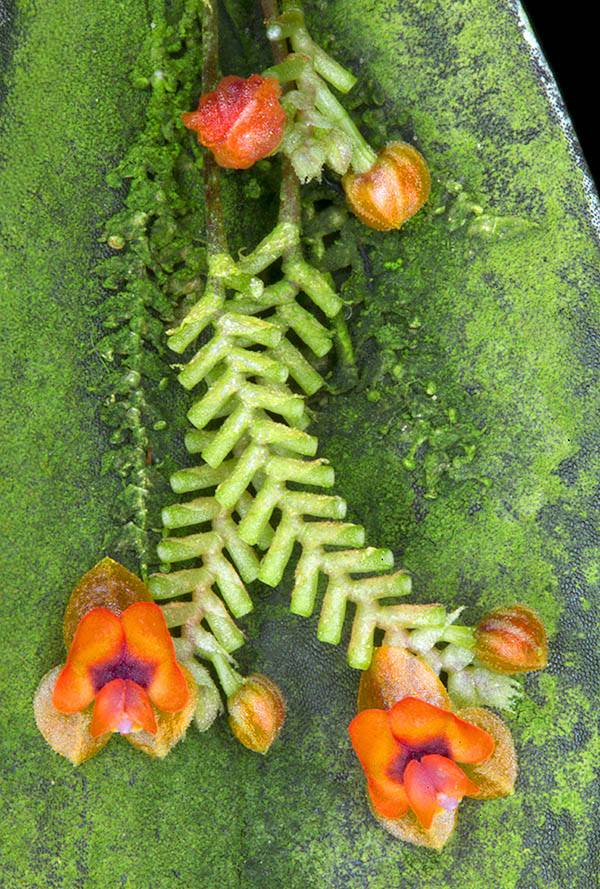
They are borne by 2-3 filiform inflorescences sited over the leaf petiolate base © Dr. Giuseppe Mazza
The male insect lands on the leaf and moves on the labellum and in particular on the appendix that simulates the sexuaal organs of the female whom it seizes by means of its genital clws and tries to mate. During this movement of rotation its abdomen gets in touch with the pollinarium that sticks to it. When the gnat visits another flower, and repeats the maneuver, deposits the pollen on the stigma completing the crossed pollinations.
The flowering generally occurs in the late spring. Once fertilization has occurred and during the fruits ripening, the floral peduncles and the ovary tend to get longer in order to remove the seeds from the mother plant and improve their dispersion through the wind. Like all species belonging to the family of the Orchidaceae, Lepanthes lappacea is included in the Appendix II of CITES (Washington Convention) to guarantee that international trade does not compromise its survival in nature.
To date, no hybrids are registered as parent Lepanthes lappacea nor are there any taxonomic varieties and not even registered horticultural cultivars. This species can be reproduced by seed, in vitro or by division of the tufts which is the simplest and most sure method for the domestic collectors. Each division must have at least 3-5 ramicauls and one active rooting apparatus to guarantee to the future seedling sufficient energy to take root.
For the growth it’s good practice to put the plant in conditions simulating its natural habitat furnished by the misty forests of Costa Rica. Usually it is cultivated on a raft (cork or tree fern) with a small moss cushion around the roots to hold the humidity. It may be grown also in small pots with a fine and draining substratum suitable for epiphytes. However, being high humidity (70%-90%) necessary, the best choice is a terrarium or a climatic showcase.
This species loves a cool to intermediate climate. The day temperatures should be around 18 °C and 24 °C, with an ideal night decrease around 12-16 °C to stimulate the growth of the plant. It requires moderate or low light and must not get direct sunlight which would burn out its delicate leaves instantly.
In order to avoid rot and fungal attacks a constant air circulation is necessary. The substratum must be always humid, never soaked but also never completely dry because, having no pseudobulbs for storing water, roots and ramicauls are very sensitive to dehydration.
If cultivated on raft, it may aver necessary to nebulize it daily with rain water or purified by reverse osmosis. It is good to administer monthly a balanced fertilizer for orchids, very diluted (about 1/4 the suggested dosage).