
Family : Orchidaceae

Text © Prof. Pietro Pavone

English translation by Mario Beltramini
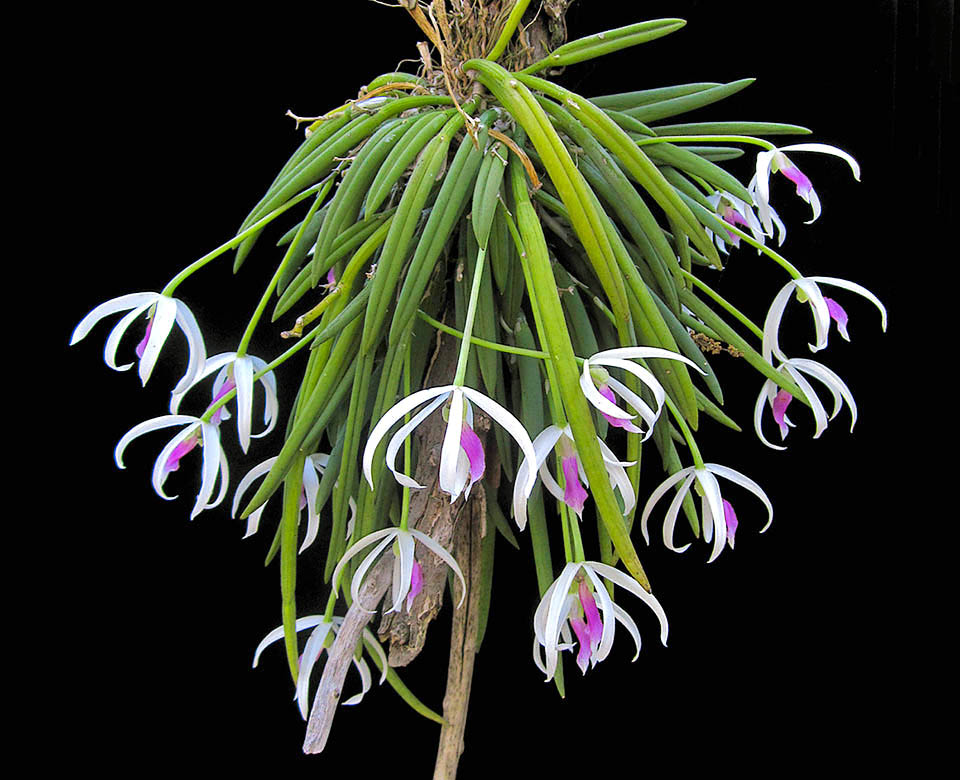
Leptotes bicolor is a species native to south Brazil and east Paraguay. It loves the subtropical rainforests at altitudes from 500 to 900 metres © dwittkowe
Leptotes bicolor Lindl. is a species of the family Orchidaceae, tribe Epidendreae, subtribe Laeliinae.
This species was described in 1833 by John Lindley (1799-1865) in the magazine Edwards’s Botanical Register (19: t. 1625). Considered the father of modern horticulture, Lindley was professor at the University College London from 1829 to 1860 and secretary of the Royal Horticultural Society (RHS). He published fundamental works for the vegetal taxonomy, like The Vegetable Kingdom (1846) and Sertum Orchidaceum (subdivided in ten parts between 1838 and 1841). Author of the first systematic work on orchids, The Genera and Species of Orchidaceous Plants (1830-1840), described there as almost 2.000 species known at his time. His vast collection of books is located in the Lindley Library, the main library of the Royal Horticultural Society (RHS) that houses the most important collection of horticultural literature in the world.
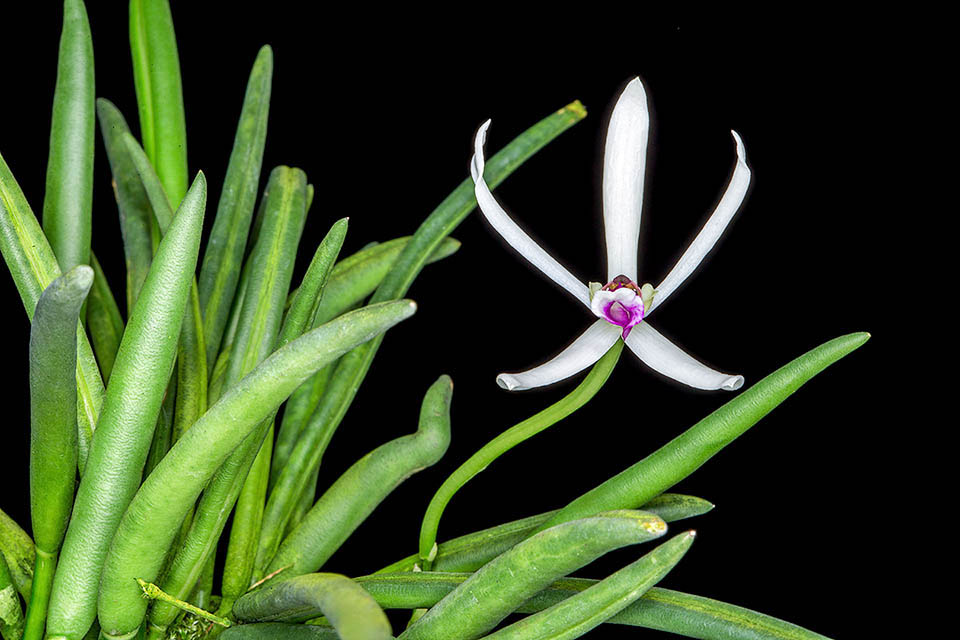
Compact posture due to the numerous close pseudobulbs. They have only one flesh leaf with dorsal groove. The inflorescence has 1-3 flowers opening in succession © Giuseppe Mazza
In the scientific description of this species, Lindley recognized not only a new species, but at least a new genus. Consequently he expressed his gratitude to Mrs. Elizabeth Harrison (ca. 1792-1834) of Aigburth (Liverpool) – known in the chronicles of that time as Mrs. Arnold Harrison – famous collector of orchids, for having provided him with the plant newly flowered in his greenhouses in April 1833. Mrs. Harrison had received it from her brother, William Harrison, English merchant living in Rio de Janeiro, who had picked it up in the Serra dos Órgãos, nowadays National Park.
The genus Leptotes created by Lindley is endemic to the Brazilian Atlantic Forest, with an area extending up to eastern Paraguay and northern Argentina. It includes small bushy plants with short stems covered by membranous sheaths, sharp, cylindrical and furrowed on the upper pagina leaves and apical inflorescences with 1-3 flowers.
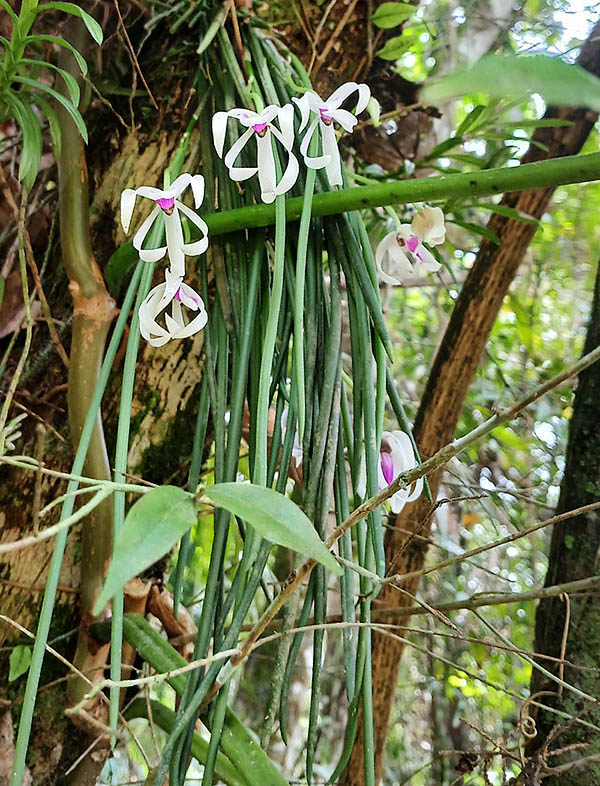
Leptotes bicolor is often found as an epiphyte, anchored to tree trunks with hanging leaves and flowers © Eduardo Dalabeneta
For a more immediate recognition, the genus Leptotes is traditionally subdivided in two morpho groups based on the shape of the labellum.
The group with trilobed labellum, linguiform, sharp with full margin, is found in Leptotes bicolor, Leptotes pohlitinocoi V.P.Castro & Chiron or Leptotes unicolor Barb. Rodr.
The group with full margin, simple, without marked divisions stands in species like Leptotes tenuis Rchb.f. and Leptotes pauloensis Hoehne.
Leptotes bicolor is a species native to southern Brazil and eastern Paraguay. In Brazil it is present in the North-East regions (Bahia), in the South-East (Espírito Santo, Minas Gerais, Rio de Janeiro, São Paulo) and in South (Paraná, Santa Catarina, Rio Grande do Sul), up to the south-eastern and southern biomes, among which the Atlantic Forest and the coastal mountain zones of the eastern departments of Paraguay.
It loves the subtropical rainforests located at altitudes between 500 and 900 metres above the sea level and may tolerate the dry periods typical of the inland plateaus.
The name of the genus Leptotes comes from the Greek “λεπτός” (leptos) that means thin, slender or delicate, with reference to the refined and elegant structure of the plant The specific epithet bicolor comes from the Latin, meaning “bicolour”, due to the surprising contrast in the flowers between the white petals and the deep purple labellum.
Leptotes bicolor is an epiphytic orchid growing anchored to the bark of the trees or to the rocks.
It displays a compact and tufted shape formed by small groups that rarely exceed the height of 10 cm.
From short rhizomes develop about 2 cm long adjacent pseudobulbs, cylindrical and succulent, covered at the base by membranous sheaths; these organs serve as water reserve to overcome the drought periods typical of its habitat.
At the apex of each pseudobulb forms one single rigid leaf with circular section, curved and at times drooping, 3 to 7 cm long, characterized by a fleshy consistency with one dorsal central groove. At the base of the pseudobulbs develop roots for the anchoring covered by the “velamen”, a spongy layer essential for the absorption of the atmospheric humidity.
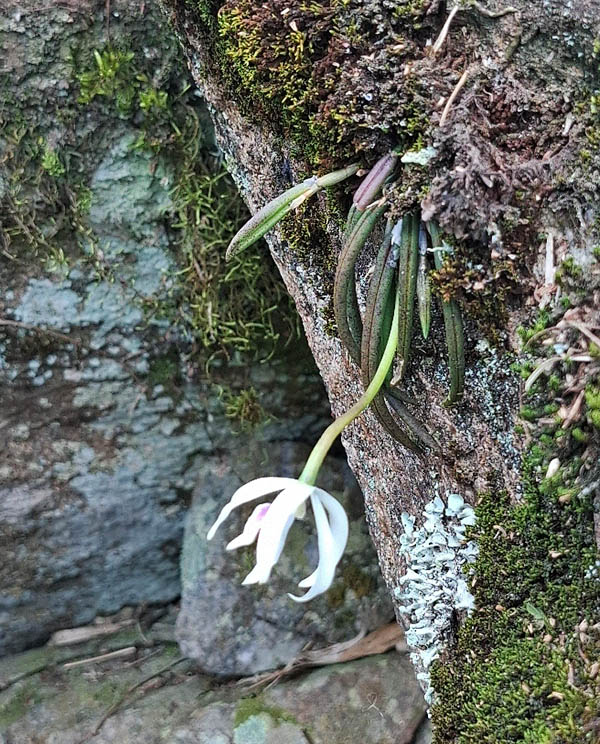
Grows also on mossy rocks, thanks to the spongy velamen of the roots that catches the humidity of the air © Emanuel Rodriguez
The inflorescence emerges from the top of the pseudobulbs, forming short arcuate, of about 1-2 cm, racemes with few flowers (1 to 3) that open in succession. Sepals and petals are similar, white and spread apart, arranged to form a cup-shaped perianth.
The labellum is trilobate with the lateral lobes wrapping the column. They are white, whilst the central lobe is purple with a paler crest, facing downward to facilitate the entry to the pollinators.
The short and white column displays membranous margins that surround the clinandrium (the apical cavity), in turn protected by the dorsal sepal. The pollinia are six (four big and two small), sessile on one only viscidium.
The flowers, with a diameter of 3,5-5 cm and with a waxy consistency, emit a vanilla fragrance during the daylight hours.
Blooming takes place between late winter and spring: from July to October in its native range (Southern Hemisphere) and from January to May if cultivated in the Northern Hemisphere.
The chromatic contrast between the white colour of the petals and the bright magenta of the labellum, united with the sweetish scent, attracts the males of the bees of the tribe Euglossini (family Apidae). These bees known as “orchid bees”, collect the odorous substances – only reward due to the absence of nectar – by means of bristly structures on their forelegs, to then transfer them into the cavities of the hind legs and use them during the nuptial parades.
When the bee lands on the labellum looking for fragrance, it stimulates the apex of the column causing the snap release of the pollinia that adhere to its thorax or to the head. Visiting another flower, the insect will lay the pollen on the female part of the column, allowing the pollination.
After the fecundation, the fruits develop: dehiscent capsules containing a lot of tiny seeds, similar to powder. The capsules take 6 to 9 months to ripen, then releasing the seeds that are dispersed by the wind over long distances. The germination necessarily requires a symbiosis with mycorrhizal fungi, that furnish the nutrients necessary as the seeds do not have their own energy reserves.
In its Brazilian range, the fruits are utilized for infusions that confer a delicate vanilla aroma to tea, milk, ice cream and sorbet.
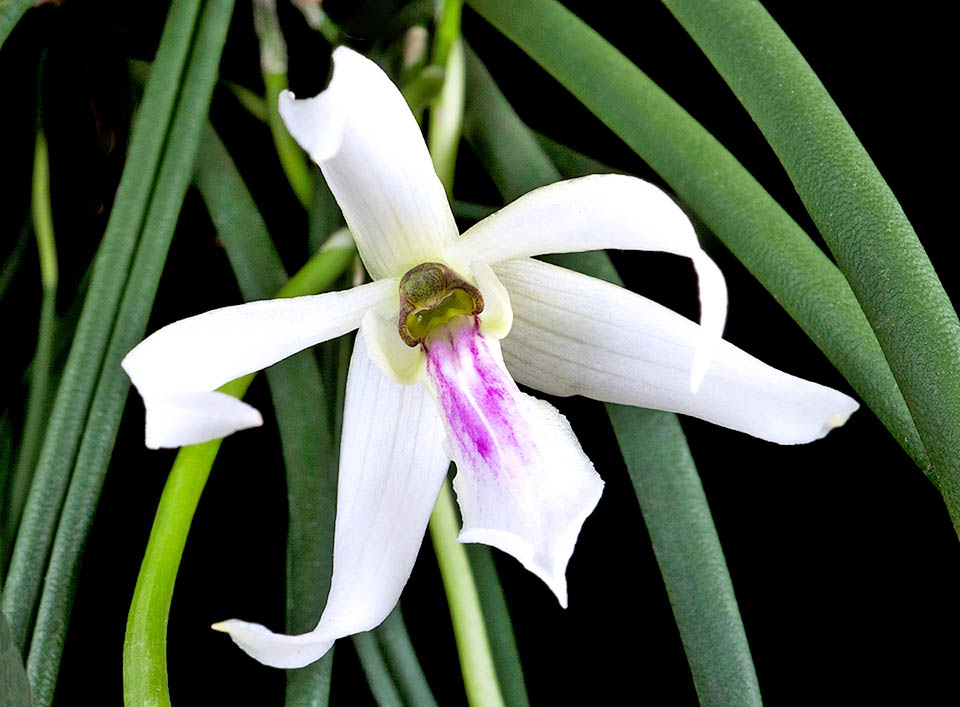
Waxy flowers have similar white sepals and petals, forming a cup. The downward-facing labellum has white lobes and a purple center with a pale keel © Luoarerec
Leptotes bicolor is not included in the IUCN Red List of the Endangered Species, even if it displays a high vulnerability due to the decline of local populations caused by the anthropogenic pressures. The main threats come from the extensive deforestation in southern Brazil and in Paraguay, where the agricultural expansion – in particular for the soy and the livestock farming – has fragmented habitats of the subtropical Atlantic forest essential for this epiphyte, particularly in the state of Paraná (Brazil) where, from 2020, is classified as endangered species.
The climate change poses an additional risk: the variations of the temperature and humidity regimes can alter the humid and shady niches worsening the degradation of its habitat. Also the unlawful collection menaces its survival. Presently the species is regulated by the Appendix II of CITES to prevent its overexploitation for international trade for ornamental purposes. Similarly, the edible use of the fruits increases the risk of extinction.
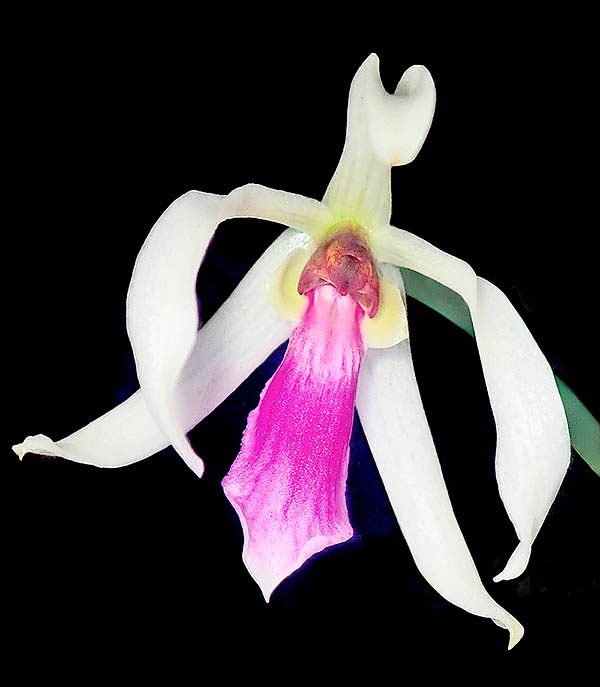
The colour contrast between white of petals and bright magenta of labellum, united to the sweetish scent attracts the male bees of the tribe Euglossini who collect essential oils for their nuptial parades – Tsssss (CC0)
Natural and artificial hybrids of Leptotes bicolor do exist, but they are fewer in number in respect to other orchids of the subtribe Laeliinae.
Among the most diffused hybrids we mention: Leptotes Pat Thurtle registered by D. Thurtle on March 27, 2018 at the Royal Horticultural Society (RHS). This hybrid, born from the cross between Leptotes bicolor and Leptotes pohlitinocoi, combines the robustness and the white flowers of the perianth of Leptotes bicolor with the pink shades of that of Leptotes pohlitinocoi.
Many other plants are selected horticultural varieties of the pure species: such as Leptotes bicolor var. alba.
Among the cultivars of Leptotes bicolor awarded during the last years, stand out for the number of awards Leptotes bicolor ‘Widderchen’, with three awards assigned between 2010 and 2013 by the Deutsche Orchideen Gesellschaft (DOG) and Leptotes bicolor ‘Big Ben’ that has obtained three awards from the American Orchid Society (AOS) between 2009 and 2011.
Other multi-awarded cultivars are Leptotes bicolor ‘Gisela’ (DOG, 2017), Leptotes bicolor ‘Natasha’ (awarded in 2008 by The Orchid Society of New South Wales (OSNSW) and by the Australian Orchid Council Inc. (AOC) and Leptotes bicolor ‘Piping Rock’ (AOS, 1994-1995).
Have received awards from the American Orchid Society, the cultivars: Leptotes bicolor ‘Goodstuff’, Leptotes bicolor ‘Malena’ (2018), Leptotes bicolor ‘Springwater’ (2018), Leptotes bicolor ‘Retzbach’ (2018), Leptotes bicolor ‘Cindy’ (2017), Leptotes bicolor ‘Fireworks’ (2017) and Leptotes bicolor ‘Andi K’ (2017), whilst the Deutsche Orchideen Gesellschaft has awarded Leptotes bicolor ‘Liina’ (2017) and Leptotes bicolor ‘Karl-Peter Firneisen’ (2017).
In cultivation, Leptotes bicolor requires filtered and diffused lighting in order to prevent leaf burns; it is therefore essential to avoid direct sunlight. The best temperatures must be warm to intermediate, with diurnal intervals of 18-25 °C and nighttime minimums not falling below 10 °C. In winter it can tolerate conditions slightly cooler, around 20-21 °C during the day.
A humidity of 60-80% is essential all over the year, reachable through daily nebulizations or humidifiers, especially in dry indoor environments. A good air circulation is necessary to mitigate the excessive heat accumulation.
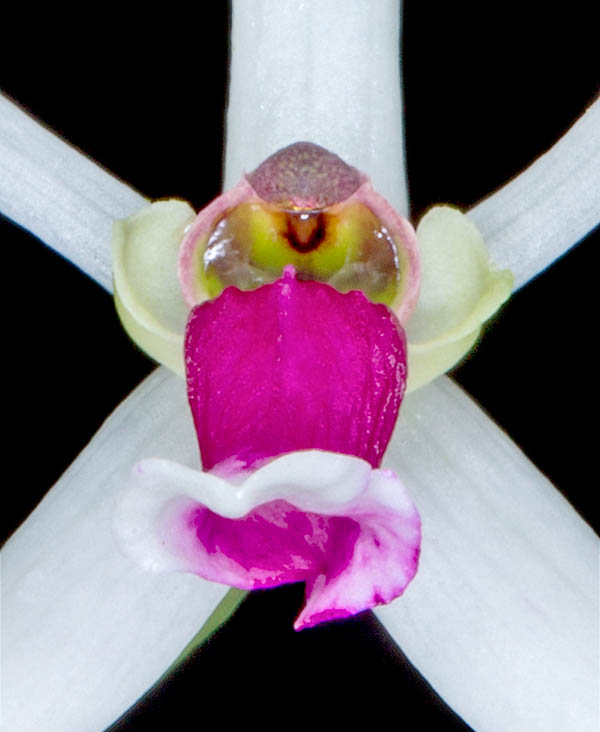
When bee lands, it triggers column apex, causing the release of pollinia, which firmly adhere to its body. The insect then carries them to another flower, thus enabling effective cross-pollination between plants © Giuseppe Mazza
The irrigation must be moderate: abundant during the growth season to maintain the substratum uniformly humid, but allowing the roots to slightly dry up between irrigations to prevent rot.
In winter it is good to reduce the frequency of watering, keeping the plant rather dry, but avoiding any prolonged dehydration.
In order to exalt its epiphytic posture, it is good to cultivate this orchid on a raft of cork or of tree fern, with a small layer of sphagnum to retain moisture. However, on the rafts the roots dry up quickly, requiring therefore daily irrigation in summer.
Alternatively,it may be grown in small pots with a very draining substratum based on small pine bark, charcoal and perlite.
It propagates mainly vegetatively, dividing the rhizomes in sections containing at least three or four pseudobulbs, an operation to be done after flowering. The repotting is to be done every 2-3 years or when the substratum decomposes. Finally, to favour flowering, it is good to fertilize with a balanced fertilizer for orchids (NPK 20-20-20) diluted at 1/4 or 1/2 the dosage, from spring to autumn, suspending during the rest period.
Synonyms : Tetramicra bicolor (Lindl.) Rolfe (1883); Leptotes bicolor var. glaucophylla Hook. (1839); Leptotes bicolor subsp. serrulata (Lindl.) C.E.M.Carvalho, J.R.Figueiredo & Van den Berg (2019); Leptotes bicolor var. serrulata (Lindl.) Stein (1892); Leptotes glaucophylla Hoffmanns (1843); Leptotes serrulata Lindl. (1838); Tetramicra serrulata (Lindl.) G.Nicholson (1887).