
Family : Grammatidae

Text © Dr. Giuseppe Mazza

English translation by Mario Beltramini
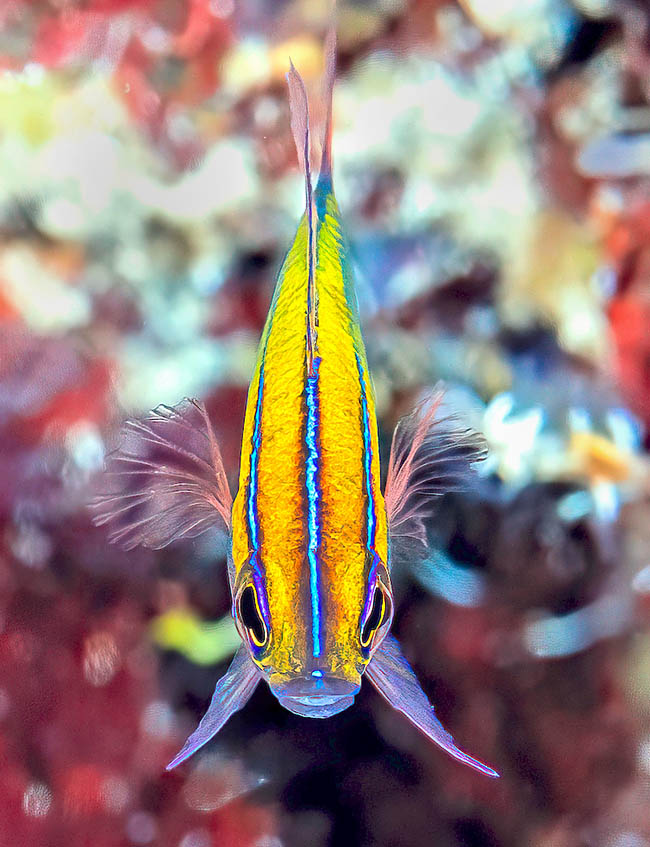
Maximum 3,5 cm long, Lipogramma trilineata is characterized by 3 blue lines with dark edges starting from head © www.carlosestape.photoshelter.com
The Threeline Basslet Lipogramma trilineata Randall 1963, belongs to the class of the Actinopterygii, the ray-finned fish, to the order of the Perciformes, and to the small family of the Grammatidae that counts about twenty species less than 10 cm in size and has only 2 genera: Gramma, created by Felipe Poey in 1868 for Gramma loreto, and Lipogramma created by Böhlke in 1960 for Lipogramma anabantoides.
Both originate from the Greek “γράμμα” (gramma), mark, with reference to their lateral line, broken in the first case and absent in the second, as stated by the prefix “lipo”, that gets its origin from the verb “λείπω” (leipo), I lack.
Conversely, the specific term trilineata alludes to the three blue lines with dark edges, present on the head, that run towards the tail: the median-dorsal starting from the lips, and the lateral two starting over the eyes.
Zoogeography
Lipogramma trilineata is a fish of central-western Atlantic, present from Bermuda, south-eastern Florida, Bahamas and the Gulf of Mexico, up to Curaçao Island off Venezuela.
Ecology-Habitat
The Threeline Basslet lives, demersal, sheltered by rocky and coral outcrops, from 15 to 152 m of depth, in relatively deep waters compared to Gramma loreto, and is often found even on the outer side of the reefs where it may reach 170 m.
Morphophysiology
Lipogramma trilineata reaches a maximum length of 3,5 cm.
The short and pointed snout has small teeth on the jaws and on the fore and the lateral part of the palate.
The body, elongated and compressed, displays a dazzling yellow livery, more or less extensive, and with brown and orange shades in the first part of the back, that fades progressively to blue-greyish towards the tail.
The margin of the preoperculum is smooth and the operculum has a flat protrusion.
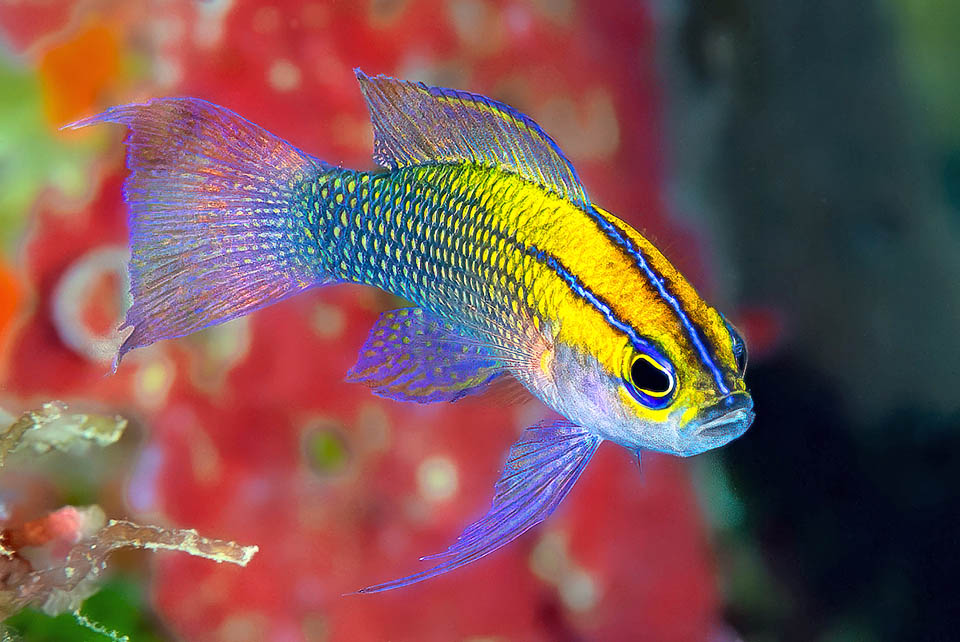
The more or less extended dazzling yellow livery with orange brown shades in the first part, turns progressively to blue-greyish towards the tail © www.carlosestape.photoshelter.com
The dorsal fin has 12 spiny rays and 10 soft; the anal 3 spiny and 7 unarmed, the pelvic 1 elongated spiny ray that exceeds the base of the anal fin and 5 soft; the pectoral ones, rounded and tending to pink, 15 of them, and the caudal fin, also pinkish, presents on the sides short spiny rays, usually 3 upward.
In juveniles, similar to adults, the blue stripe close to the eyes reaches the upper part of the caudal peduncle, and is flanked, further down, by another that starts from the base of the pectoral fin.
Ethology-Reproductive Biology
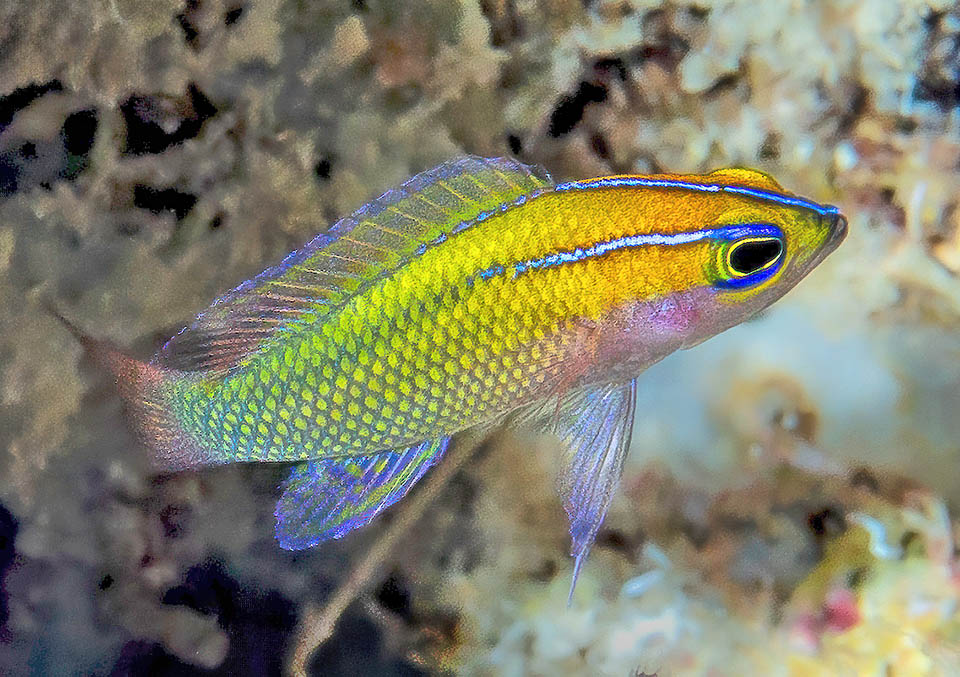
Lives in Caribbean from 15 to 152 m deep, but may descend to 170 m on the outer side of reefs. Menaced by Red lionfish it’s not however an endangered species © www.carlosestape.photoshelter.com
Due to its size and the high depth where it lives, little is known about life and reproduction of Lipogramma trilineata maybe similar to that of Gramma loreto. Like this one, in fact, it feeds on plankton and tiny crustaceans and spawns on the sea beds.
In nature it has been sighted in small schools of up to 5 individuals. However no diver has ever had the opportunity of observing the nest, and in the aquarium it was seen while building a shelter with weeds.
It is most likely threatened by the Red lionfish (Pterois volitans), carelessly introduced in the Caribbean and who usually attacks demersal preys of less than 15 cm in size, but its survival is not believed to be at risk, and since 2011 Lipogramma trilineata appears therefore as “LC, Least Concern”, in the IUCN Red List of the endangered species.
→ For general information about FISH please click here.
→ For general information about BONY FISH please click here
→ For general information about CARTILAGINOUS FISH please click here.
→ To appreciate the BIODIVERSITY of BONY FISH please click here.
→ To appreciate the BIODIVERSITY of CARTILAGINOUS FISH please click here.