
Family : Malacanthidae

Text © Dr. Giuseppe Mazza

English translation by Mario Beltramini
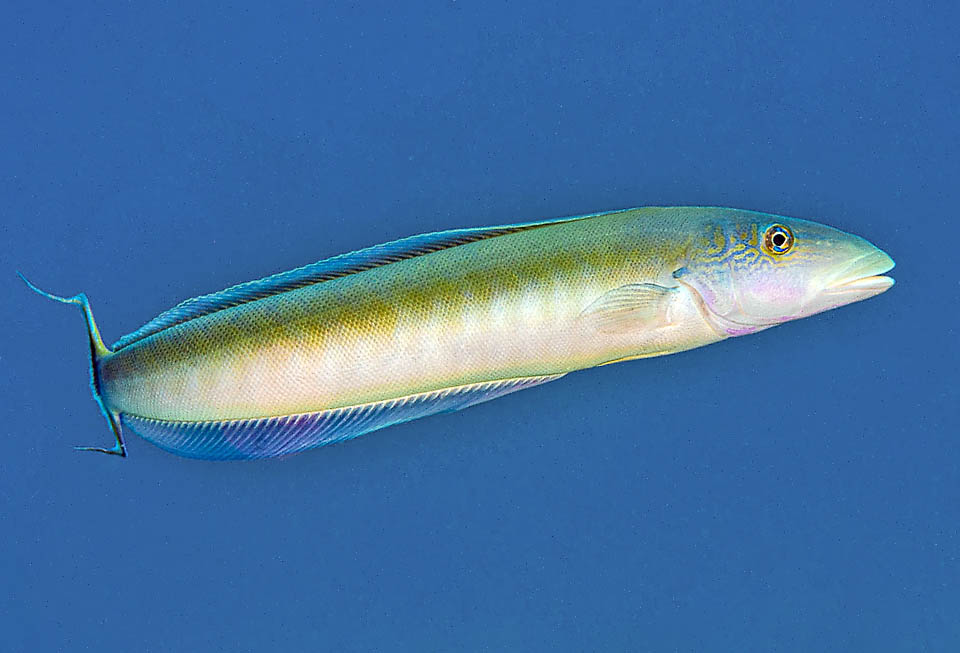
Usually 50 cm long with a 70 record, the Sand tilefish (Malacanthus plumieri) is present from North Carolina and Bermuda to the Gulf of Mexico and all Caribbean. After an interruption between Orinoco mouth and the Amazon River, reaches Uruguay and offshore Trinidad Island and Ascension Island in eastern Atlantic © François Libert
The small family of the Malacanthidae, inserted in the class of the Actinopterygii, the ray-finned fish and in the order of the Perciformes, gathers species with waving dorsal and anal fins, relatively long, used also used backwards in precision movements, whilst they entrust the fast ones to the strength of the caudal, for hunting, sheltering or getting out from their dens on the seabeds.
It includes colourful aquarium fishes like Hoplolatilus fourmanoiri, Hoplolatilus marcosi and Hoplolatilus purpureus, but also species exceeding the metre in length like the stout Lopholatilus chamaeleonticeps Goode & Bean, 1879 reaching 70 cm, with a current size of 50.
The genus Malacanthus originates from the Greek “malako”, tender, and “acanthus”, spine, with reference to the thin and flexible spines preceding the numerous soft rays of the dorsal.
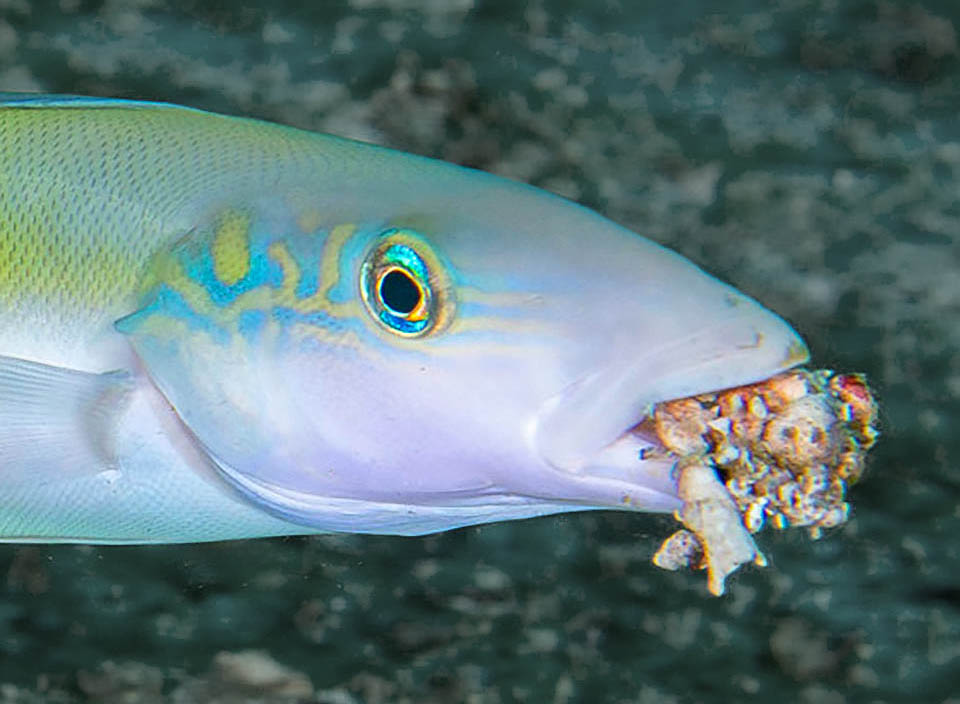
It lives in a den dug into the sand that stubbornly tiles, day by day, with coral fragments collected or stolen to other fishes in the radius of 30 m © Frank Krasovec
Conversely, the specific term plumieri is a homage to Charles Plumier (1616-1704), Franciscan monk and naturalist who gave Bloch information about this fish and an accurate drawing.
Zoogeography
Malacanthus plumieri is present in western Atlantic Ocean from North Carolina and Bermuda to south of Florida, Bahamas and Gulf of Mexico. It is then found in the Yucatan and along all coasts of the Caribbean. In South America is absent between the Orinoco mouth and the Amazon River, and then, after this, skirts the continent up to Uruguay, reaching, offshore, the islands of Trinidad and of Ascension in eastern Atlantic.
Ecology-Habitat
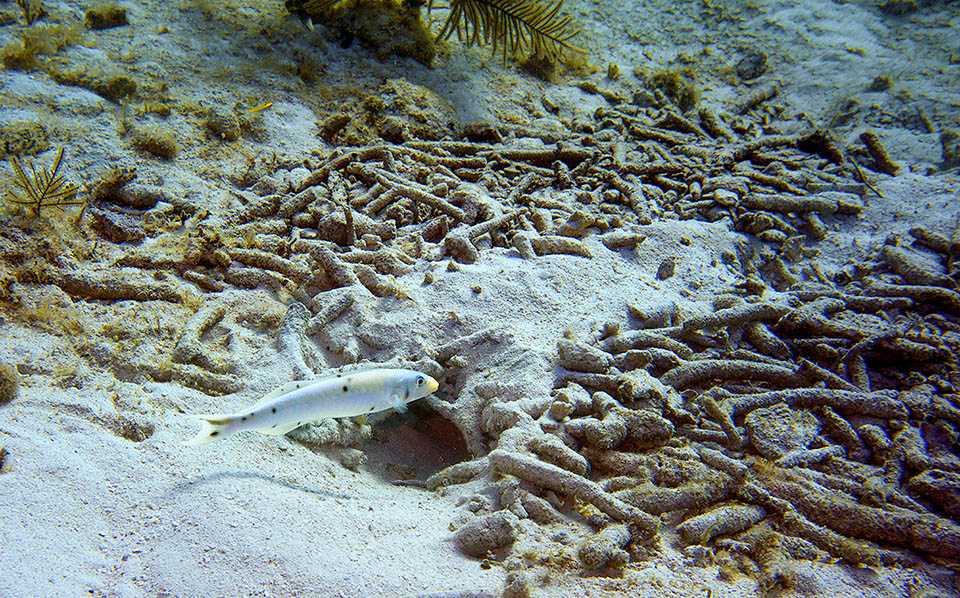
Over time, creates imposing piles forming a characteristic 60-180 cm ring placed at the centre of an about 1000 sq.m. land for males and 250 sq.m. for females © Jeff Mitton
The Sand tilefish is a benthic species usually present from 10 to 50 m in depth but that has been sighted even at 153 m. It prefers to live, as the vulgar name states, on the sandy madreporic seabeds where its livery, pale bluish grey over, at times with black spots, and whitish under, goes unnoticed.
It digs a hole between rocks and submerged marine phanerogams prairies adapting, when there is nothing better, also to sandy locations, and stubbornly tiles, day after day, the vicinities of its shelter, covering them with coral fragments collected and stolen to other fishes within a radius of about thirty metres.
Imposing heaps that may weigh tons and are well visible even from far away because they form a characteristic ring of 60-180 cm of diametre, center of a hunting territory that occupies about 250 square metres for the females and 1000 square metres for the males who allow them to enter geographically overlying on their boundaries.
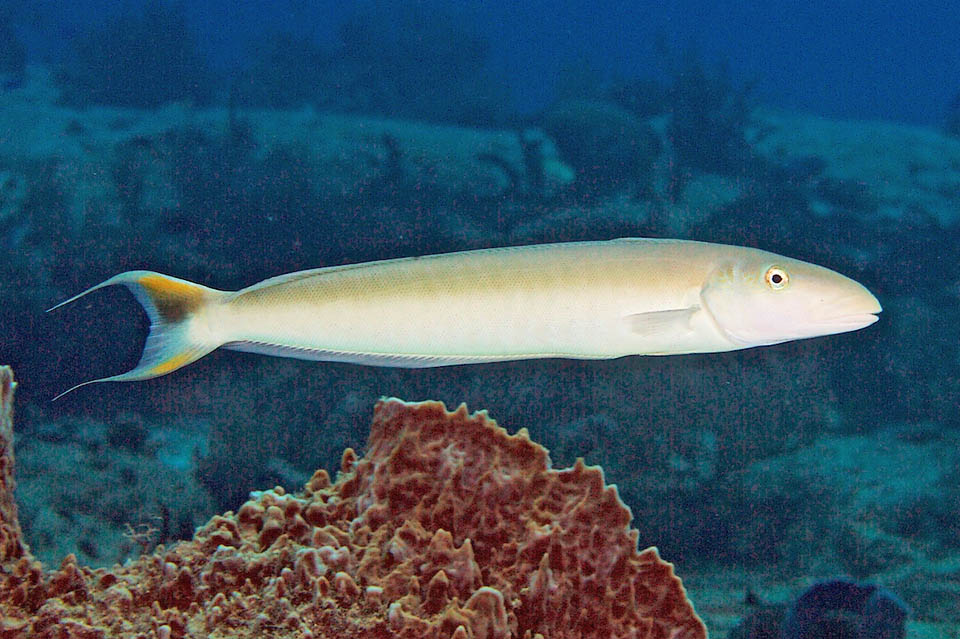
The males, recognizable by its lira-shaped tail with long filaments, accepts them with territories overlapping its own and every evening looks if they are ready to spawn © www.carlosestape.photoshelter.com
Morphophysiology
Malacanthus plumierii has the body slightly compressed and very elongated. The head, slim and rounded, with pale yellow dots among blue vermicular patterns close to the eyes, has a large sharp spine at the corner of the gill cover.
The dorsal fin has 4-5 spiny rays and 54-60 soft; the anal 1 spiny ray and 48-55 unarmed and the caudal with the upper and lower edge orange yellow and a blackish dot up, is lunate and later on lira-shaped in the seniors.
The males, who reach 1 kg, are usually bigger than the females with more intense colours and long wavy caudal extensions. The juveniles often display an orange stripe along the back side of the sides.
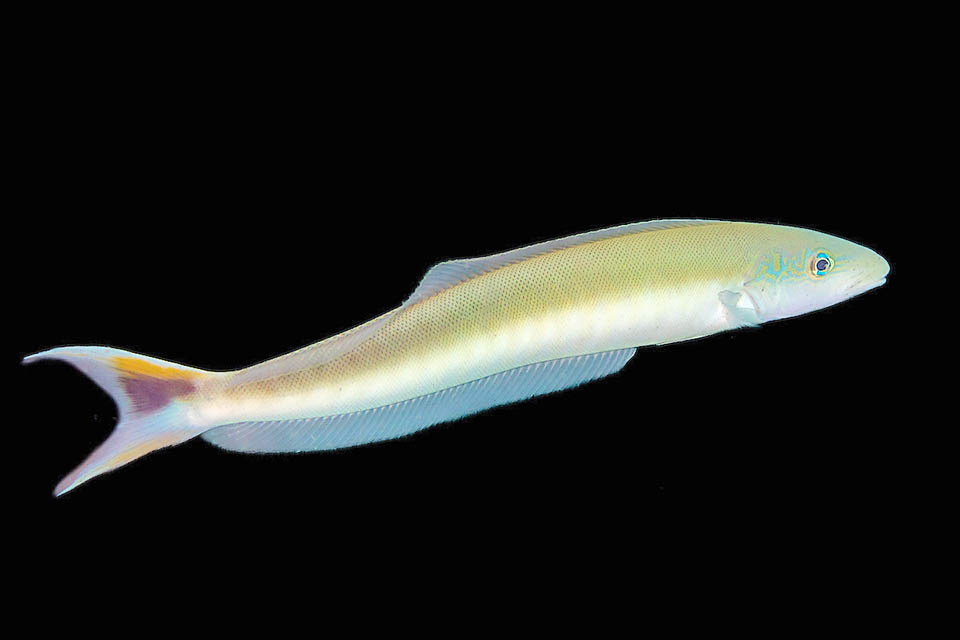
After courtship, with a ritual made of bows and sudden glides, the female accepts and the pair reaches the surface to entrust the fecundated eggs to the currents © www.carlosestape.photoshelter.com
Ethology-Reproductive Biology
Malacanthus plumieri feeds on all species it finds on the seabeds: mainly polychaete worms, mollusks, sea urchins, fragile starfishes with their long thin arms, amphipods, shrimps and small fishes.
The females are proterogynous hermaphrodite, that is, the female organs mature before the male ones, and then may change sex, but unlike what usually occurs in other species, for instance in the Labridae, this phenomenon object of studies does not depend on their size or on the death of the male who defends the group’s boundaries.
The fecundation of the eggs takes place in pairs, close to the surface.
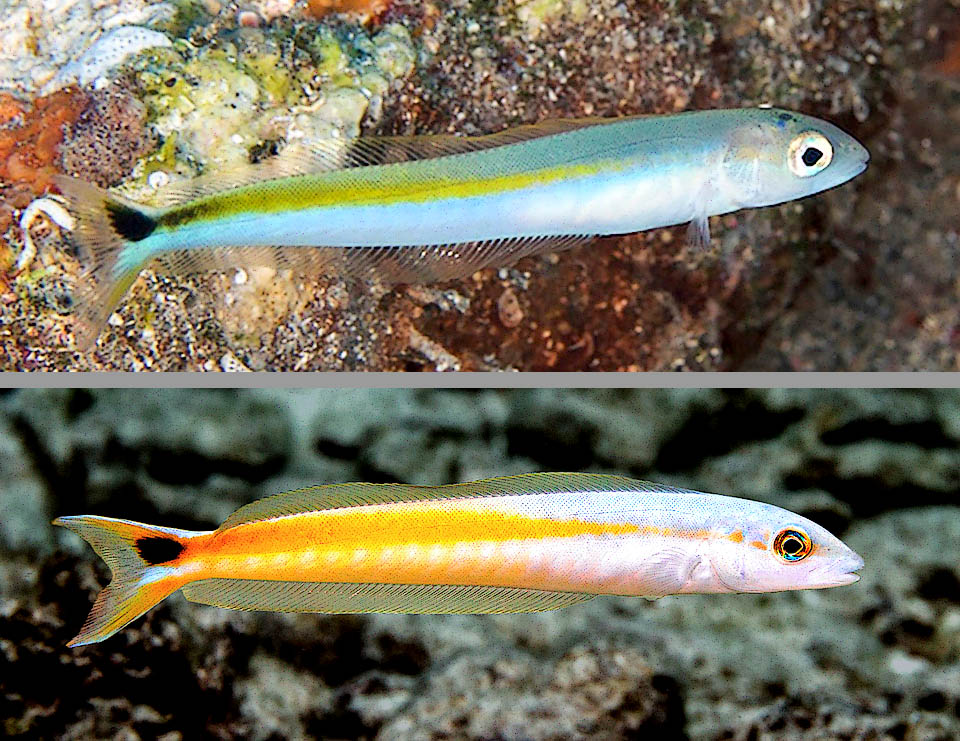
Growing juveniles. The planktonic larvae explain the vast diffusion of the species and even if caught in trawl nets Malacanthus plumieri is not an endangered species © www.carlosestape.photoshelter.com
Every male visits in the evening the females of its territory and stimulates those ready to spawn with a precise ritual of courting made of bows and sudden glides, as the two rise on the water column to entrust the fecundated eggs to the currents, and this, together with the mobility of the pelagic larvae, explains the vast diffusion of the species.
The fishing vulnerability index, mainly linked to by-catches, is mediocre, marking 54 on a scale of 100. From 2013 Malacanthus plumieri appears as “LC, Least Concern” in the IUCN Red List of the endangered species.
Synonyms
Coryphaena plumieri Bloch, 1786; Malacanthus trachinus Valenciennes, 1841; Dikellorhynchus tropidolepis Berry, 1958.
→ For general information about FISH please click here.
→ For general information about BONY FISH please click here
→ For general information about CARTILAGINOUS FISH please click here.
→ To appreciate the BIODIVERSITY of BONY FISH please click here.
→ To appreciate the BIODIVERSITY of CARTILAGINOUS FISH please click here.