
Family : Labrisomidae

Text © Dr. Giuseppe Mazza

English translation by Mario Beltramini
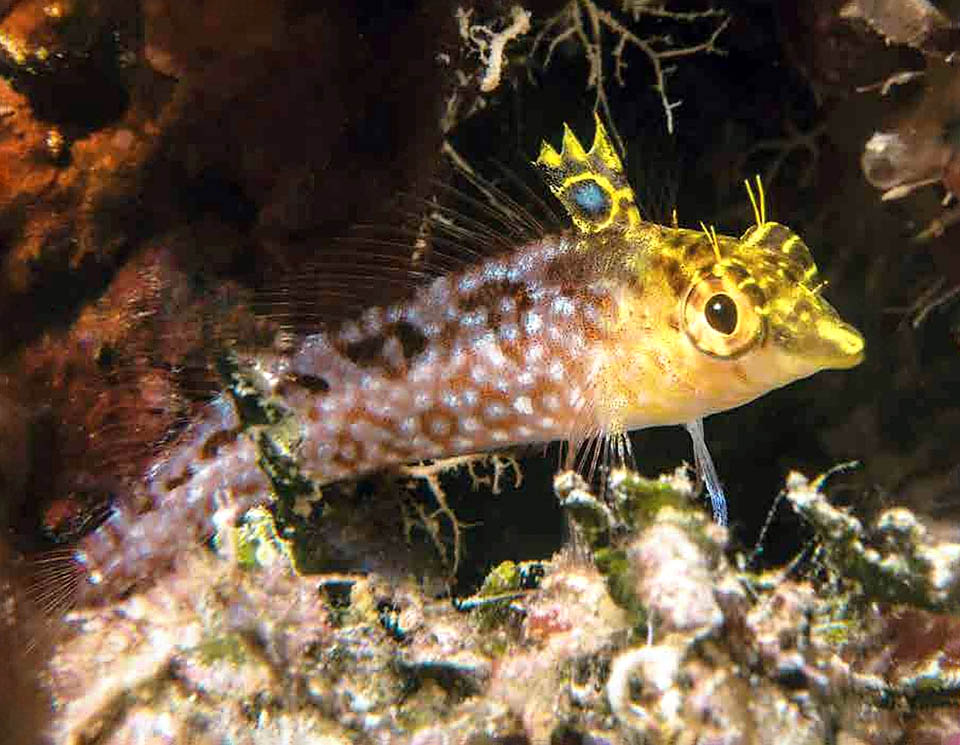
Known as Diamond blenny due to its drawings on the sides, Malacoctenus boehlkei is at once recognized due to the shining ocellus among the first rays of the dorsal fin © Mickey Charteris
Inserted in the class of the Actinopterygii, the ray-finned fish, the surprising order of the Blenniiformes hosts large fishes exceeding one metre, like the Anarhichas orientalis, Anarhichas lupus or the gigantic Anarrhichthys ocellatus that reaches 240 cm in length and 18,4 kg of weight, but also species of modest size such as Blennius ocellaris, the Butterfly blenny, frequent in the Mediterranean and tiny species likeAcanthemblemaria aceroi, that is just over 4 cm long and takes refuge underground into tubes stolen from the annelids, Hypsoblennius invemar, less than 6 cm long, who lives inside the empty shell of a cirriped or the changeable and flashy Cochleoceps orientalis of similar size.
An order hosting also snake-like small fishes like Stathmonotus hemphillii, crafty impostors like Aspidontus taeniatus that perfectly imitates an honest cleaning fish to then tear off, discrediting it, shreds of flesh to the clients, and even a poisonous species, Meiacanthus grammistes, with hollow teeth connected like the vipers to poison glands.
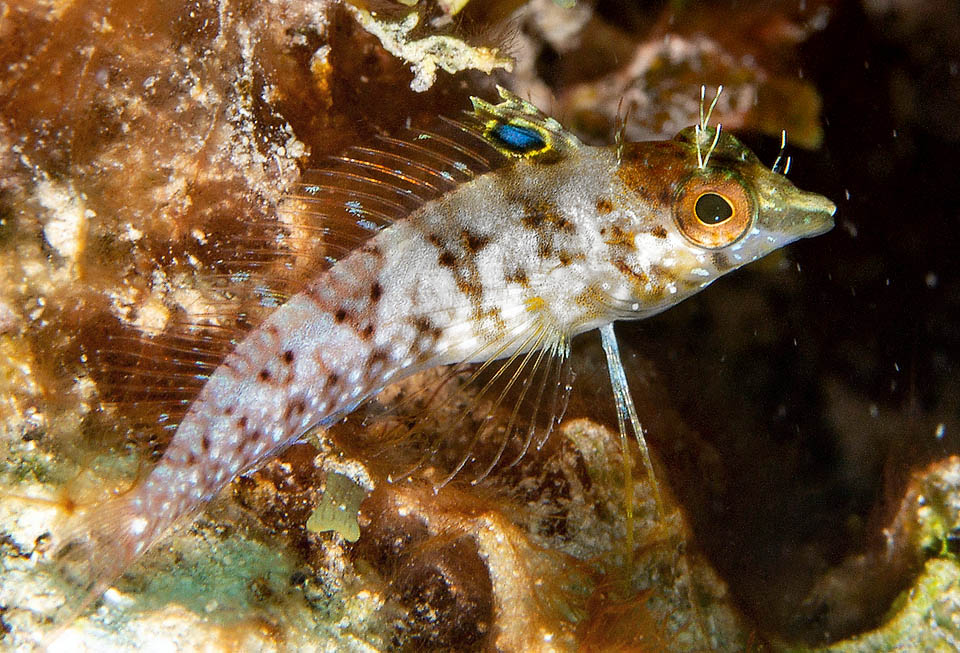
It lives along the Caribbean coasts where leaning diagonally on its enormous pelvic fins hunts motionless, in ambush, small crustaceans and other benthic invertebrates © www.carlosestape.photoshelter.com
Malacoctenus boehlkei Springer, 1959, known as Diamond blenny, is a Blenniiformes inserted in the family. pof the Labrisomidae, which amazes due to its characteristic shining ocellus with yellow border among the first rays of the dorsal fin and the diamond-shaped spots on the sides that have rightly given origin to the vulgar name.
The genus Malacoctenus, created by Gill in 1860, originates composed by the Greek “malakos”, soft, and “cteno”, comb, with reference to the pectiniform tendrils of the head; whilst the specific term boehlkei is an acknowledgement of the contribution made for the description of the species by James Erwin Böhlks and his wife Eugenia Louisa who worked both for the Philadelphia Natural Sciences Academy where Springer was the ichthyology curator.
Zoogeography

Males display aligned at the top, towards the back, 7 irregular blackish spots with clear centre sided below by 10 smaller ones diamond-shaped with white centre © Pauline Walsh Jacobson

In the females the pattern is similar but is of brownish orange colour © Pauline Walsh Jacobson
Malacoctenus boehlkei lives along the central-western Atlantic, from the Bahamas and Virgin Islands up to Bonaire in Venezuela, reaching Belize westwards.
Ecology-Habitat
It is usually found in waters where the temperature is included between 25,4 and 28,1 °C mainly between 2 and 8 m on depth, but also at 30 m, on the drops of the reefs and rocky ravines where, leaning on its long pelvic fins, waits, motionless, for the arrival of small crustaceans and other benthic invertebrates it seizes in a flash.
Immunized as it is to its poison, it is not rare to find it at the base or between the tentacles of Condylactis gigantea, a Caribbean ball anemone where it finds protection from predators.
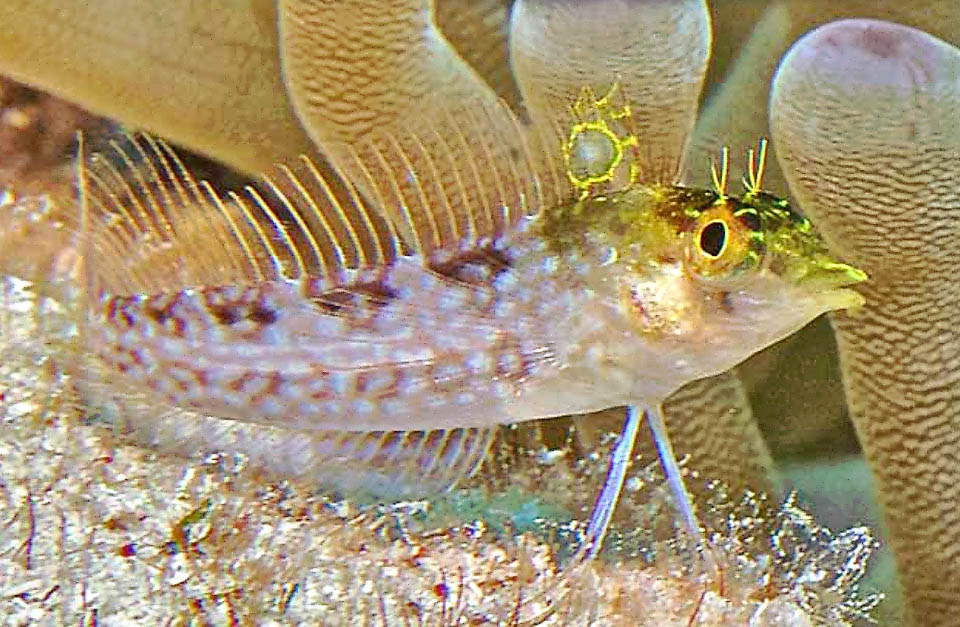
Immunized as it’s to its poison, is not rare to find Malacoctenus boehlkei at the base or among the tentacles of Condylactis gigantea, anemone protecting it from predators © www.carlosestape.photoshelter.com
Morphophysiology
Malacoctenus boehlkei reaches a maximum length of 6,4 cm. The body, with smooth scales in the back, is elongated with a slender head and pointed snout. Over the eyes is present a ramified tendril and then two more on the nape, richer in ramifications. The upper jaw has an outer row of teeth, which is conversely absent on the sides of the palate.
The dorsal fin has 18-23 spiny rays, then followed by a notch of 9-13 unarmed; the anal 2 spiny rays and 20-23 unarmed; the pectoral ones have 15 rays and the very long fins preceding them reach and surpass the beginning of the anal.
The head is yellowish brown and the body is brownish with a fine punctuation, clear on the sides.
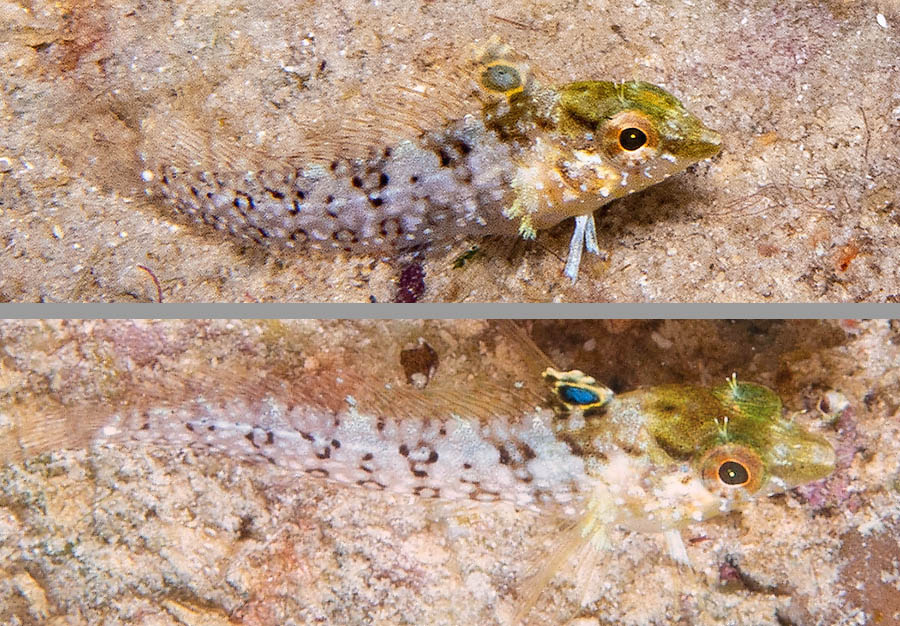
Juveniles, easy to recognize due to the proportionally bigger eye and short pelvic fins, instead rely uniquely, acting on the chromatophores, on the mimetic livery © www.carlosestape.photoshelter.com
In the livery we note a slight sexual dimorphism. The males have, aligned at the top towards the back, 7 blackish irregular spots from the clear centre sided below by 10 smaller ones, diamond-shaped with the white centre. In the females the drawing is similar but of brownish orange colour.
Ethology-Reproductive Biology
Like for other Labrisomidae, the eggs of the Diamond blenny are laid on the bottoms and are surveyed until hatching by the male.
The resilience is not known, but the fishing vulnerability, very low, marks only 10 on a scale of 100. Considering also the vast diffusion, Malacoctenus boehlkei appears then as “LC, Least Concern” in the IUCN Red List of the endangered species.
→ For general information about FISH please click here.
→ For general information about BONY FISH please click here
→ For general information about CARTILAGINOUS FISH please click here.
→ To appreciate the BIODIVERSITY of BONY FISH please click here.
→ To appreciate the BIODIVERSITY of CARTILAGINOUS FISH please click here.