
Family : Orchidaceae

Text © Prof. Pietro Pavone

English translation by Mario Beltramini
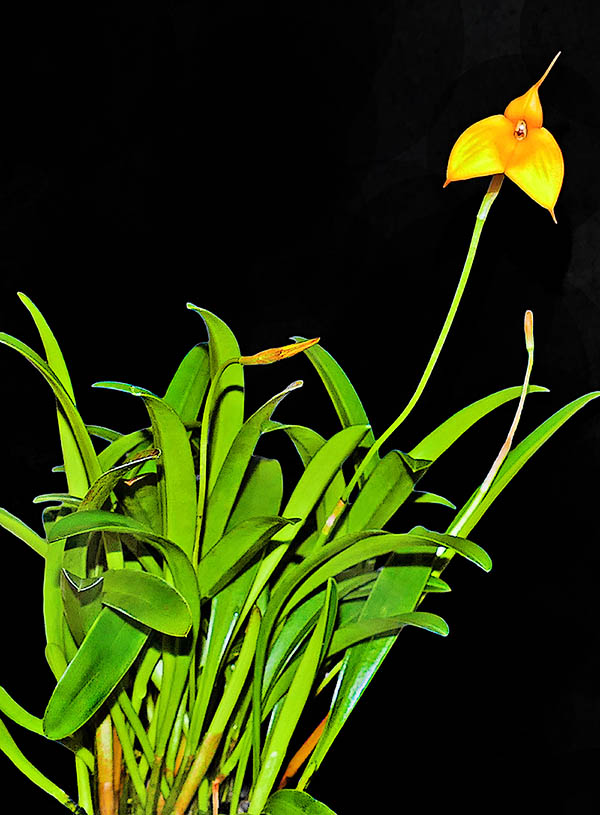
Masdevallia davisii grows at very high altitudes, 3000 to 4000 m, in the Peruvian mountain zones © Nolehace Photography
Masdevallia davisii Rchb.f. belongs to the family Orchidaceae, to the subfamily Epidendroideae, to the tribe Epidendreae, to the subtribe Pleurothallidinae, to the subgenus Masdevallia, to the section Masdevallia, subsection Coccineae.
Masdevallia davisii was described in the prestigious magazine Gardeners’ Chronicle London (Gard. Chron., n.s., 2: 70 (1874) by Heinrich Gustav Reichenbach (1824-1889), eminent botanist of the German science of the XIX century considered as the world’s leading authority on orchids so much to be nicknamed “The Orchid King”.
He was professor of botany and director of the Botanical Garden of the University of Hamburg from 1863 until his death.
Among his most important publications we mention: Xenia Orchidacea, work in three volumes published from 1858 to 1900, rich in descriptions and illustrations of hundreds of species known at that time, Beiträge zu einer Orchideenkunde Central-Amerika’s of 1866, with numerous contributions on the taxonomy of the family Orchidaceae; De Pollinis Orchidearum Genesi ac Structura of 1852, pioneer study on the formation of the pollen in the orchids; Diagnoses Orchidearum Novarum published in several parts inside the magazine
Otia Botanica Hamburgensia from 1876 to 1877, with descriptions concerning the new species just discovered during the botanical expeditions in various parts of the world.
His immense herbarium and his library were left as legacy to the Naturhistorisches Museum of Vienna, provided that they were not consulted during the first 25 years following his demise.
In fact, to justify this, he wrote in his will: “…. to avoid the inevitable destruction of the expensive collection generated by the present orchid mania”, However, it is probable that the unusual prescription was done to prevent some young colleague, possibly Robert Allen Rolfe (1855-1921) of the Kew Gardens , for whom he had little respect for, to get possession of his discoveries.
The name of the genus Masdevallia honours Josep Msdevall Terrades, famous Spanish doctor, botanist and scientist, an important character of the Spanish public health of the second half of the XVIII century.
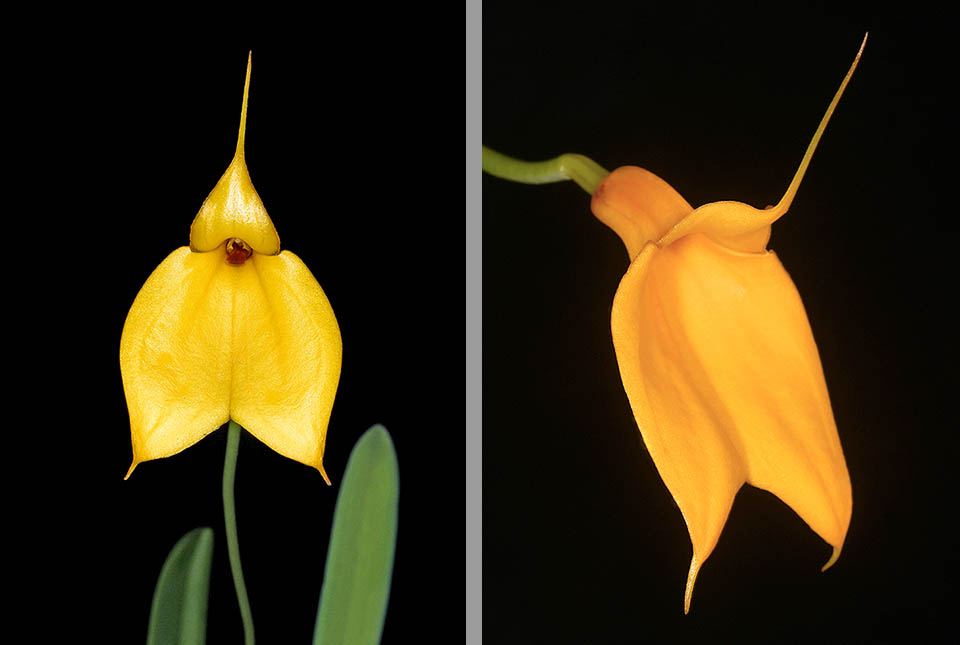
The nice bright yellow flowers, at times with orange hues, have three long points similar to tails © Ron Parsons
The name of the species was dedicated to Mr. Walter Davis (1847-1930) British botanist and collector of plants who was working for the famous firm James Veitch & Sons, one of the most important nurseries of the Victorian era. Davis collected this species in 1873, near Cuzco, Peru and once in England it flowered for the first time in August of 1874.
As soon as described it got great success among the European nursery men, but finally it disappeared from the collections for several decades, mainly because of its extreme exigencies of cultivation (low night temperatures in summer) and difficulties in getting new specimens in the wild.
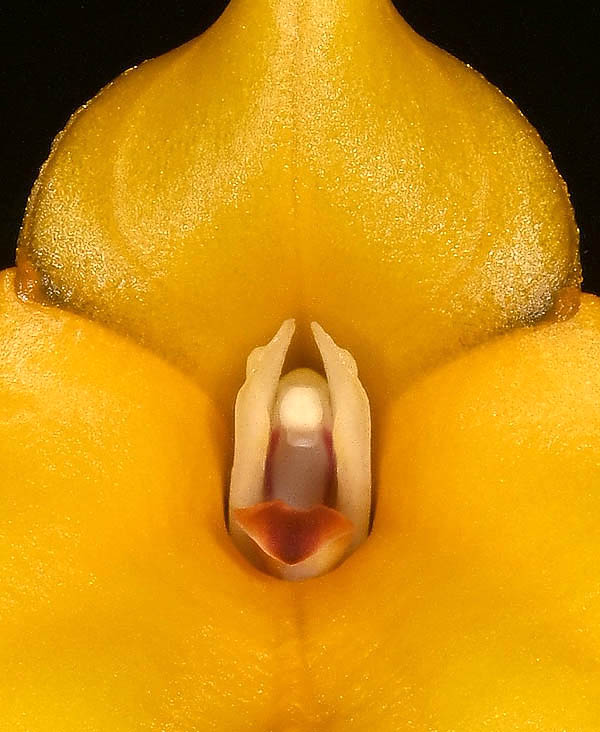
The petals, inside the tube, are very small, whitish or yellowish, arranged on the sides of the winged column, white, yellow at base with crimson edges. The very reduced labellum is often of orange colour © Ron Parsons
It was re-introduced in the nurseries by David Wellisch of San Francisco in 1978 and by Berthold Wurstle of Spielberg (Germany) in 1980, allowing its coming back in the specialized collections thanks to the modern systems of air conditioning. The vulgar name in the Quechua language is “Qoriwaqanki”.
This name means “You will cry with gold” because a legend exists about a wonderful princess who fell in love of a soldier of the army of her father, the supreme Sovereign Inca, sun of the god Sun.
As the two belonged to different social classes, the union was strictly forbidden, and so the king ordered that the warrior was to be sent on a suicide mission and the princess was to be locked up into a religious community. However the princess was able to escape and started to look for her beloved inn the Andes, but, not finding him, he tears turned into beautiful bright yellow coloured flowers right like those of Masdevallia davisii.
It is also called “Orchid of the Sun”, or “Davis’ Masdevallia”.
In Peru this species represents the symbol of eternal love, but also of the melancholy.
This species grows in the humid tropical biome, at very high altitudes (3000-4000 meters), in the mountain areas of Peru, on rock outcrops, at the limit for the pluvial cloud forests.
It is a terricolous or lithophyte species, with miniature to small size, typical of the cold climates with short ramicaul wrapped by basal scarious sheaths and one single apical leaf, coriaceous, oblanceolate, tapered into a short stark.
The flowers, scented and single, are 6,5 to 9 cm long and supported by erect and thin peduncles, up to 25 cm long. They appear in late spring and in summer, one after the other, in one inflorescence having 3 thin tubular bracts, scarious and distant, that supports the flower, quite showy, besides the leaf. When the flower withers another one forms just over the base. The sepals, thick and well developed, are partially merged at the base to form a tube and at the apex they prolong in three elongated points similar to ropes (one bent upwards and the other two looking down).
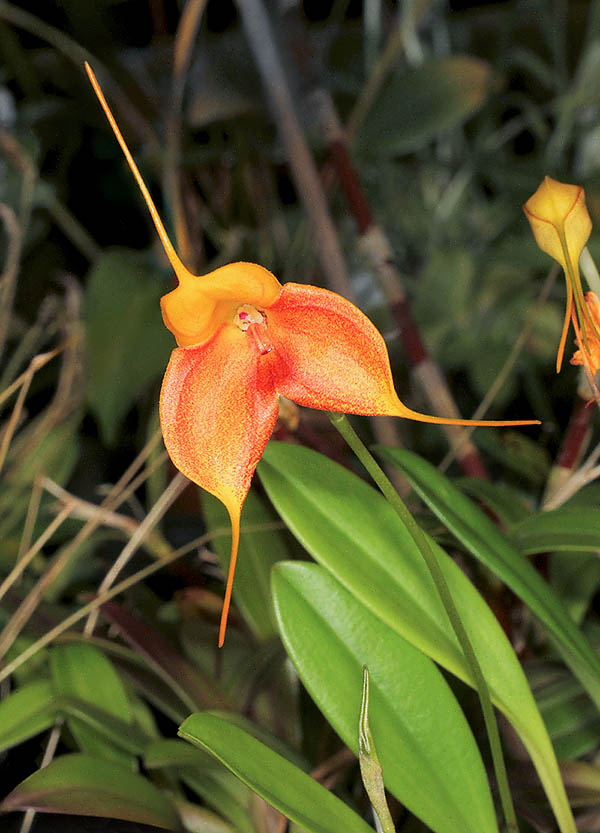
Masdevallia Pixie Gold ‘Sunbrust’ is a primary hybrid’s clone, Masdevallia davisii x Masdevallia caudata © John Varigos
It is likely that the tails can act as physical guides to help the pollinators in locating the entrance of the floral tube.
The sepals are of bright yellow and orange colour towards the centre.
The petals, placed inside the tube, are very small, whitish or yellowish, arranged on the sides of the column that is strictly winged, white, yellow at the base and with crimson margins.
Also the labellum stands inside the tube, very reduced and hinged to the base of the column and often of orange colour.
The pollination, as per investigations carried out on similar species, is done by the Lesser violetears (Colibri cyanotus) that frequent the cloud forests of Peru where this orchid lives at high altitude, attracted by the bright colours of the flower.
Due to these visits while looking the nectar, the pollinarium becomes attached to the bird, usually at the base of the bill
It is also possible, as observed in other species like Masdevallia floribunda and Masdevallia tuerckheimii that have the sale mechanism of pollination, that the flower may attract, with its sugary secretions, small diptera like the fruit flies (genus Zygothrica) that remain trapped between the labellum and the column, and for getting free they hit the viscidium that make the entire viscidium stick to the upper part of their thorax.
The ovary is slightly curved, 0,95 cm long, and after the fecundation transforms in a small elongated green capsule, brown when ripe, with longitudinal cracks for freeing the very small seeds.
They are very light, being without endosperm containing nutrients, therefore suitable for being transported by the wind.
However for the germination is necessary the presence of mycorrhizal fungi to compensate the nutritional deficiencies.
Masdevallia davisii is included in the Appendix of the CITES (Convention on International Trade in Endangered Species of Wild Fauna and Flora) that regulates the trade to avoid the risk of extinction of the species in the wild.
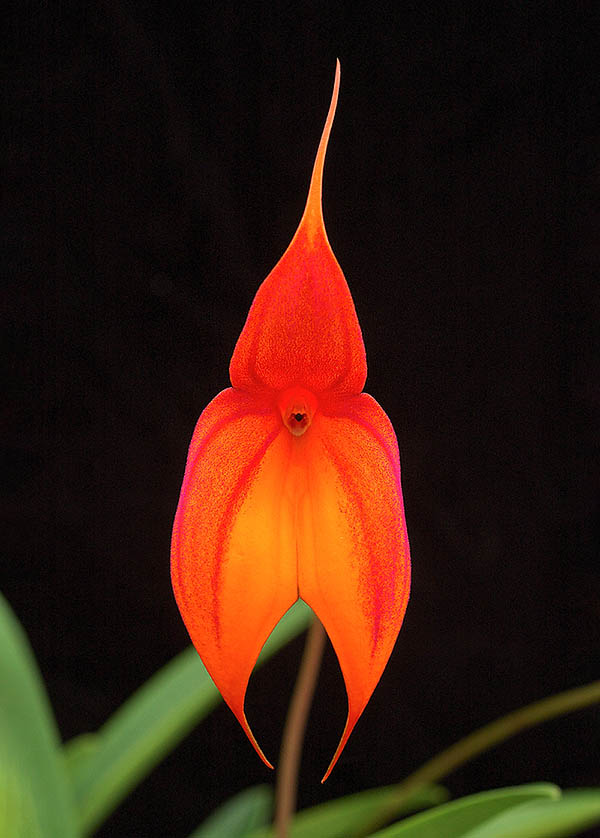
Masdevallia Gauriana ‘Laurie’ is another clone of hybrid between Masdevallia davisii and Masdevallia veitchiana. Has a big scarlet orange to yellow-orange iridescent flower that reaches 10 cm © Eric Hunt
Several hybrids exist of this species. Masdevallia Gairiana is an artificial hybrid with the flower up to 10 cm big, tails included, of iridescent scarlet orange to yellow-orange colour. It was registered on Jan. 1st, 1884 in the database “The International Orchid Register” of the Royal Horticultural Society (RHS°, by Harry James Veitch (1840-1924) owner of the nurseries “James Veitch & Sons” of London.
The hybridizer was John Seden (1840-1921), head gardener of the Veith’s, who realized materially the cross between Masdevallia davisii and Masdevallia veitchiana in the greenhouses of the “Royal Exotic Nursery”, located at King’s Road in the London borough of Chelsea.
To Mr. Seden, one of the most prolific hybridizers of his time, was given, in 1897, the important acknowledgement “Victoria Medal of Honour (VMH)” by the Council of the Royal Horticultural Society.
Another hybrid is Masdevallia Harvest Moon, registered on Nov. 22nd, 1991 at RHS by J & L. Orchids, nursery in Easton, Connecticut (USA). It is a cross between the hybrid Masdevallia Sunbeam and Masdevallia davisii. It has 4 to 6 cm (tails included) flowers, of intense yellow-gold orange-amber hues. The sepals are almost iridescent giving the flower a bright look.
Several varieties and clones of Masdevallia davisii do exist, created to guarantee constant flowerings, purity of colour and more resistence to the temperature changes in cultivation compared to the wild plants.
Masdevallia davisii ‘Elena’ offers constant flowerings and produces bright yellow colour flowers, with a typical hood shape. Thanks to this exceptional quality it has received in 1990 the “Premio al Merito” (Award of Merit) with 80 points from the American Orchid Society (AOS).
Masdevallia davisii ‘Pui Y’s’ is a clone created by Puy Y. Chin, famous grower of San Francisco, who, on July 19th, 1988, has received the prestigious recognition the Highly Commended Certificate (HCC) from the American Orchid Society.
Its inflorescence rises straight above the leaves, the flower is big (up to 9 cm) of bright golden yellow colour.
Masdevallia davisii ‘Sol’ is a clone appreciated for the flower of saffron yellow colour.
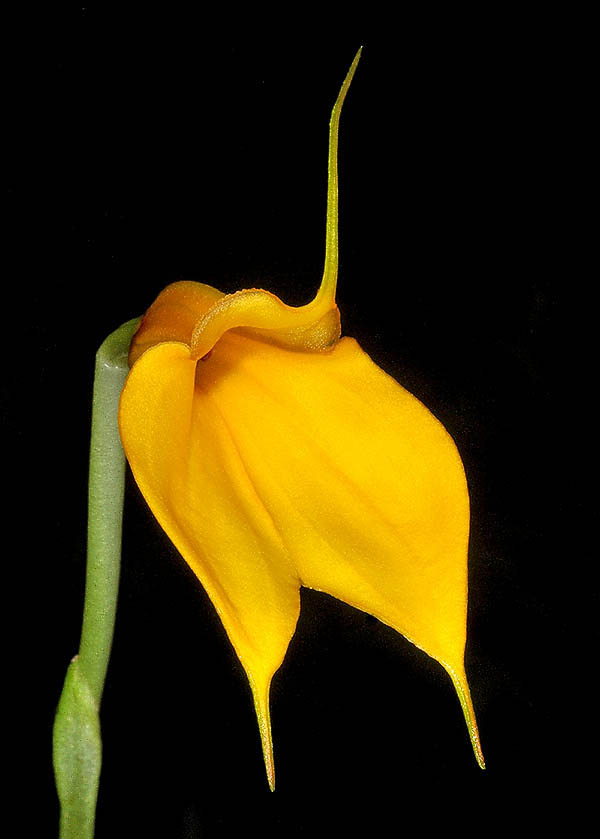
Masdevallia davisii ‘Elena’ is an exceptional quality clone offering very long flowerings © Ron Parsons
Masdevallia davisii ‘George’ is a clone produced by Joh Leathers, famous American grower and hybridizer. Its flower is of about 5-7 cm (tails included), with stretched sepals of very saturated yellow colour, almost fluorescent.
The creation and preservation of these varieties is presently guaranteed by the reproduction in vitro because the rigid control of CITES ensures that every specimen on the market must come from controlled artificial propagation.
In cultivation, being a high mountain (2600-3500 meters in the Peruvian Andes), requires cool conditions and a constant humidity for growing well.
The optimal daytime temperature should be around 15 °C and 20 °C and the night one from 10 °C to 13 °C with a lowering of 5-8 °C. The plant suffers from the heat over 25 °C. It must grow in shaded or partially shaded position and never exposed to direct solar light, that would burn the leaves.
The growth substratum should be formed by shredded pine bark, of sizes between 3 and 8 millimeters, sphagnum and perlite to guarantee water retention and excellent drainage.
As having no pseudobulbs for storing water, the substratum must never dry out completely but is to be kept humid without water stagnations. The environmental humidity must be high, from 60% to 80%, with ventilation to prevent rots and fungal diseases.
For a better growth it is good to utilize a specific fertilizer for orchids very diluted every 2-3 weeks during the growth period (April-October). The substratum must be periodically washed with pure water to avoid salt accumulations.
Every 2-3 years it’s good to do a repotting to avoid the decomposition of the material due to the persistent humidity.