
Family : Orchidaceae

Text © Prof. Pietro Pavone

English translation by Mario Beltramini
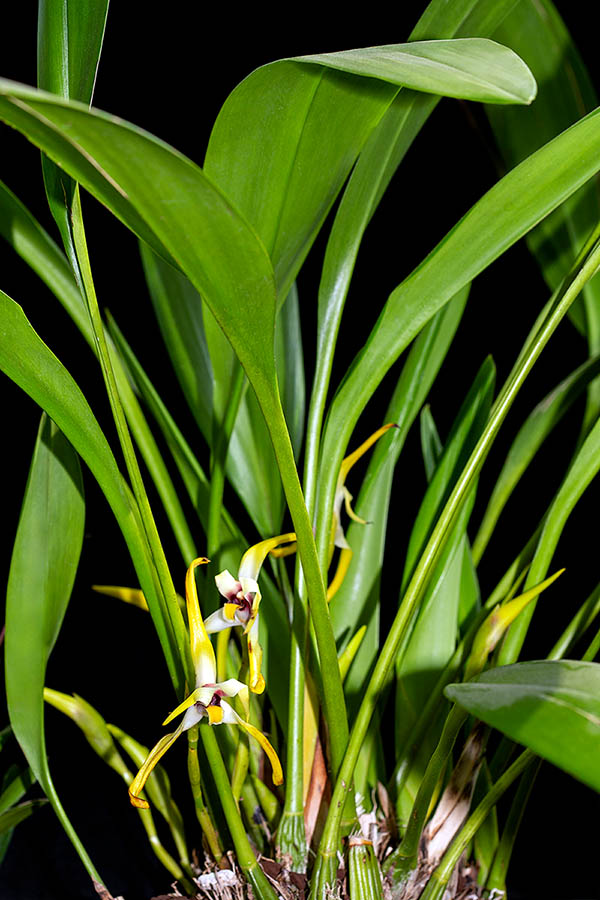
Maxillaria leptosepala grows in the cloud forests of tropical South America. Its pseudobulbs have only one coriaceous, linear-lanceolate apical leaf. From the base of each pseudobulb form 2-3 floral scapes © Dr. Giuseppe Mazza
Maxillaria leptosepala Hook. is a species belonging to the family Orchidaceae, subfamily Epidendroideae, tribe Cymbidieae, subtribe Maxillariinae.
It was described for the first time in 1849 by the British botanist William Jackson Hooker (1785-1865) in the famous magazine Curtis’s Botanical Magazine (Bot. Mag. 75: t. 4434, 1849).
Hooker was botany teacher at the University of Glasgow and, from 1841 until his demise, director of the Royal Botanic Gardens of Kew. Under his direction, the gardens were expanded and many new greenhouses created and a museum of economic botany was established. To enrich the greenhouses collections, Hooker hired William Purdie (1817-1857) an experienced gardener trained at the Royal Botanic Garden of Edinburgh and skilled plants and seeds collector, to send him to explore South America.
Purdie left for Jamaica in 1843 and then ventured to Colombia 1844), Venezuela (1851) and Puerto Rico (1854). During his explorations in the region of Sants Marta, in the then Nueva Granada (that included the nowadays territories of Panama, Colombia, Ecuador and Venezuela), in 1846 discovered the Maxillaria leptosepala.
The plant was despatched to England and bloomed for the first time in the greenhouses of Kew in July of 1849. Hooker, impressed by the flowers, as he said “large and beautiful”, immediately described it highlighting its long and narrow sepals.
He assigned it the specific epithet leptosepala, coming from the union of two terms: the old Greek “leptos” (λεπτός), that means “thin” or “delicate”, and the botanical adjective sepala (from the Greek sképē, that is “cover” or “protection”) rightly to describe the shape of the sepals.
The name of the genus Maxillaria, conversely, comes from the Latin maxilla (jaw) and refers to the column and the labellum of the flower that, seen together in profile, resemble a jaw apparatus. It is commonly known as “Thin sepals Maxillaria”.
Maxillaria leptosepala is found in Colombia, Venezuela, Guyana, Suriname, Brazil, Ecuador and Peru. It mainly grows in the cloud forests as an epiphyte plant on the trees, at altitudes of about 1500 metres.
The plant displays oblong-ovoidal pseudobulbs, compressed, wrapped at the base by imbricate sheaths. Each pseudobulb has one single apical leaf, erect, coriaceous, linear-lanceolate, restricted and conduplicate at the base, having one simple short petiole. From the base of the pseudobulb form two to three floral scapes, usually 6 to 7,5 cm long, much shorter than the leaf, covered, almost completely, by 6 yellowish, tubular, membranous bract, of which the upper one is the biggest and covers the ovary.
The flowers are solitary, scented and about 5 cm wide. The sepals are open, up to 5,5 cm long, of white-yellowish colour, strictly lanceolate, sharp and with revolute edges. The petals are similar to the sepals in shape and colour, but are smaller. The labellumi is divided into three lobes (trilobate). The lateral lobes are usually small and facing upwards, embracing the column partially, whilst the median lobe usually has an elliptical or ovate shape.
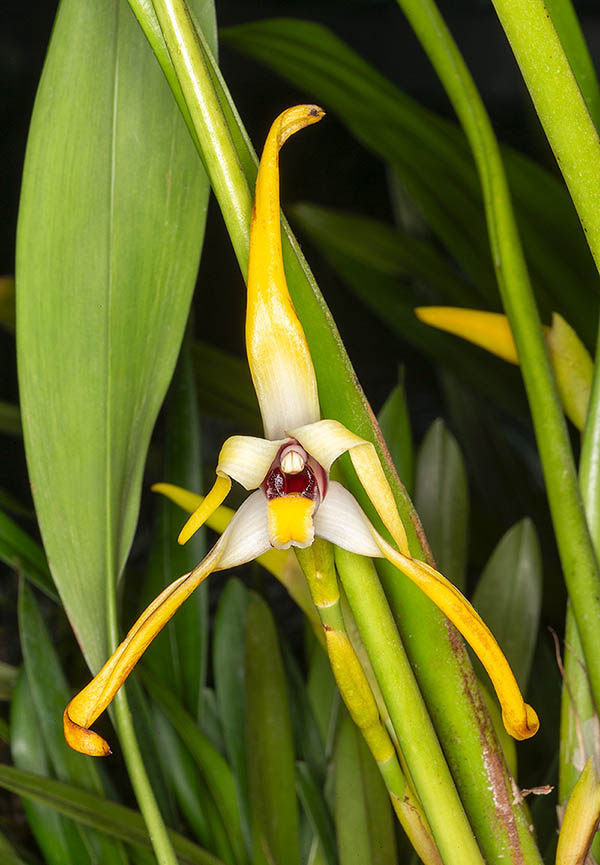
The unusual flowers are solitary, about 5 cm broad, shorter than the leaf. They mainly appear in spring © Dr. Giuseppe Mazza
The upper part of the labellum (disc) has a yellow and hairy callus that acts as visual and tactile allure for the pollinators. Also the strong chromatic contrast produced by the red-purple or brown-reddish streaks, placed at the base and on the lateral lobes, serves to attract the pollinators. As soon as these reach the labellum, they are pushed towards the reproductive organs: in fact the labellum is articulated at the base of the column, and sways under their weight. The column is short, typically cylindrical and thick. The anther, located at the apex of the column, has a smooth operculum having a big and crested lobe. Inside the anther stand four yellow waxy pollinia, arranged in two couples. The ovary is inferior, unilocular, with a lot of ovules; externally it appears smooth and of greenish colour, being almost indistinguishable from the floral pedicel.
Blooming occurs mainly in spring, but a second flowering is possible in autumn. The strong vanilla scent of the flower serves as a long-distance lure for the pollinating insects looking for food. Usually these are stingless bees belonging to the tribe Meliponini. However the plant does not produce a true nectar, but relies entirely on olfactory and visual deception. When the bee lands on the labellum to collect the waxy or gummy substances produced by the hairs of the vallus, it gets in touch with the pollinia glueing on the back or the head with the sticky viscidium.
After the pollination and the fecundation forms the fruit (a capsule) and the quite numerous microscopic ovules transform in seeds having a powdery appearance. The seeds, having no endosperm (reserve tissue), require the symbiosis with specific mycorrhizal fungi to germinate in nature.
Maxillaria leptosepala is a species protected and included in the Appendix II of CITES, that regulates its international trade to prevent its overexploitation in nature.
In the past, some botanists (among which Eric Alston Cheristenson, 1956-2011) had proposed to consider Maxillaria leptosepala as synonym of Maxillaria setigera. However, this taxonomic revision has not been accepted by most scholars and appears not convalidated in the main international databases like that of the Kew Gardens, Plants of the World Online, because the two species display clearly distinguishable morphological structures. In fact, Maxillaria leptosepala has a narrower and more elongated labellum and a callus differently shaped compared to that of Maxillaria setigera: this last presents a wider labellum and characterizes for the typical “bristles” (hence the epithet setigera, that is “bristles bearer”. Moreover, Maxillaria leptosepala tends to have a more compact growth and leaves of different consistency compared to those of Maxillaria setigera.
Horticulturally, is known the cultivar Maxillaria leptosepala ‘Lelia’, characterized by sepals of intense, bright cream yellow colour and of waxy consistency. It has been selected by the Colombian farmer Mrs. Lelia García López and has received in 2014 the “Certificate Cultural Merit” (CCM) by the American Orchid Society.
The cultivation of Maxillaria leptosepala is relatively simple in intermediate simple (medium-warm temperatures). It may be cultivated in rafts (on wood or cork) or in pots or baskets with a very draining compost based on bark, perlite or sphagnum.
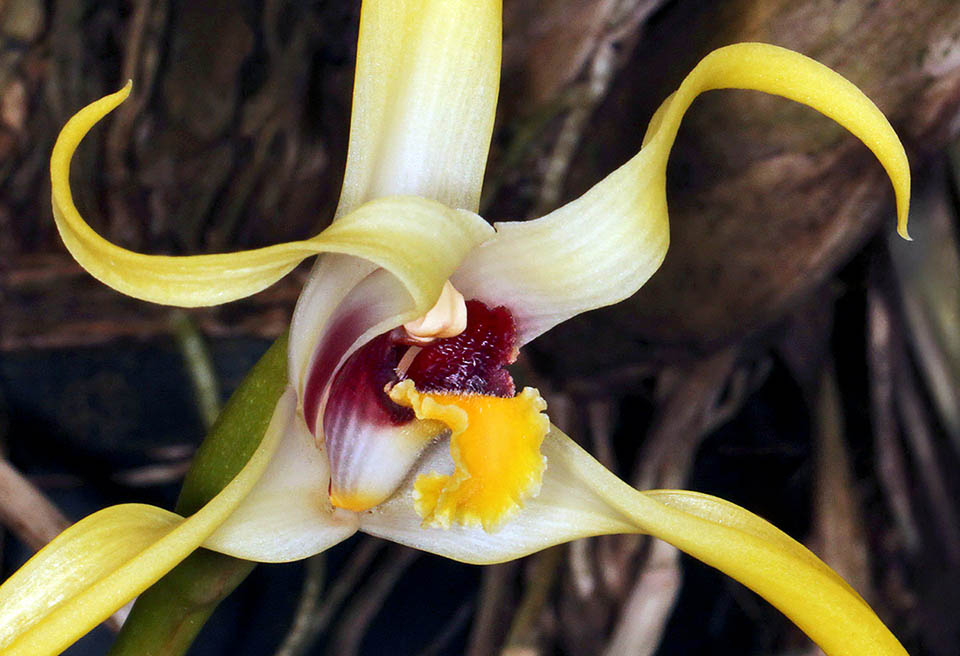
Sepals are narrow, open and lanceolate, of a white-yellowish colour. Petals are similar in shape and colour, but reduced. The trilobed labellum bears a yellow, hairy callus, with red-purple streaks at the base. The flower’s vanilla scent serves as a lure for stingless bees belonging to the tribe of the Meliponini, aiding pollination © John Varigos
It is better to irrigate with rainwater or demineralized to avoid the accumulation of mineral salts, to which the roots are very sensitive. Between one irrigation and the next the substratum must not be allowed to dry out excessively, as the roots decay quickly if left dry.
The plant requires filtered and bright light (avoiding the direct sun) and day temperatures of about 21-27 °C, with a night-time temperature change of about 5-9 °C. In winter the night lows should never decrease under 12-14 °C in order to simulate the natural habitat and induce flowering. The environmental humidity must be high (between 60% and 80%); if the air is too dry, it is suggested to intervene with a humidifier or with daily nebulizations.
During the growth season (spring-summer) it is good to fertilize every 2 weeks administering a balanced fertilizer for orchids (NPK 20-20-20) at half or slightly reduced doses compared to those recommended on the package. The fertilizations are to be reduced during the winter. When the plant has completely filled up the container or when the substratum begins starting to degrade (usually every 2 years), it is necessary to proceed to repotting to avoid the radical asphyxia.
Synonyms: Maxillaria leptosepala var. subintegerrima Regel (1856); Maxillaria setigera var. carolii I.Bock (1984).