
Family : Orchidaceae

Text © Prof. Pietro Pavone

English translation by Mario Beltramini
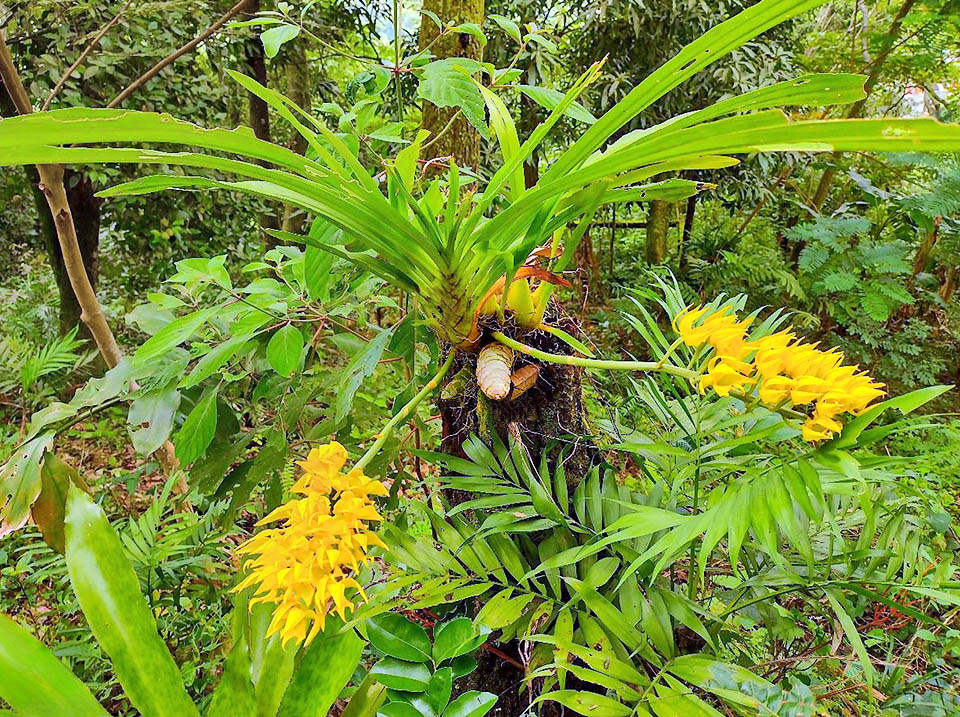
Endemic to central and south Mexico, Mormodes maculata is an epiphytic orchid of the rainforests from 600 to 2200 m of altitude © Mónica Aguilar Gallardo
Mormodes maculata (Klotzsch) L.O.Williams is a species belonging to the family Orchidaceae, subfamily Vandoideae, tribe Cymbidieae, subtribe Catasetinae.
This species was initially described in 1838 with the name of Cyclosia maculata by Johann Friedrich Klotzscg (1805-1860), curator of the Royal Herbarium and of the Botanical Garden of Berlin. However due to the morphological characteristics attributable to the genus Mormodes, created by John Lindley already in 1836, due to the rule of the priority, Louis Otho (Otto) Williams (1908-1991) has reclassified it in Mormodes maculata and the new combination has been published in the magazine Ceiba (vol. 1p. 188, 1950). Williams was an American botanist famous for his studies on the flora of Mexico and of central America. He has been director of the American Orchid Society Bulletin, presently Orchid, official magazine of the American Orchid Society (AOS) and director of the magazine he founded in Honduras Ceiba, still active.
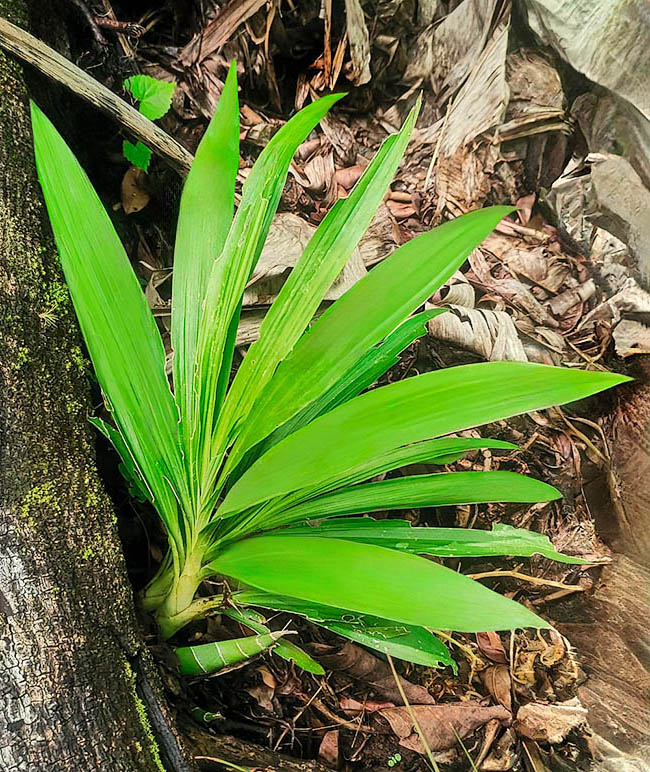
The pseudobulbs bear 4-6 deciduous, plicate, leaves, oblanceolate to elliptic, sharp, wirth evident veins © Victor De la Cruz
The name of the genus Mormodes comes from the Greek words mormō (μóρμω), that means “goblin”, “ghost” or “scary monster”, and -oeidēs (-οειδής) that means “similar”, or “similar in the shape”, alluding to the look of the flowers that have a particular asymmetrical shape.
The specific epithet from Latin “maculatus”, spotted, refers to the characteristic staining of the flowers.
The species does not have a vulgar name but to indicate it, reference is made to the genus whose species in English are called with the name Goblin Orchid .
The genus Mormodes counts 87 epiphytic species diffused especially in the humid tropical and piedmont forests, characterized by high yearly rainfalls that usually amount from 800 and 4000 mm and temperatures often exceeding 17 °C averagely.
All species of the genus are diffused from Mexico up to tropical South America.
They grow on the rotting trunks of the trees and on the fallen branches.
They have proterandrous flowers mainly pollinated by the male bees belonging to the tribe Euglossini (family Apidae) because they are attracted by the scent emitted by the labellum.
As a matter of fact, these bees collect the scents, only reward without nectar, with their bristly structures present on the front tarsi to transfer them in the spongy cavities of the rear legs to then utilize them in their nuptial parades.
When the bee lands on the labellum, looking for scent, stimulates the apex of the column, making the column bend in a way that only one pollinium can be spurted and fixed on its thorax or on its head.
This is favoured also by the asymmetry of the flower caused by the torsion of the labellum, to the left or to the right, that obliges the bee to place for the correct fixing of the pollinarium.
In turn the bee, always looking for scent, will lay the pollinarium on the female part of the column of another flower in order that the pollination may take place.
The pollination in the orchids, due to the complexity of their flowers, has been the subject of attention by many scholars.
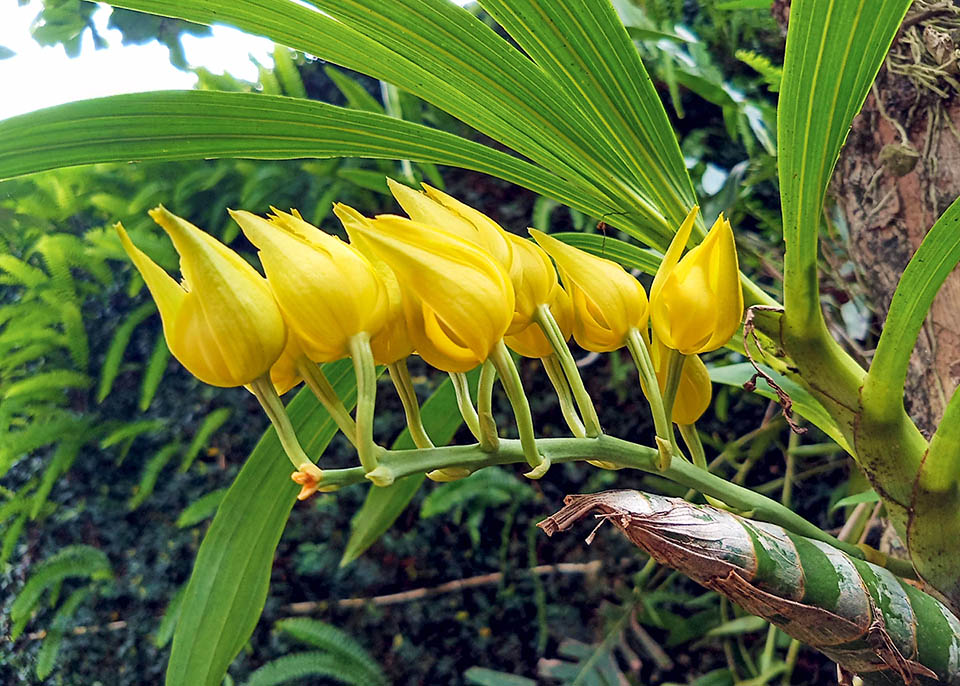
As the scientific name states, Mormodes maculata var. unicolor has uniformly coloured flowers usually yellow © Orlik Gómez García
Charles Darwin himself, father of the theory of evolution by natural selection, when published in 1862 his text “Fertilisation of Orchids”, wrote that the stratagems the orchids used for attracting their pollinators “transcend the imagination of any human being”.
After the fecundation from the ovary forms a dehiscent fruit (capsule) that frees many very small seeds dispersed by the wind. For germination is necessary the presence of symbiotic mycorrhizal fungi for providing the essential nutrients, as the seeds have no endosperm and depend on these fungi for their initial development.
Mormodes maculata is a species endemic to Mexico, and its range is limited to the central and southern regions. In fact, it has been found in the States of Jalisco, Guerrero, Oaxaca, Veracruz and Puebla, where it grows in the mountain rainforests, from 600 to 2200 metres above the sea level.
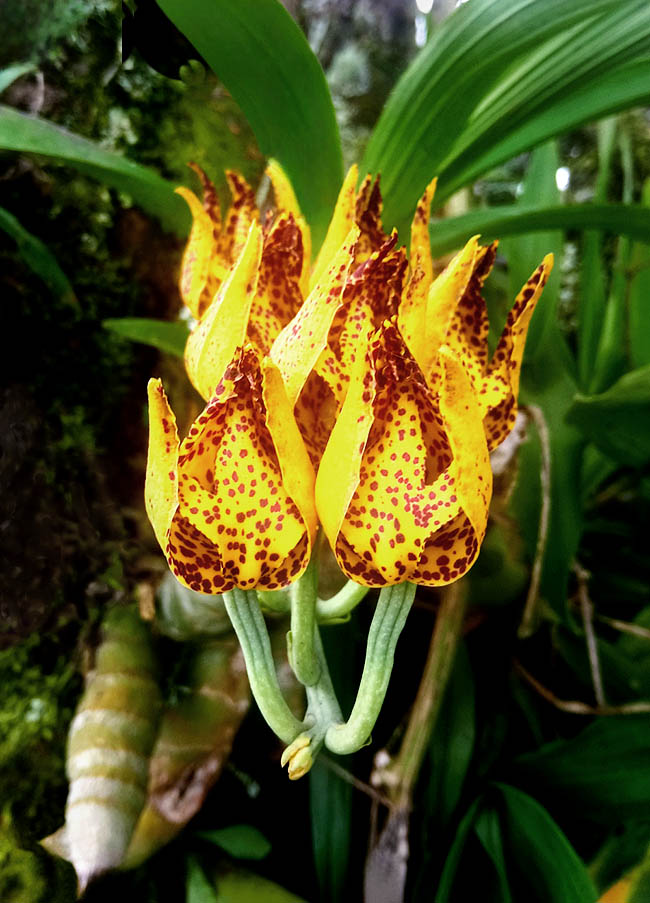
Instead in Mormodes maculata var. maculata are decorated by red, brownish or purple spots on yellow background © Romeo
The species is encountered mainly on decaying wood that allows the orchid to anchor and exploit the decomposing organic matter for the acquisition of the nutrients.
It is an epiphytic herbaceous plant with fleshy roots, whitish, 4-6 mm thick.
From the rhizome form cylindrical-fusiform pseudobulbs, up to 30 cm long and 2-5 cm wide, wrapped by scarious and imbricate sheaths.
Every pseudobulb be,ars 4-6 deciduous leaves, plicate, oblanceolate to strictly elliptic, acuminate, with evident veins.
The inflorescence is racemose, 20-50 cm long, arcuate, unilateral and can have up to 30 flowers, showy, up to 5 cm large, pointing upwards and malodorous.
The perianth has yellow elements similar between them, from scarcely to densely dotted with red-brownish spots.
The dorsal sepal varies from lanceolate to lanceolate-elliptic (35-42 x 10-13 mm), with slightly revolute margins and sharp apex. The lateral sepals are obliquely lanceolate (36-41 x 10-13 mm).
The petals vary from ovate-elliptic to lanceolate-elliptic (32,5-36,5 x 11,5-14,5 mm), revolute, with undulating margins. The labellum is trilobed and slightly curved-concave, 31,5-41 long and 15,5-18 mm wide, with base broadly cuneate and blunt and thickened keel.
The lateral lobes are triangular-falcate and sharp, whilst the median lobe is strictly triangular and attenuated, curved.
At the base of the labellum is present a conspicuous callus, formed by five longitudinal keels, the central one rises out clearly from the others.
The column has a semi-circular section, ~15 × 5 mm, asymmetric, minutely papillose at the apex and with thin antenna, arcuate and twisted. The clinandrium has a triangular shape.
Under the stigma stands an infrastigmatic tabula, support for the pollinators and integral part of the trigger system for the ejection of the 5-6 mm long pollinarium. The pollinia are two, yellow, ~2 × 1 mm ovoidal, stuck to the massive and very viscous viscidium. The ovary, pedicellate, is up to 40 mm long and 4,5 mm broad.
The blooming period lasts 1-2 months, from autumn to early winter, and the flowers that usually open at the same time on the inflotrescence, last 1-2 weeks.
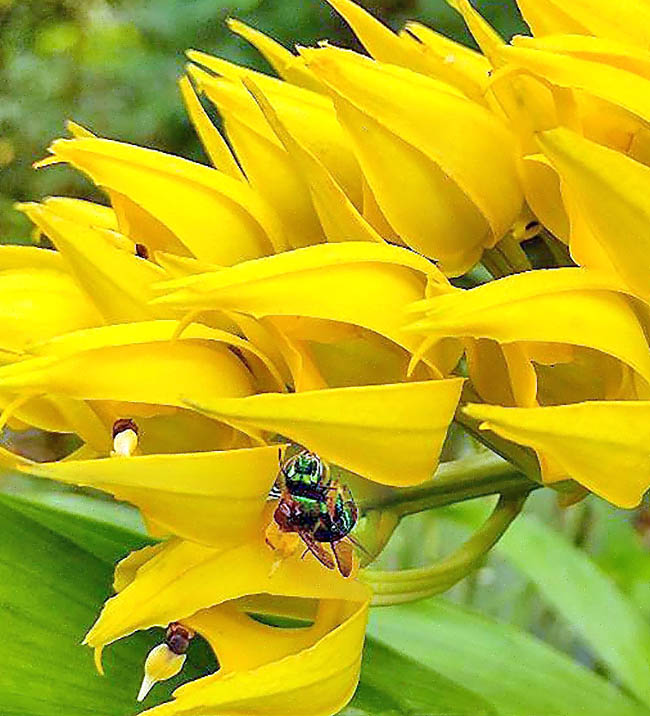
Pollination is mainly entrusted to colourful bees of the tribe Euglossini attracted by the labellum strong odour © Mónica Aguilar Gallardo
After the pollination, almost always done by bees of the tribe Euglossini, do form the fruits (capsules) ellipsoidal, 5,5-6 x 2,5-3 cm, that free very small seeds that require mycorrhizal fungi for the germination.
Mormodes maculata is threatened due to the loss of its habitat and to illegal harvesting. It is protected by the Appendix II of the CITES that regulates international trade in order to prevent its overexploitation. The climate change further endangers the populations due to the changes in seasonal precipitation as well as the consequent fires that interest various areas of its habitat.
Known varieties: Mormodes maculata var. maculata and Mormodes maculata var. unicolor (Hook.) L.O.Williams.
Thanks to its quite particular flowers this species is amply sought after by the lovers.
In cultivation it requires intense indirect light. The substratum must be well draining formed by fir bark, perlite, charcoal and moss of sphagnum able to support the heavy pseudobulbs. Humidity must be maintained around 60-80%.
The plant must be watered with parsimony without causing any water stagnation in order to avoid rots. During the growth phases, to water can be added, once a week, fertilizer with high contents of nitrogen (30-10-10), during flowering the percentage of nitrogen can be reduced (20-20-20), finally the fertilization is to be suspended during the dormancy to avoid accumulation. of salts.
For repotting must be used terracotta pots or mesh baskets to accommodate one or more pseudobulbs with roots, repotting every 2-3 years in spring when the new buds get out in order to refresh the substratum and space the tufts if necessary.
The American Orchid Society (AOS) has awarded the following cultivars: Mormodes maculata var.
unicolor ‘Bob Sanker’ (1986), Mormodes maculata var. unicolor‘Everglades’ (1976), Mormodes maculata ‘Buena Vista’ (1968).
Synonyms: Cyclosia maculata Klotzsch (1838); Mormodes pardina Bateman (1840).