
Family : Salamandridae

Text © Dr. Nicolò Pellecchia

English translation by Mario Beltramini
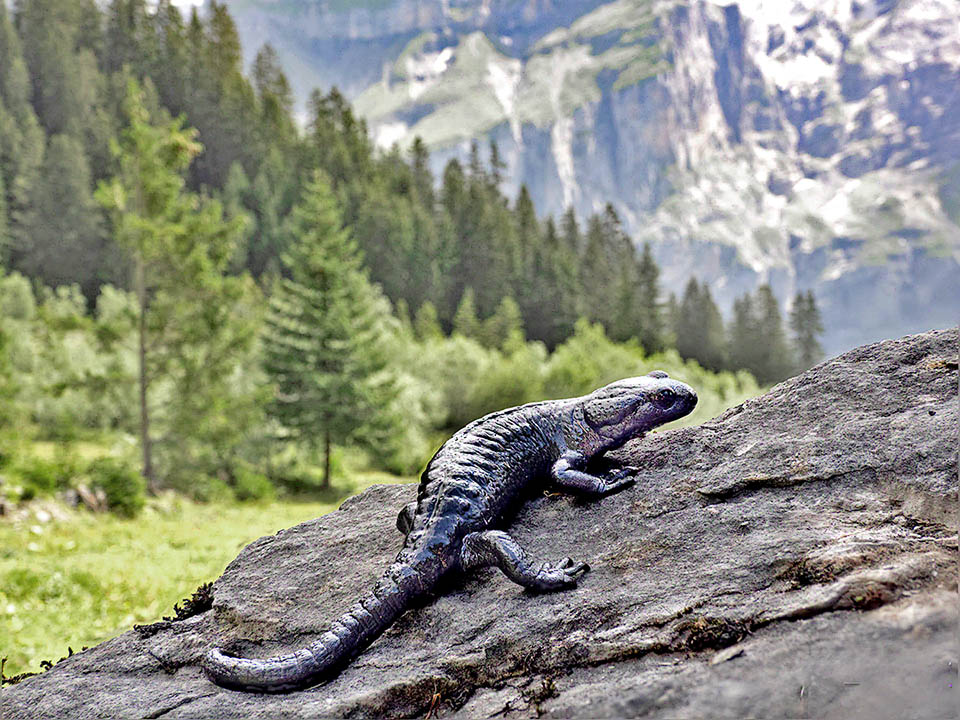
The Alpine salamander (Salamandra atra) occupies a vast range in Europe between 400 and 2800 m in altitude © Bryan Maltais
The Alpine salamander, Salamandra atra Laurenti, 1768, is an amphibian belonging to the order of the Caudata and to the family of the Salamandridae. It is a typically mountainous species, spread along part of the Alpine arc and, with disjunct populations, in the main mountain massifs of the Dinaric Alps and of the western Balkans.
The generic term Salamandra comes from the Latin and from the Greek “σαλαμάνδρα”, salamander, name by which already in the ancient times were indicated these amphibians. Conversely, the specific epithet atra comes from the Latin ater, «black», and reminds the characteristic dark colouration of the nominal form, usually uniformly black.
The classification of Salamandra atra presents a complex history and is still now subject of discussion. Traditionally, inside the species have been recognized several subspecies, among which Salamandra atra atra, Salamandra atra aurorae, Salamandra atra pasubiensis and Salamandra atra prenjensis. The situation, however, is more complex than what is suggested by this simple geographic subdivision.
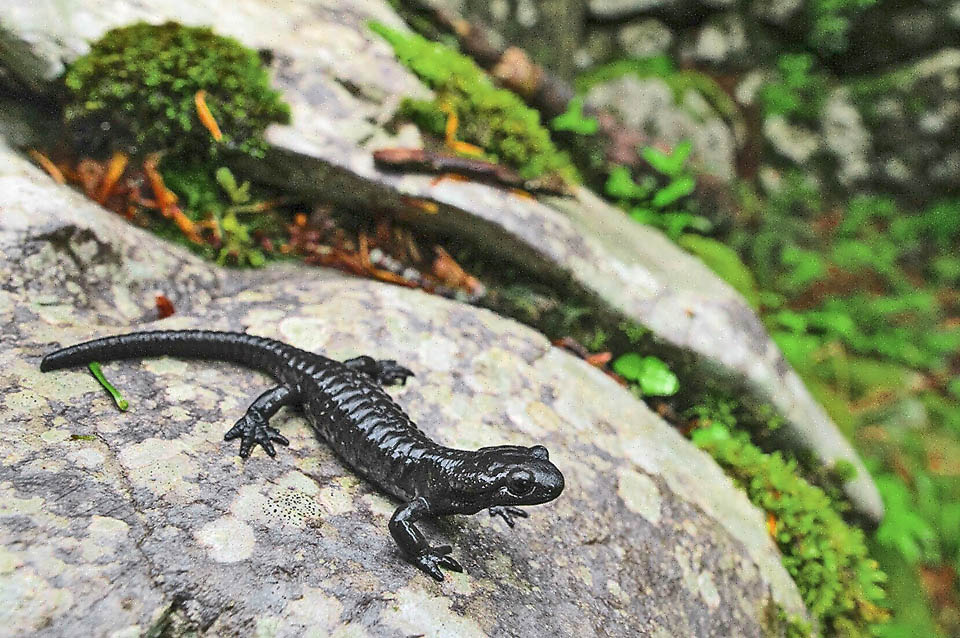
It’s found in humid forest environments, where is mainly active the night, hiding the day in the crevices © Lennart Schmid
Salamandra atra aurorae presents an extremely restricted range in the Vicentine Alps, whilst Salamandra atra pasubiensis isassociated with the Pasubio massif. Conversely, the form Salamandra atra prenjensisis linked to the reliefs of the Dinaric Alps, in particular to the area of the Prenj and of other massifs of Bosnia and Herzegovina and of the surrounding Balkan regions.
Zoogeography
The Alpine salamander has a mainly Alpine distribution, to which adds a set of populations isolated in the mountain chains of the western Balkans.
In the Alpine area it is present from France and Switzerland through Austria and southern Germany up to northern and north-eastern Italy. Further south-east the range gets strongly discontinuous and includes populations distributed in the reliefs of Slovenia, Croatia, Bosnia and Herzegovina, Serbia, Kosovo, Montenegro and Albania.
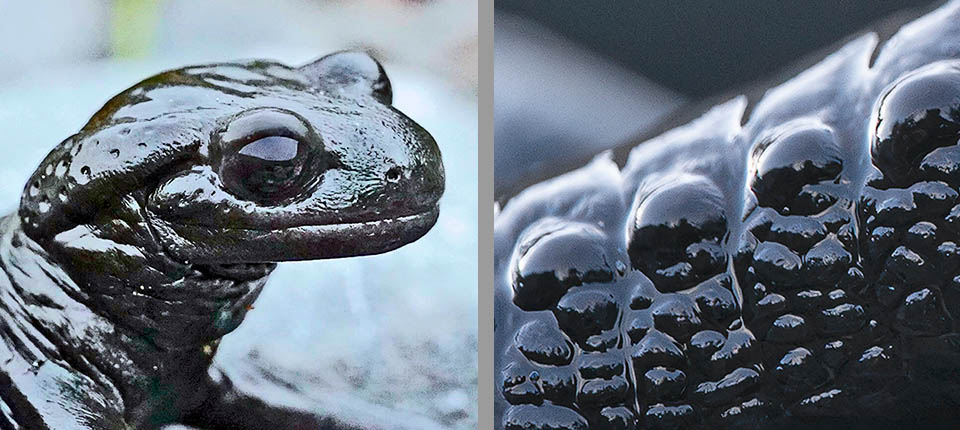
It protects with secretions issued by glands spread on the body. The head has two called parotoids, whilst on the back have a roundish look © nbasargin (left) © Tobias Polzer (right)
Therefore, the distribution is not homogenous. In the Alps the population can form relatively continuous nuclei, whilst in the Balkans the species is represented mainly by isolated populations associated with the mountain massifs. The disjunct range and the limited capacity of dispersal of the individuals favour the isolation of the populations and have contributed to the genetic differentiation observed in several sectors of the range.
Ecology-Habitat
Salamandra atra is a strictly terrestrial species, particularly adapted to the mountain and subAlpine mountain pin environments.
It frequents mountain woods, mainly beech forests, but also formations dominated by silver fir, Norway spruce and larch. It can also live in the subAlpine shrublands of mountain pine or green alderand in more open environments, such as subAlpine grasslands, meadows, detrital slopes and rocky substrata characterized by a discontinuous herbaceous and shrub cover.
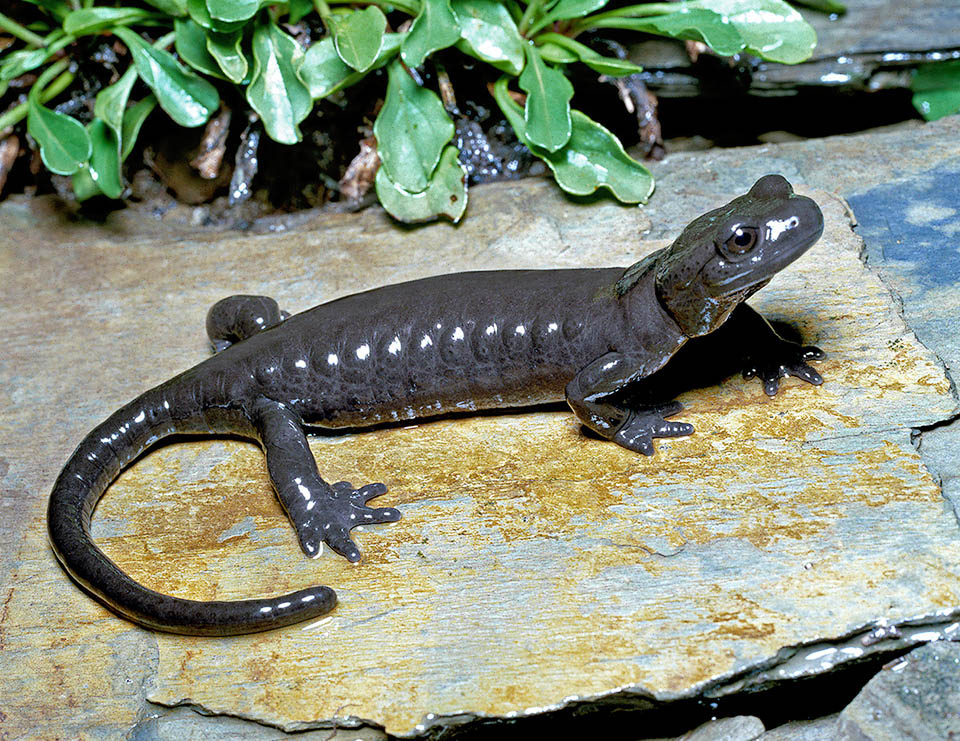
It measures 11-12 cm, with a 14 maximum in adult females. There is no sexual dimorphism but various subspecies do exist © Giuseppe Mazza
It seems to love microenvironments characterized by the presence of crevices, stones, debris and other shelters where it can avoid dehydration and unfavourable temperatures.
Locally it may reach high densities, even of several hundreds of individuals per hectare in particular favourable locations. However these values must be considered as local and not representative of the average density of the species.
The species has an ample altitudinal range, with observations included between about 400 and 2.800 m of altitude. The altitude occupied varies significantly between the different sectors of the range and depends on the climate conditions and on the availability of suitable microhabitats.
One of the fundamental elements of the ecology of the species is the relationship with the humidity. The Alpine salamander is observed especially during or just after the rainfalls, when the atmospheric humidity and that of the substratum reduce the risk of dehydration.
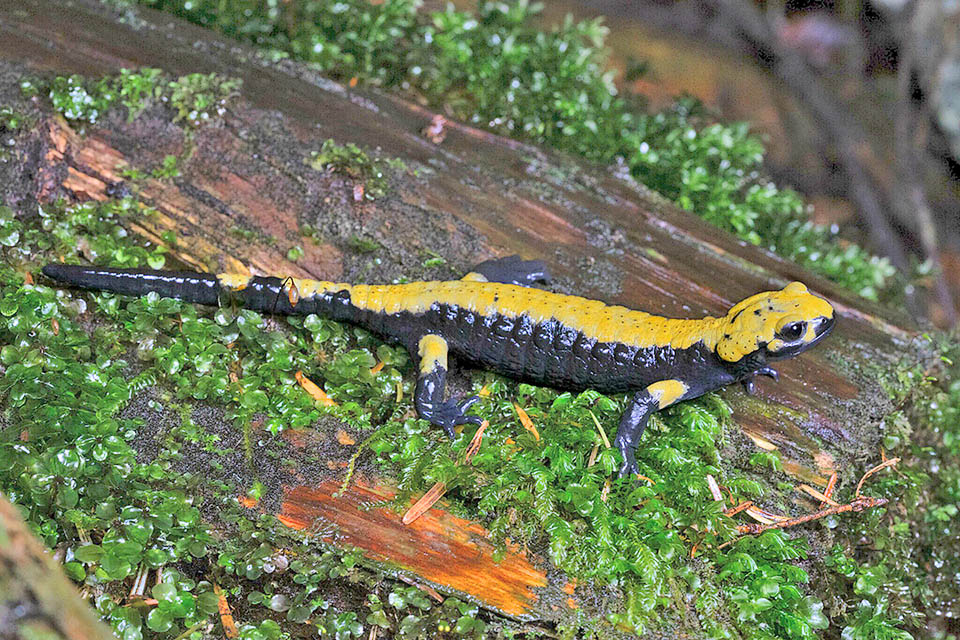
This, characterized by the yellowish back, is Salamandra atra aurorae, present on the Sette Comuni plateau, Vicentine Prealps © Wouter Beukema
The individuals may keep hidden for long times during the warmest and driest phases of the year. Conversely, in favourable conditions that may carry out superficial activities even during the day, especially in presence of intense rainfall and moderate temperatures. The epigean activity of the species typically begins in spring, between April and May, and may go on until September or October, with significant variations depending on the altitude and on the local climate conditions.
Morphophysiology
Salamandra atra has the typical robust and elongated look of the salamanders, with a cylindrical and relatively massive body. The total length in the adults is usually of about 11-12 cm, even if the bigger individuals may attain about 14 cm.
On the sides of the head are present two clearly evident parotoid glands, glandular structures responsible for the production of defensive skin secretions. On the back are well visible two series of paravertebral glands, whilst along the sides are present rows of glandular protuberances usually rounded and equipped with pores.
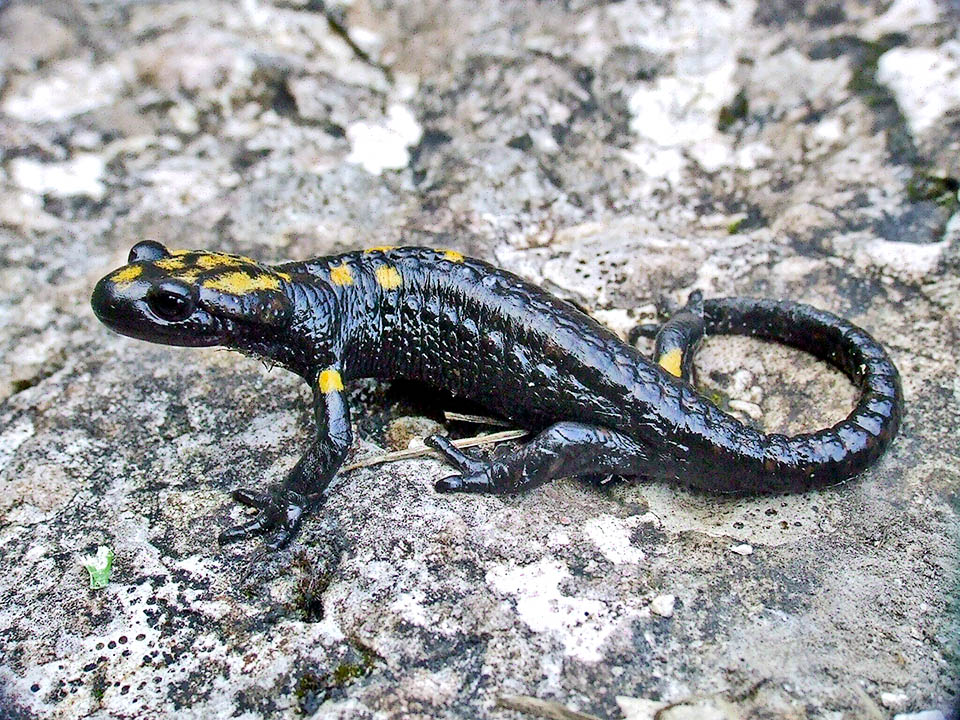
Salamandra atra pasubiensis, endemic to southern slope of Pasubio Massif, differs due to small isolated dots © Wouter Beukema
The tail is fairly short and laterally flattened and usually ends with a more or less marked tip. The most immediately recognizable characteristic of the nominal form is however the colouration. Salamandra atra atra is usually uniformly black on the back, whilst the ventral surface may display grey-dark shades. A striking exception is represented by the Golden Alpine salamander Salamandra atra aurorae, characterized by a pronounced dorsal yellow marbling, very variable in extension and intensity, from pale yellow to more lively shades.
Conversely, Salamandra atra pasubiensis presents an intermediate colouration: the yellow marks are usually more localized and interest mainly the head and the trunk, even if some individuals may aver almost completely black.
Sexual dimorphism is relatively inconspicuous. Usually the adult males are slightly smaller and less robust than females and can be recognized especially for the more swollen cloaca.
Ethology-Reproductive Biology
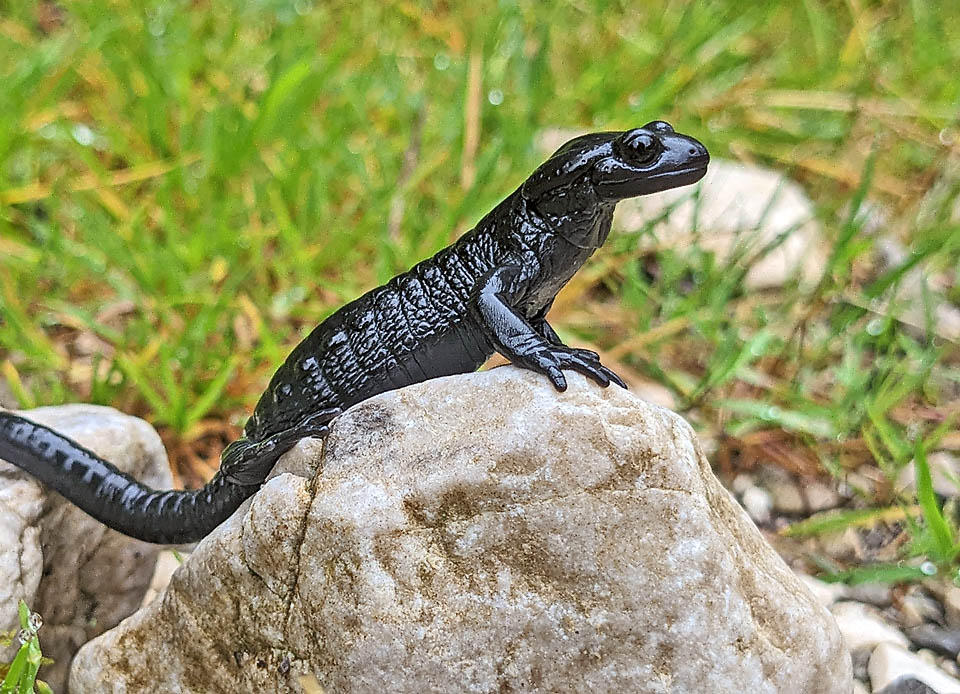
Salamandra alpina males control a territory where only females are allowed to enter © Norbert Lanzanasto
Salamandra atra is a generalist predator. Its diet includes mainly oligochaetes, gastropods, isopod crustaceans, diplopods, chilopoda, arachnids and several groups of insects and may vary depending on the local availability of the preys and on the characteristics of the habitat.
Like in other salamandrians, have been observed competitive behaviours and ritualized fightings between males, especially during the reproductive period. In fact, it is not rare to observe individuals placed over boulders or other raised supports, while controlling the territory, full-blown chases, and finally the fight.
The most extraordinary feature of the biology of Salamandra atra concerns the reproduction. The species is viviparous and completely independent from the aquatic environment. Mating occurs on land and the fecundation is internal. The male chases the female and gets under her body, grabbing its forelegs with its own ones. Then follows a courting phase and of stimulation characterized by movements of the body and repeated contacts between the snout of the male and the region of the throat of the female. Once courting over, the male lays on the ground one spermatophore. The female collects it through its cloaca, allowing the internal fecundation.
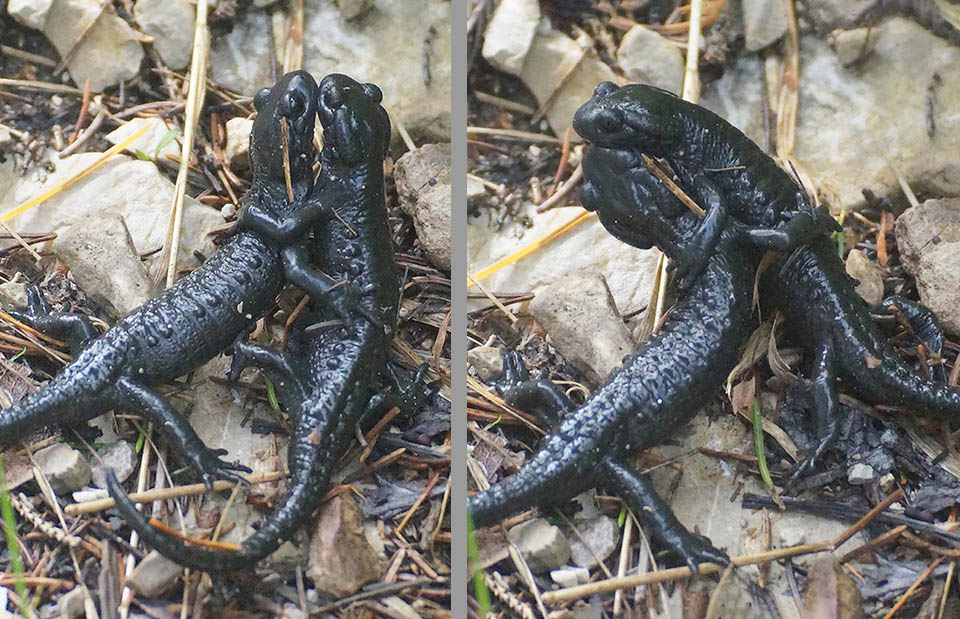
When they cross the line ritual fights are frequent, where winner’s strength prevails over intruder © redhat
The gestation is one of the most extraordinary phenomena known among the amphibians. The embryonic development occurs totally inside the maternal uterus and may last several years, with a duration strongly influenced by altitude and by the environmental conditions. The duration of the gestation is generally in the order of some years and can reach or exceed the four years in the high altitude populations.
During the long intrauterine development, the embryos get their nourishment through a particular system. After hatching from the egg membranes, they initially feed on the mass originated by the not fecundated decaying eggs (oofagia). Once this resource is finished, feeding continues through the ingestion of the epithelial cells produced by a specialized region of the uterine wall, called trophic zone (epitheliophagy). At the end of the gestation, which may last several years, the female delivers directly on the ground a very reduced number of young already completely metamorphosed, called also direct development larvae.
Newborns are already completely formed and are independent from the aquatic environment. They display body proportions different from those of the adult, with a relatively big and rounded head if compared with the trunk.
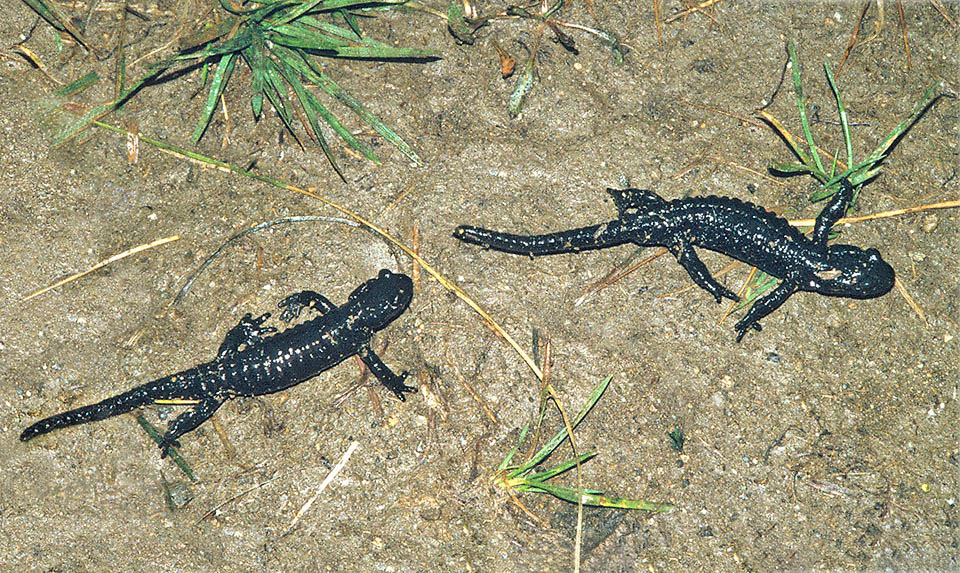
Male chases female for reproduction releasing on the ground the spermatophores with the gametes the partner sucks with the cloaca © Tuoichen
The viviparity and the intrauterine development represent some of the most important evolutionary adaptations of the species to the life in a mountain environment, where the availability of small ridges of water suitable for the reproduction may be strongly limited.
Sexual maturity is usually reached after some years of life, indicatively around 4-5 years, even if ages and dimensions at maturity may vary among populations. The growth is relatively slow and strictly conditioned by the temperature, the trophic availability and by the annual duration of the period of activity. Longevity may be remarkable for a small amphibian; in natural conditions have been reported individuals having reached at least about fifteen years.
The Alpine salamander locally can be abundant and is not globally considered as a species near to extinction. However, the range is strongly fragmented in several factors and some populations, especially those belonging to forms with extremely restricted distribution, present a much greater vulnerability. The alteration and the fragmentation of the habitat may reduce the connectivity between the populations. The limited dispersal capacity of the species in fact makes the natural recolonization of the habitats from where a population has disappeared difficult.
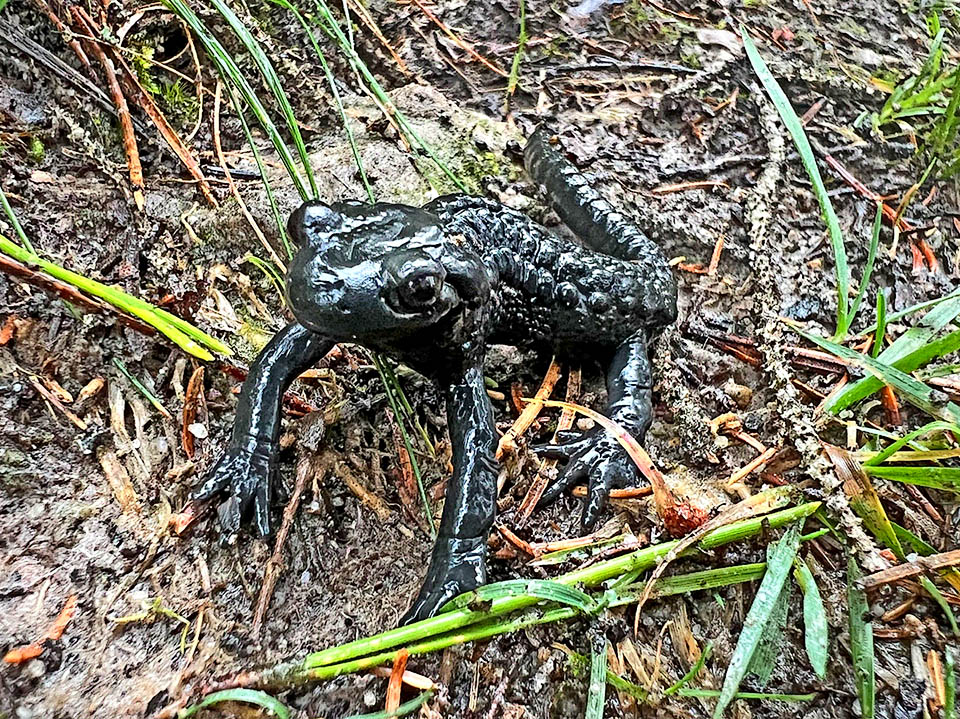
The babies are born already metamorphosed and independent, wholly released from the water environment © Claudia Pogoreutz
A further factor of growing interest is represented by climate change. The increase of temperatures, the bigger frequency of drought periods and the changes of the precipitation patterns may alter the microclimatic conditions necessary for the surface activity of the species.
For the taxa with extremely restricted distribution, like Salamandra atra aurorae and Salamandra atra pasubiensis, to the climate pressures we may add the fragmentation of the habitat and the vulnerability coming from the reduced dimensions of the ranges. Therefore, the conservation of the species requires not only the protection of the forest areas, but also the maintenance of the structure of the microhabitat, of the vegetation cover, of the shelters and of the ecological continuity within the populations. On a global scale, Salamandra atra is presently classified since 2023 as “LC, Least Concern” by the IUCN.
Synonyms
Salamandra fusca Laurenti, 1768; Lacerta atra Sturm, 1828; Triton fuscus Schinz, 1840; Salamandra nigra Gray, 1850; Salamandra alpestris Knauer, 1878.
→ For general notions about Caudata please click here.
→ To appreciate the biodiversity within the SALAMANDERS please click here.