
Family : Scorpaenidae

Text © Dr. Giuseppe Mazza

English translation by Mario Beltramini
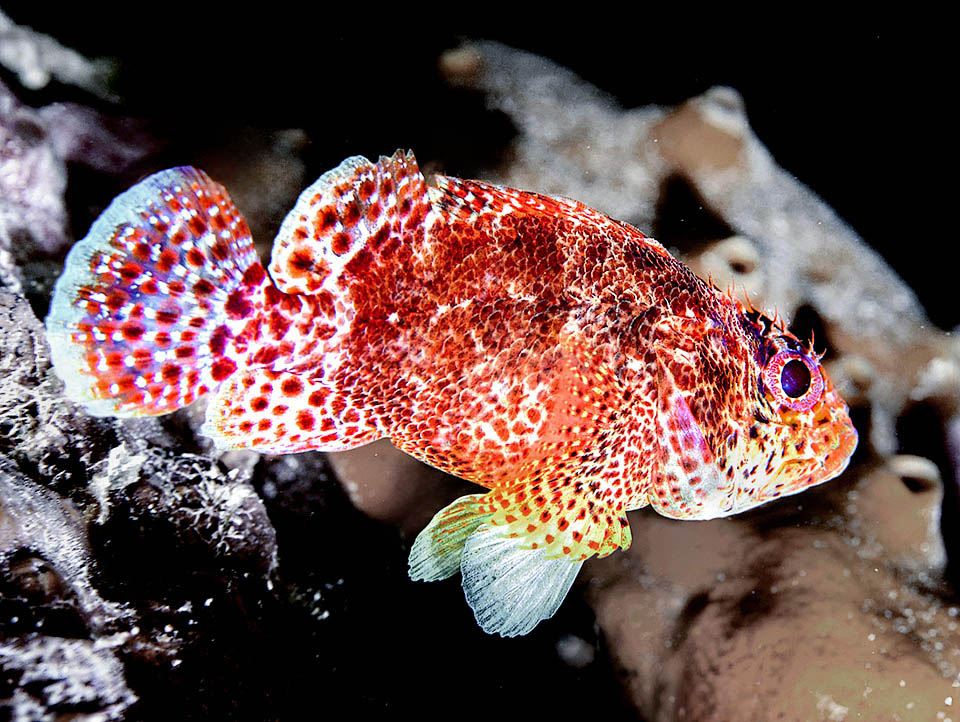
Rarely observed in open water, the Coral Scorpionfish (Scorpaenodes caribbaeus) has rounded fins that reinforce the camouflage provided by its cryptic coloration © www.carlosestape.photoshelter.com
Whilst the Mediterranean is dominated by scorpionfishes of the genus Scorpaena, including the giant Scorpaena scrofa, which may reach 50 cm in length and almost 3 kg in weight, the Caribbean also hosts members of the lesser-known genus Scorpaenodes. Among them is the colourful and highly variable Reef scorpionfish (Scorpaenodes caribbaeus Meek & Hildebrand, 1928), a modest-sized species that rarely exceeds 12 cm.
The ending “-oides”, meaning “similar to” in Greek, used by Bleeker in 1857, underlines the strong similarity of these genera, belonging to the order Scorpaeniformes and to the family Scorpaenidae, whilst the specific term caribbaeus, of the Caribbean in Latin, refers to the place where it lives.
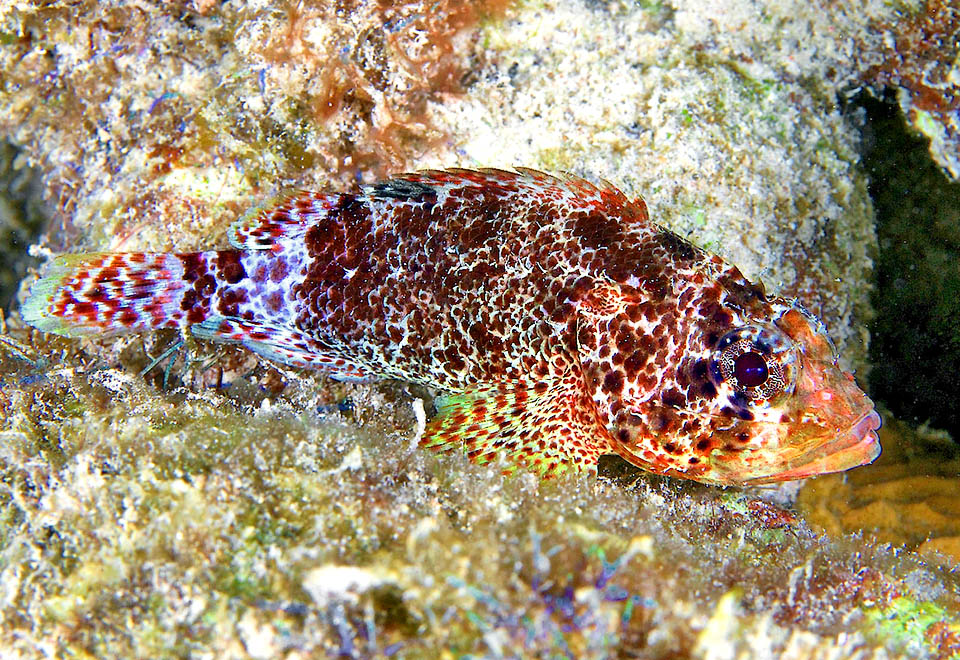
Like scorpionfishes of the genus Scorpaena, it occurs in the Caribbean. Barely a dozen centimeters long, it defends itself with spines and venomous dorsal-fin spines © www.carlosestape.photoshelter.com
Zoogeography
Scorpaenodes caribbaeus is a shy but common fish, found from Florida, the Bahamas and the Gulf of Mexico southward to Panama, the Antilles, Trinidad and Tobago, and the northern coast of South America.
Ecology-Habitat
It is a solitary nocturnal predator, present in waters with temperatures between 26,2 and 28,2 °C, that spends the hours of the day hidden in caves, rocky or madreporic ravines, between the surface and 35 m of depth, with occasional records from depths of about 70 m.
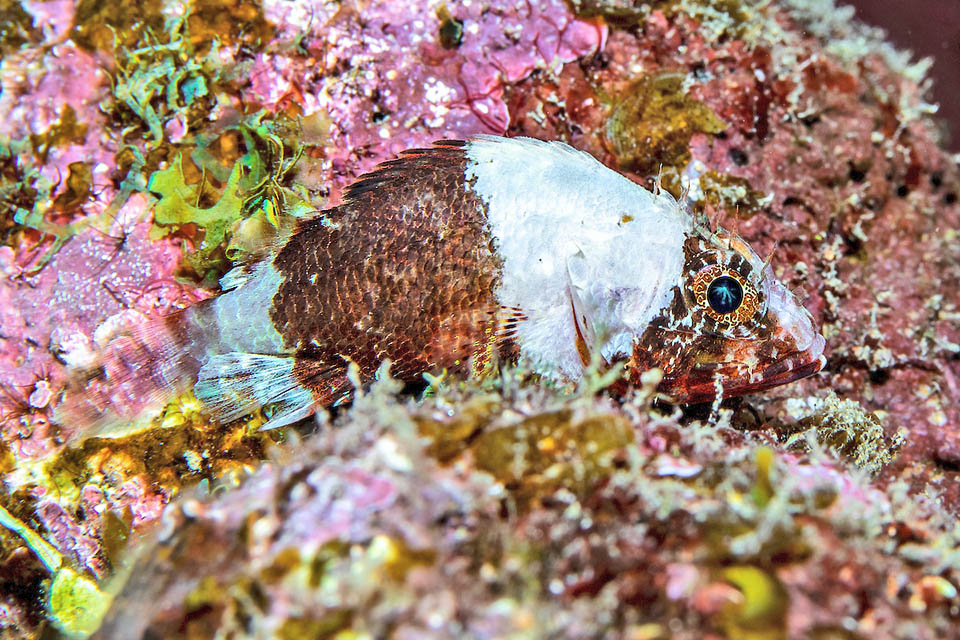
Acting on chromatophores, the pigments cells, it can change gaudily look to escape predators and surprise in dark the small prey it hunts in ambush © www.carlosestape.photoshelter.com
Morphophysiology
The body is relatively deep, with rough scales extending onto the bony head, which is protected by numerous spines.
The mouth is terminal, with the jaw protruding beyond the eye and teeth at the centre but not on the sides.
The dorsal fin has 13 spiny rays, associated with venom glands, and 9 soft rays; the anal 3 armed rays and 4-5 unarmed; the pectoral ones are ample with 18-20 rays longer at the center; the caudal, rounded, has at the base, above and below, some small spiny rays.
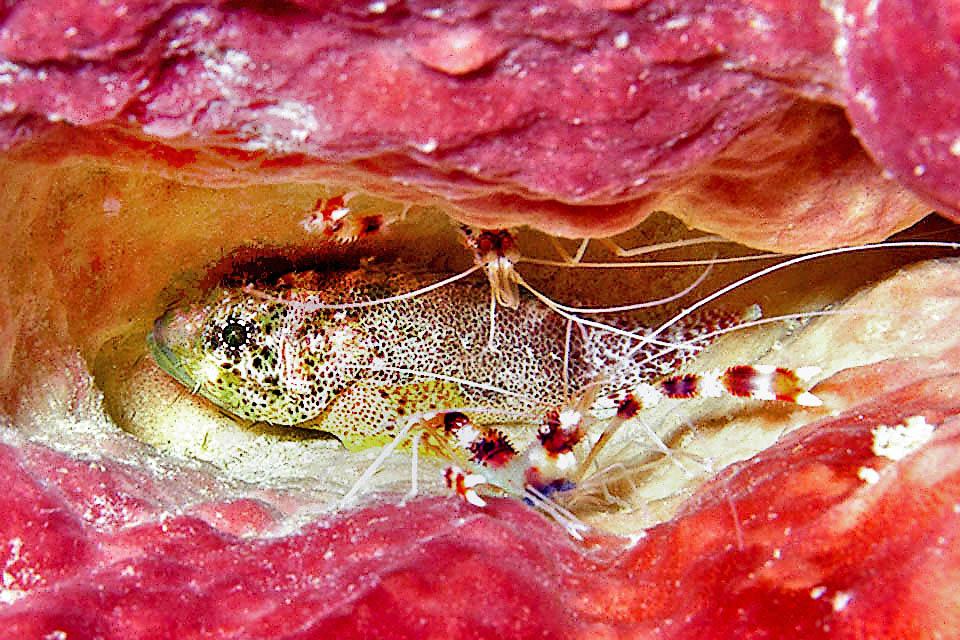
During the day it rests in rocky or madreporic ravines, here in the company of Cleaner shrimps (Stenopus hispidus) © www.carlosestape.photoshelter.com
The venom, present in many Scorpaeniformes and particularly powerful in the Reef stonefish (Synanceia verrucosa), is not used to attack but to defend itself. Scorpaenodes caribbaeus hunts by ambush, suddenly darting at small fishes, crustaceans and benthic molluscs.
The lateral line is complete, with 22–25 pored scales, and its coloration is extremely cryptic, so much so that divers, even when the fish is right before their eyes, often notice it only after carefully examining the photographs taken during the dive.
The colour is very variable due to the effect of the chromatophores, the cells containing the pigments. Overall, the fish appears dark brown or reddish, with black spots and often large white patches on the sides. The most conspicuous white patch lies just behind the eye, with another, often broken into streaks, near the caudal peduncle.
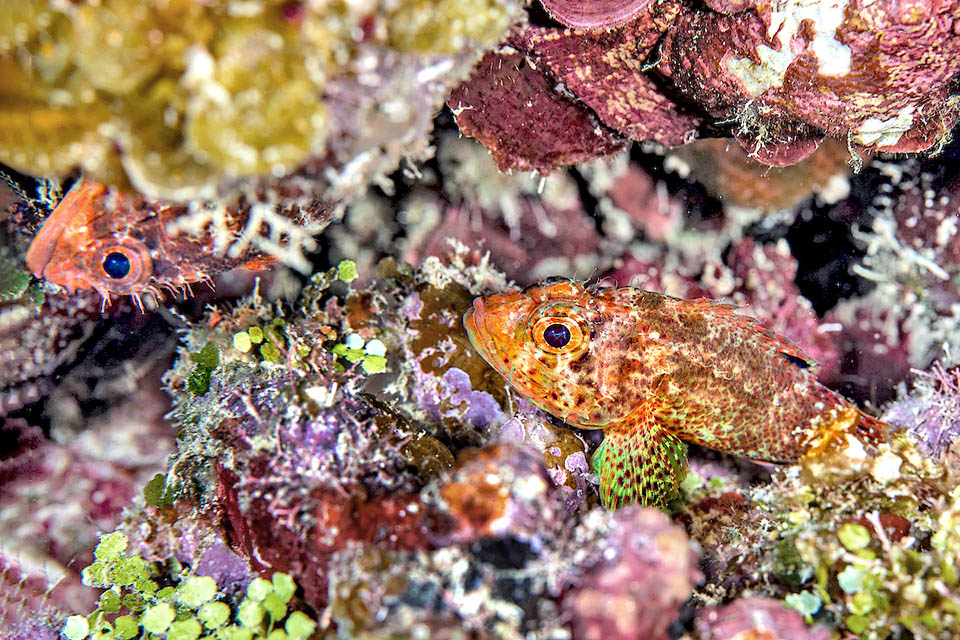
It lives solitary and may be seen in pairs only during the reproductive period. The females lay thousands of floating eggs © www.carlosestape.photoshelter.com
Ethology-Reproductive Biology
Scorpaenodes caribbaeus reproduces only when the temperature of the water increases, and this is the only moment when it can be found in pairs.
Females lay thousands of floating eggs fertilized externally by the male as they are released. They hatch after a couple of days and the fishlings grow up in surface waters up to about 25 mm.
The resilience of the species is high with a possible doubling of the populations in less than 15 months, and the fishing vulnerability, very low, marks only 10 on a scale of 100. Considering the vast area as well, Scorpaenodes caribbaeus is not therefore in danger and from 2015 appears as “LC, Least Concern” in the IUCN Red List of the endangered species.
→ For general information about FISH please click here.
→ For general information about BONY FISH please click here
→ For general information about CARTILAGINOUS FISH please click here.
→ To appreciate the BIODIVERSITY of BONY FISH please click here.
→ To appreciate the BIODIVERSITY of CARTILAGINOUS FISH please click here.