
Family : Tincidae

Text © Dr. Giuseppe Mazza

English translation by Mario Beltramini
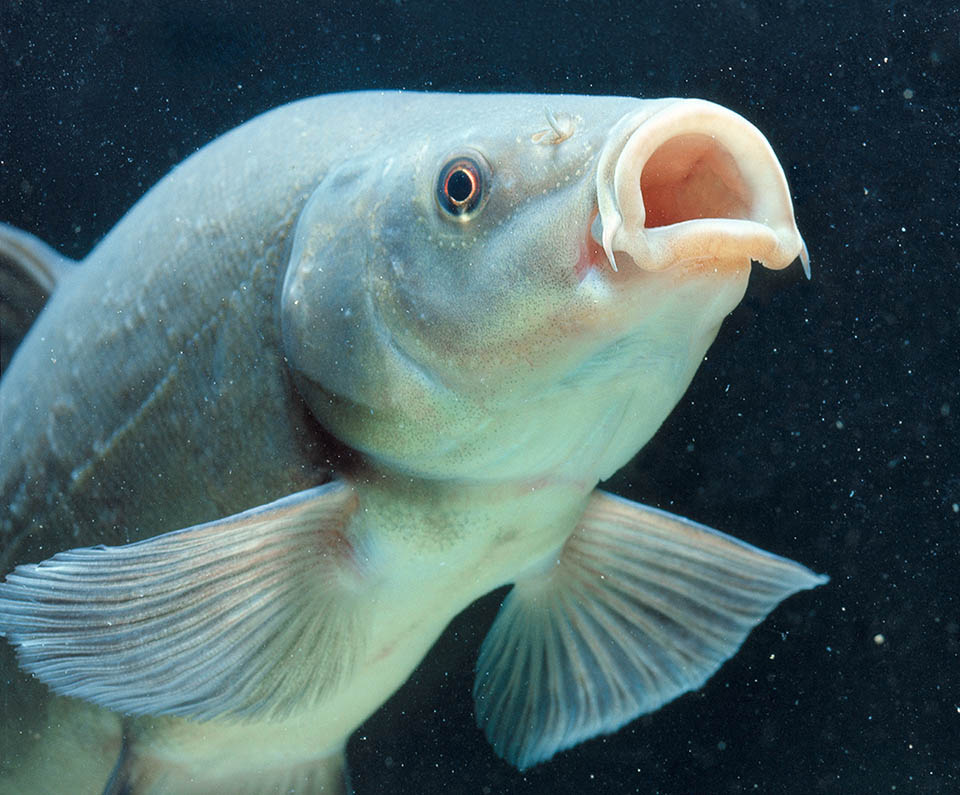
Common in slow water streams, rich in plants or muddy bottoms, the Tench (Tinca tinca) copes better than other fishes high temperatures and oxygen scarcity © G. Mazza
The Tench Tinca tinca (Linnaeus, 1758) can live twenty years, and may be more. A surprising longevity for a fish leading a quiet life, between the vegetation of the calm waters and the muddy bottoms.
It’s a robust fish, able to cope with high temperatures and conditions of poor oxygenation that would put in a difficult position many other species. Growing slowly, it can remain for a long time in the same environment, where it finds most of its food on the bottom.
Once inserted in the Cyprinidae, the Trench belongs to the order of the Cypriniformes and to the family of the
Tincidae, created by David Starr Jordan in 1878. An uncommon family, as it nowadays includes only one genus and only one species: Tinca tinca.
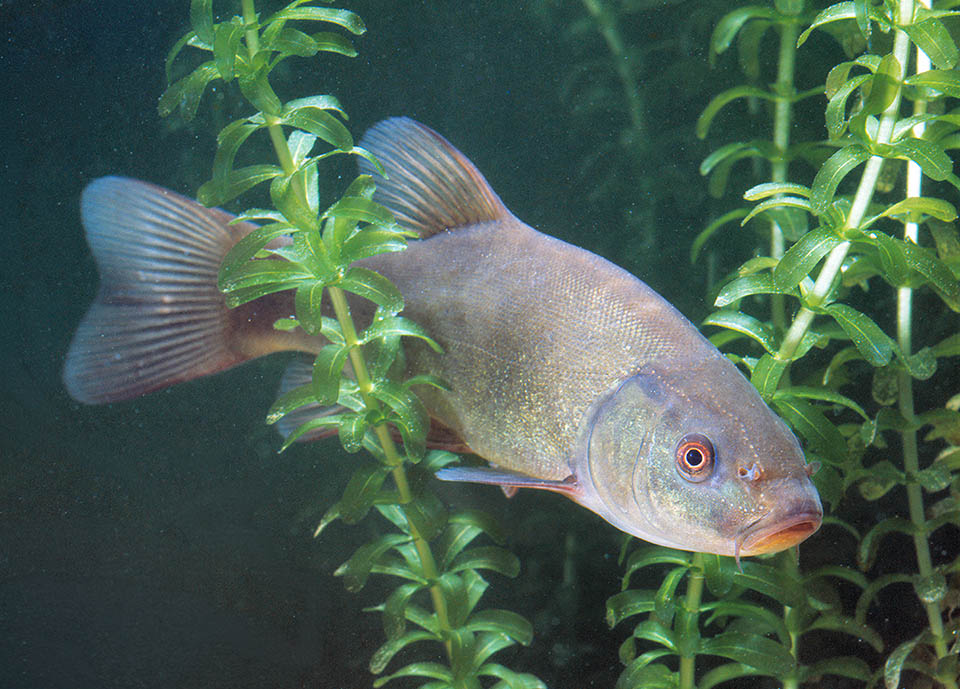
Its growth is slow, but may exceed 20 years of life, often spent in the same place it perfectly knows, thanks to barbels and cephalic sensory pores © Giuseppe Mazza
The generic name Tinca comes from the old Latin denomination of the fish; and also the epithet tinca shares the same origin.
Zoogeography
Tinca tinca is native to most of Europe and to some western Asia regions. Its natural range includes mainly the slow-flowing fresh waters of central and eastern Europe, spreading eastwards up to Asian areas. Over time it has been introduced in several regions outside its native range, especially due to the interest linked to fishing and the fish farming.
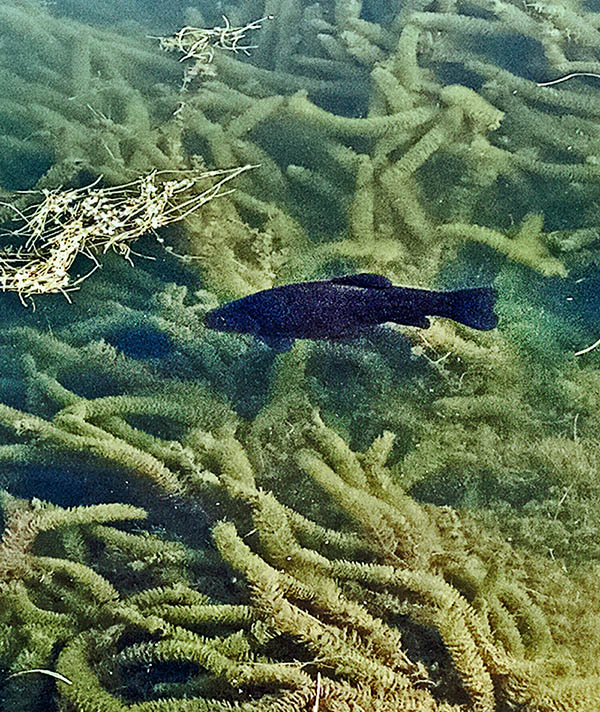
Here on a stretch of Elodea densa, also called Egeria densa, where larvae get shelter and food © Régis Guillemin
Therefore presently can be met also in environments where its presence is due to human intervention.
Usually it loves the calm or slow-moving waters: lakes, ponds, oxbows, canals and calm stretches of watercourses.
The most favourable environments are those rich in aquatic vegetation, where it finds shelter and food and where it completes most of its vital cycle.
Ecology-Habitat
Tinca tinca spends a lot of time close to the bottom, exploring the substratum looking for small organisms.
The protractile mouth allows it to collect especially invertebrates and larvae, but also plant material and other available resources.
Its connection with the soft seabeds is particularly cler: the sediment can form a real and entire pantry, rich in small organisms it detects and collects while looking for food.
The aquatic vegetation covers in turn an important function.
Among the stems the Tench finds shelter and, especially at the beginning of its life, a greater protection against the predators.
The calm and rich in plants waters form consequently one of the most typical environments of the species.
To this capacity of exploiting environments rich in vegetation we have to add a remarkable tolerance to the low concentrations of oxygen. During the hottest periods of the year, when the water may get particularly poor in oxygen, the Tench is able to stand conditions that are difficult for many other fishes.
Morphophysiology
Sturdy and compact, Tinca tinca usually measures 20 cm, but can attain the length of 70 cm with a weight of about 7,5 kg. The body is covered by small scales deeply inserted into the skin.
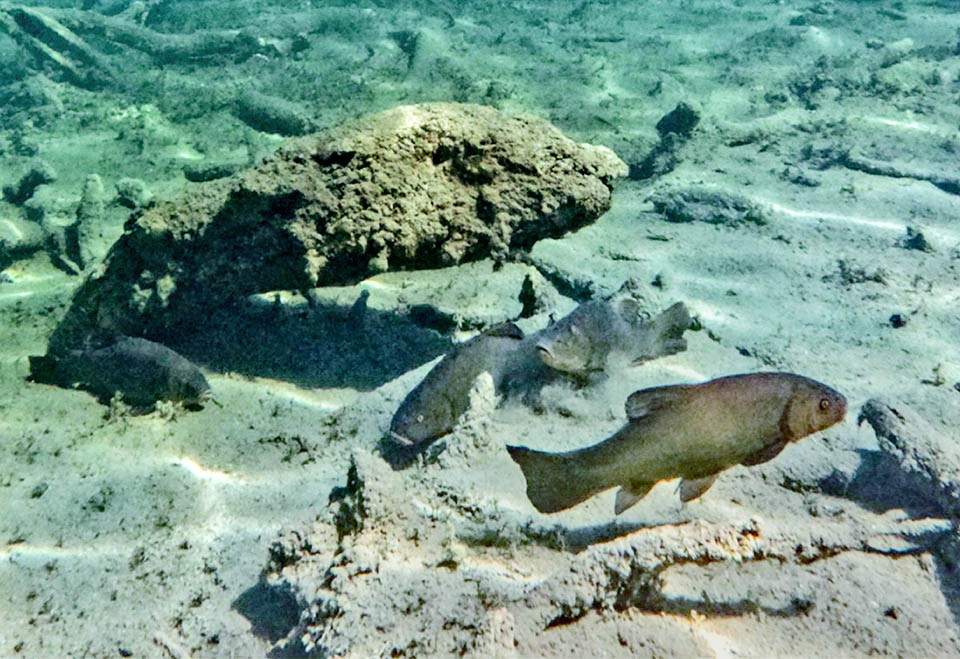
Small group on sediments seabed, rich in small organisms the Tench finds and collects during its food searching © Harry Meyer
The lateral line, formed by scales deeply embedded in the skin, runs along the sides and forms an important part of the sensory system of the species. On the head, the system of the lateral line continues through a net of cephalic sensory canals recognizable externally due to a series of small pores arranged especially around the eye and along the snout up to the mouth region. These structures allow to perceive vibrations and variations of the water movements of the water in the surrounding environment.
The colouration is generally greenish or olive-brown, darker on the back and paler towards the belly, with shades that may vary depending on the environment.
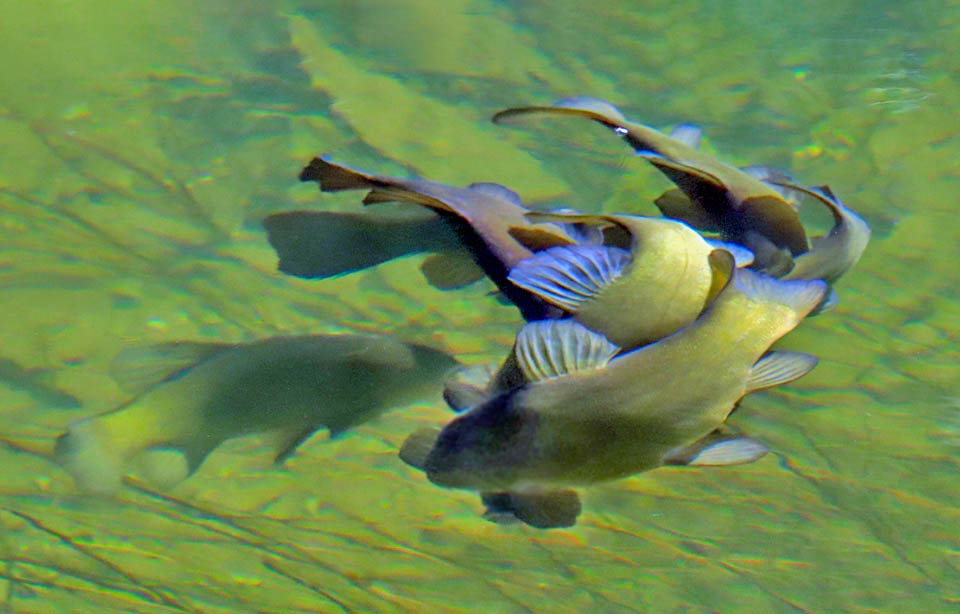
Tinca tinca life is poorly gregarious, but in the reproduction time fecundation often occurs mid-water, with more males compete to fertilize eggs © Harry Meyer
One of its most evident features is the abundant protective mucus that reduces the friction with the water.
The rounded fins contribute to the compact appearance of the species. The caudal, relatively little engraved, is consistent with the life in calm and rich in vegetation locations it frequents.
The mouth, protractile and slightly turned downwards, is particularly suitable for searching for food. On the sides are present two small barbels, sensory structures that contribute in the exploration of the environment and in the localization of the prey. Like in the other Cypriniformes, the teeth are not placed in the mouth, but in the pharyngeal region where the grinding of food before the deglutition takes place.
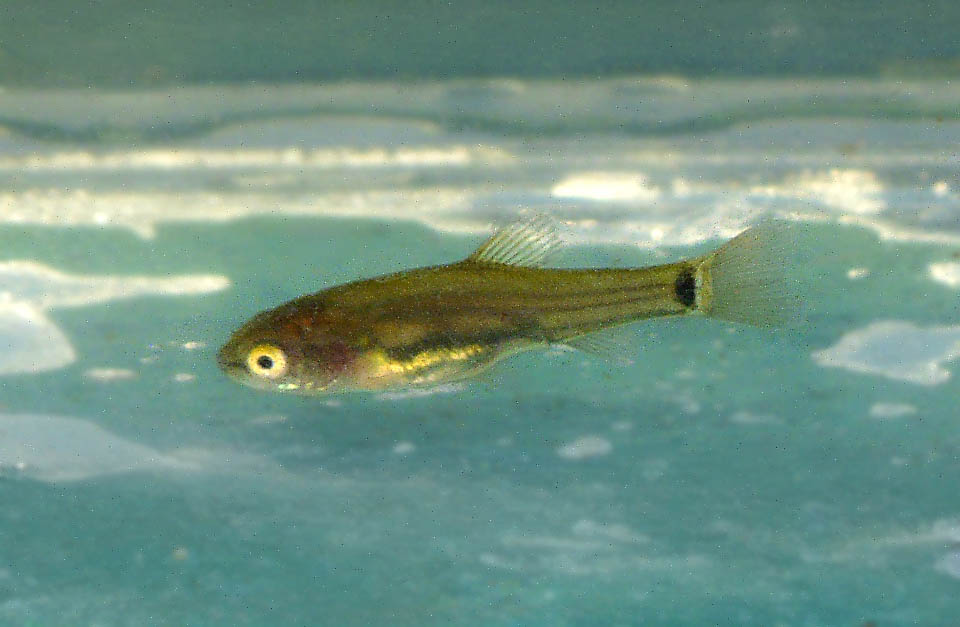
Juveniles grow up very slowly often sharing the environment with the previous generations © age02
Ethology-Reproductive Biology
Tinca tinca carries on a usually calm and little gregarious life. However, during the reproductive season, the behaviour changes and numerous individuals may gather in the areas suitable for the deposition.
Reproduction occurs in the warmest months, when the temperature of the water favours the maturation of the gonads and the development of the eggs. These are released in great quantity and the fecundation often takes place mid-water, with several males competing to fertilize them while falling on the grassy seabed.
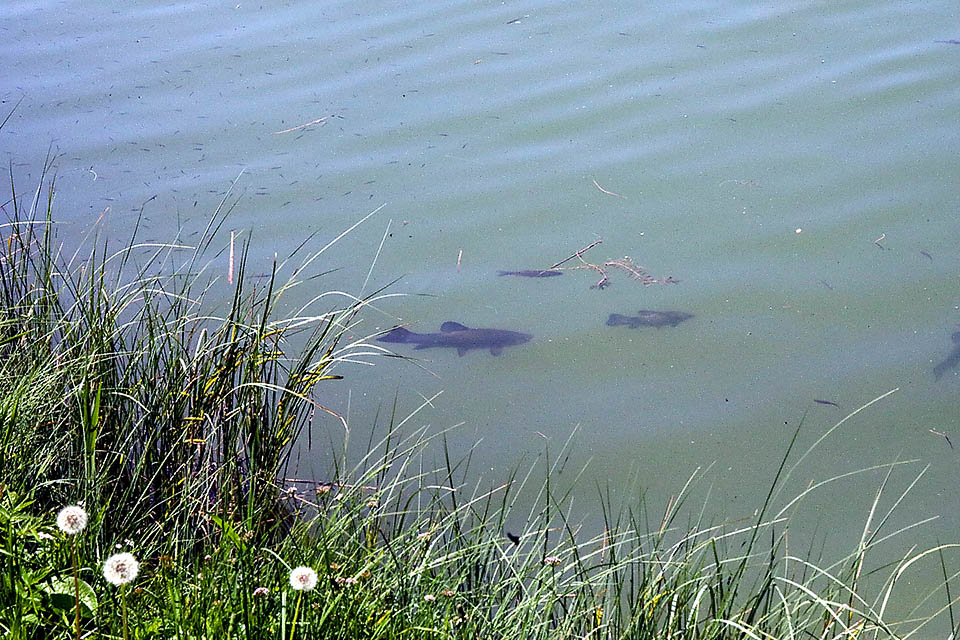
Adults, juveniles and dense group of very young on the surface. Delicate moment because several predators look at them © Sepp Schmid
From the eggs hatch very small larvae, that during the first phases of life keep associate to the plants. While growing they progressively get the look of the adult and become increasingly autonomous. The young thus often share the environment with already older individuals, creating a continuous presence of different generations. In fact the growth is very slow and this explains the longevity of the species.
Tinca tinca is part of the food web and may become prey, especially when young, of bigger fishes, and also the adults are often preyed upon by birds linked to the aquatic environments. Herons, grebes and birds of prey remind us that also a robust and long-living species occupies a precise level in the trophic web.
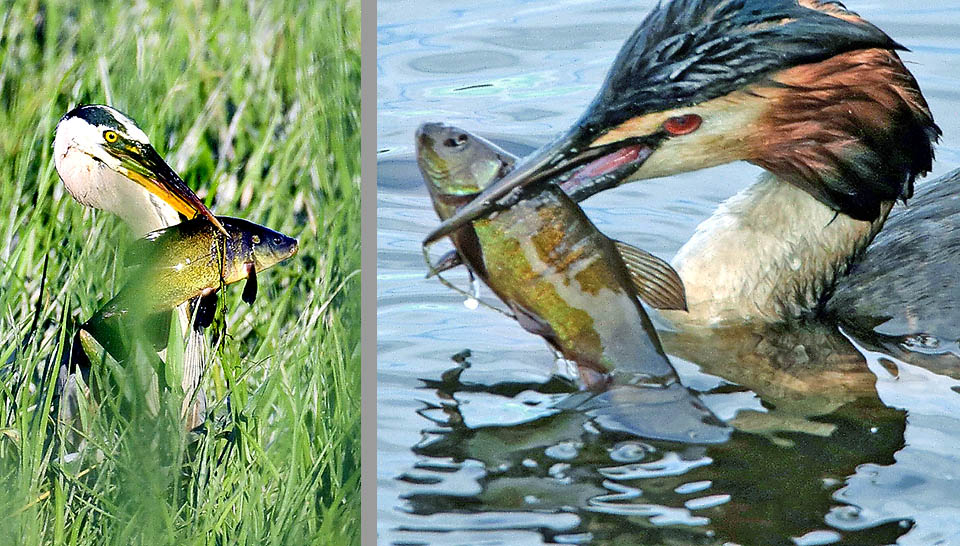
Herons and grebes are frequent perils and cormorans and otters attack them underwater and in the sky fly raptors like osprey. Left, Ardea alba © Tristan Jobin and right Podiceps cristatus © Sofia Voynovskaya
Resilience is mediocre, with a possible doubling of the populations in 1,4-4,4 years and the fishing vulnerability, relatively high, marks 58 on a scale of 100. Even if in some locations the populations are decreasing, considering the vast diffusion, Tinca tinca appears from 2022 “LC, Least Concern”, in the IUCNlist of the endangered species.
Synonyms
Cyprinus tinca Linnaeus, 1758; Cyprinus tincaauratus Bloch, 1782; Cyprinus zeelt Lacepède, 1803; Cyprinus tincaurea Shaw, 1804; Tinca vulgaris Fleming, 1828; Tinca chrysitis Fitzinger, 1832; Tinca italica Bonaparte, 1836; Tinca vulgaris maculata Costa, 1838; Tinca communis Swainson, 1839; Tinca limosa Koch, 1840; Tinca linnei Malm, 1877; Tinca vulgaris cestellae Segre, 1904.
→ For general information about FISH please click here.
→ For general information about BONY FISH please click here
→ For general information about CARTILAGINOUS FISH please click here.
→ To appreciate the BIODIVERSITY of BONY FISH please click here.
→ To appreciate the BIODIVERSITY of CARTILAGINOUS FISH please click here.