
Family : Gobiidae

Text © Dr. Giuseppe Mazza

English translation by Mario Beltramini
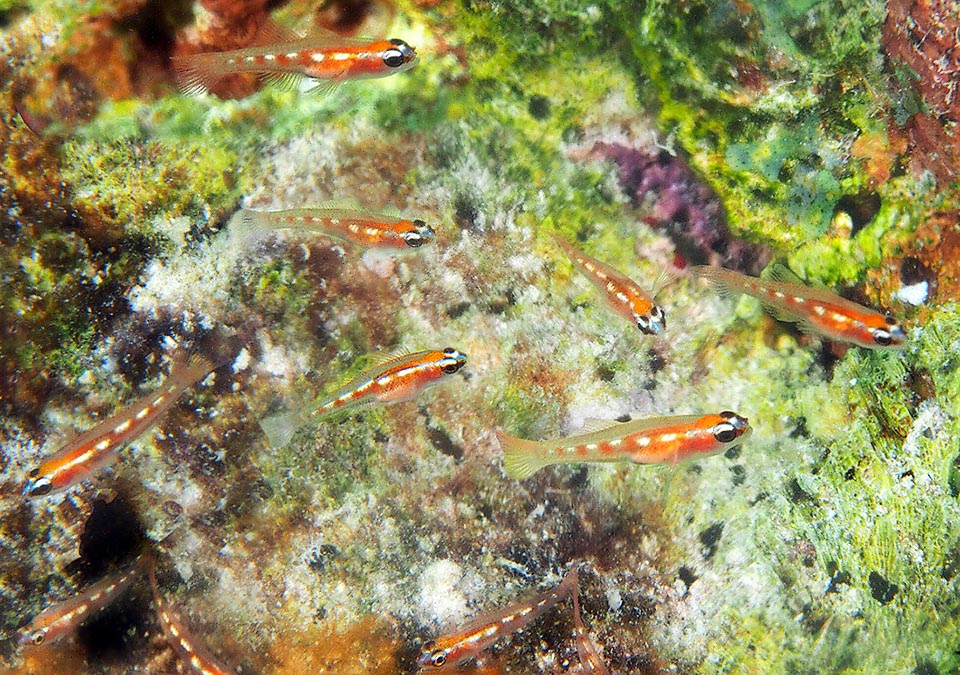
The Glass goby (Coryphopterus hyalinus) is an about 2,5 cm tiny Caribbean fish, swimming in small schools at 50 cm from seabeds © Dennis Rabeling
About 2,5 cm long and a record at 4 cm, the Glass goby, Coryphopterus hyalinus Böhlke & Robins, 1962, taxonomically inserted in the Actinopterygii and in the Gobiiformes is one of the smallest membres of the family of the Gobiidae which counts more than 2000 of them.
It competes in this record with the Yellow clown goby (Gobiodon okinawae) less than 3,5 cm long, and also stands out in the world of fishes as has an adult life shorter than the larval, unique case in the current knowledge.
As a matter of fact, when the young adults reach the bottoms, they are much more preyed upon than the larvae in the open sea and can survive usually only a couple of months.
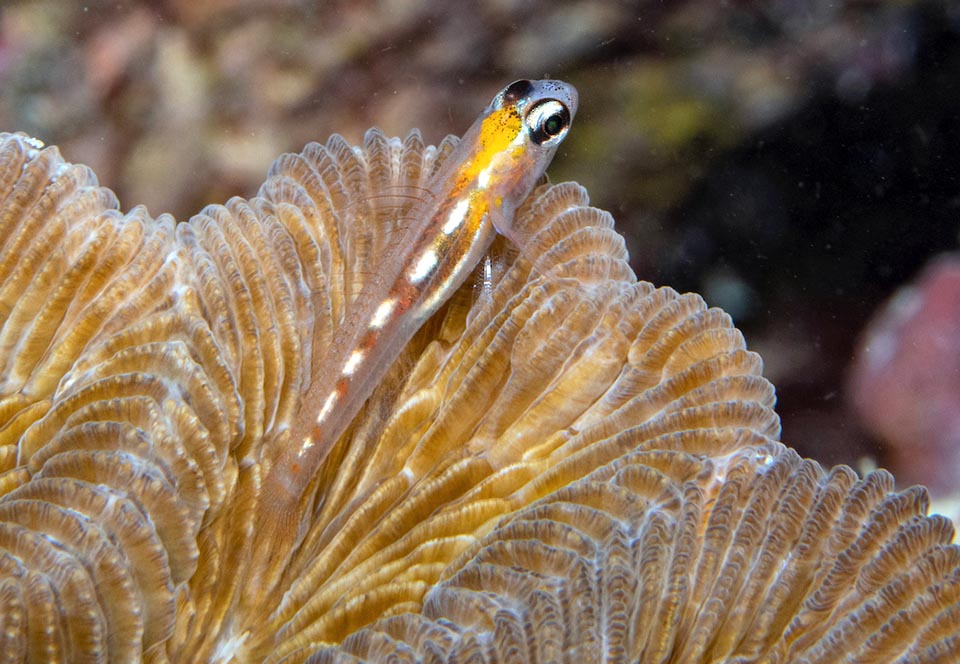
The diaphanous body, with mimetic drawings, protects from predators when staying on the bottom, but when swims is an easy target and adults rarely exceed 2 months © www.carlosestape.photoshelter.com
The term Coryphopterus, created by Gill in 1863 for the description of Coryphopterus glaucofraenum, originates from the Greek “corypho”, summit, and “pterus”, fin, with reference to the dorsal rays of that species; whilst hyalinus, from the Greek “hyalinos”, glass, is a clear allusion to the transparency of the Glass goby.
Zoogeography
Coryphopterus hyalinus is present in the tropical waters of western Atlantic, from Bermuda and the Bahamas up to the Gulf of Mexico, the northern Yucatan, Cuba, Cayman Islands and French Antilles up to Trinidad and Tobago.
Ecology-Habitat
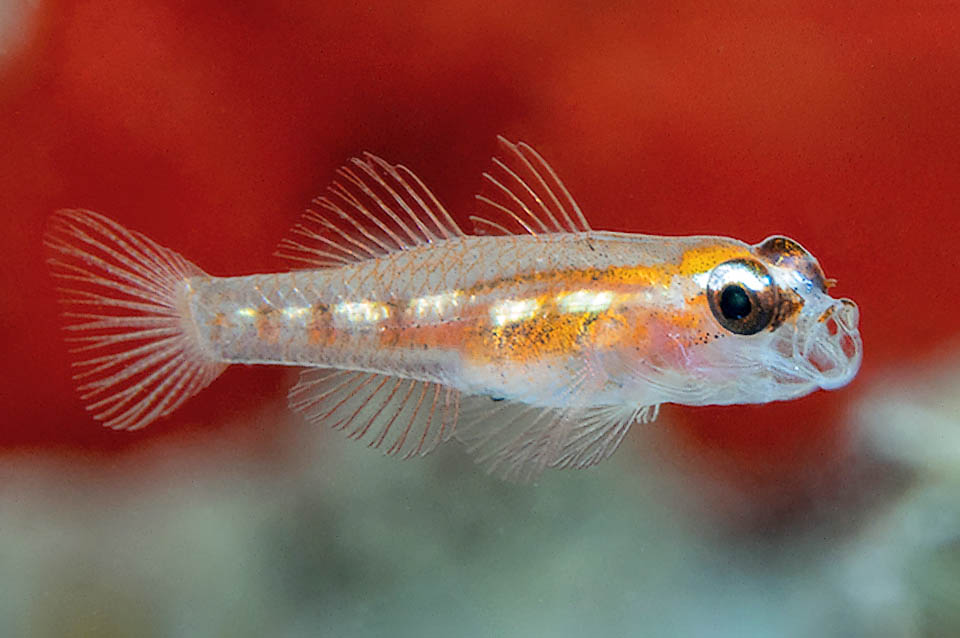
It feeds only on plankton it fastly seizes with its small horizontally protruding mouth © www.carlosestape.photoshelter.com
It lives in small schools swilling over the madreporic formations, at about 50 cm from the substratum, up to 8 and 52 m of depth, often mixed with those of Coryphopterus personatus, a slightly larger species, indistinguishable in nature, usually present between 3 and 10 m, characterized by a mask on the head and a slight dark stripe on the lower edge of the body towards the tail.
On the other hand, Coryphopterus hyalinus displays a dark cross-hatching on the margin of the scales and countless black small dots.
Morphophysiology
The Glass goby, protected by big rough scales absent on the head, has no lateral line.
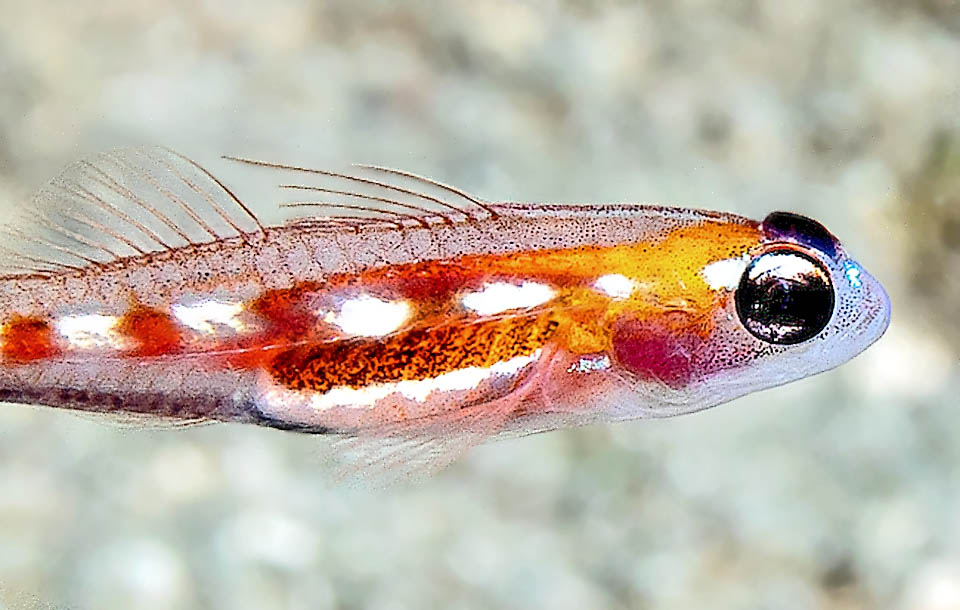
It often lives mixed with Coryphopterus personatus, almost similar species, but recognizable from the dark hatching on the edge of the scales and countless dark small dots © www.carlosestape.photoshelter.com
On the snout, with slightly rounded profile, we note two small pores between the fore part of the large eyes, 1 central pore just behind and two more between the rear nostrils with a simple hole, whilst the fore ones are tubular.
There are two dorsal fins. The first, with 6 hard rays, and the second with one spiny ray and 9 soft.
The anal has 1 hard ray and 9 unarmed. The pectoral ones 14-15 rays and the pelvic, usually separated by a reduced fore membrane, 1 hard ray and 5 soft ramified at the apex, as well as all unarmed rays and the caudal.
The translucent livery has on the sides, more or less orange, 6-7 clear spots aligned.
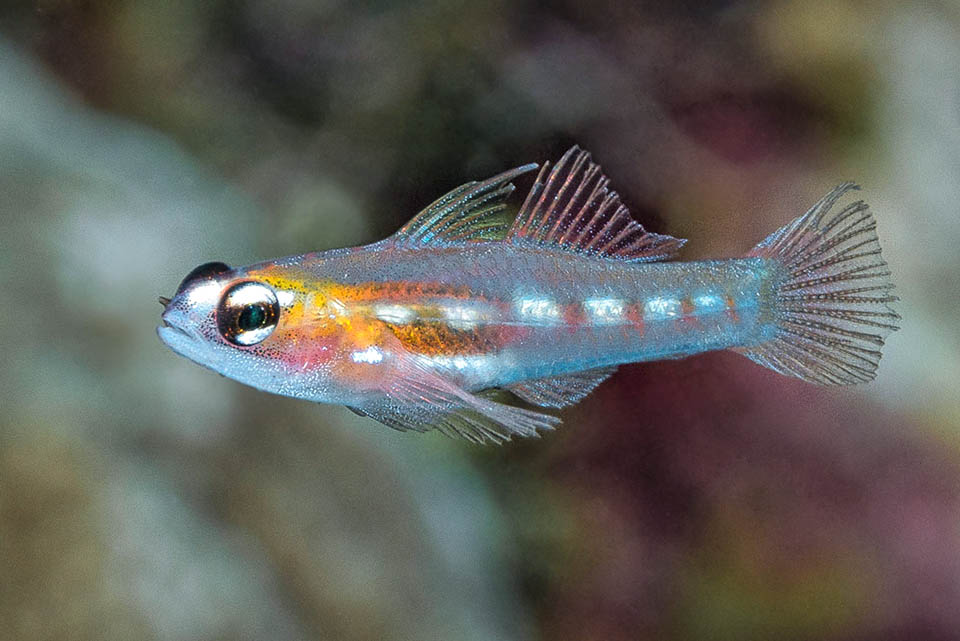
Couples form for reproduction. Small adhesive eggs are laid into a nest on the seabed and the male protects them until hatching © François Libert
Ethology-Reproductive Biology
Coryphopterus hyalinus feeds exclusively only on plankton, which grabs quickly with its small mouth protruding horizontally.
It is a sequential protogynous hermaphroditic species, that is with females that, while growing, may transform into males.
Couples take form, and the tiny adhesive eggs are laid on the seabed, usually in small depressions on corals or rocks that escape the gaze of the predators.
The males protect the nest as best they can, ventilating it until hatching that occurs after about three days with the birth of planktonic larvae.
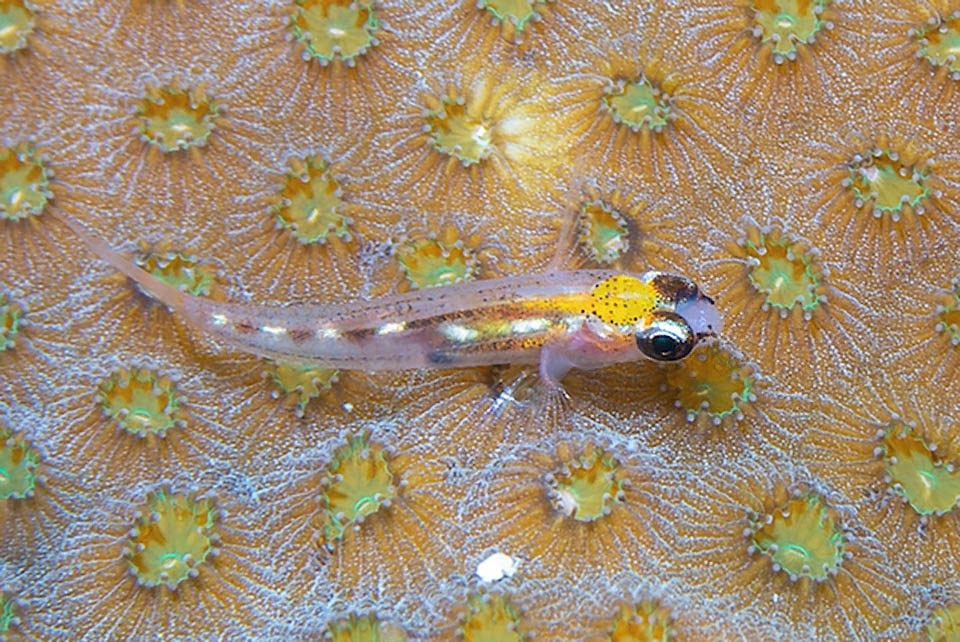
Coryphopterus hyalinus now appears as vulnerable in the IUCN Red List. Its environment is disappearing due to death of the corals and is preyed upon by Pterois volitans © www.carlosestape.photoshelter.com
The high resilience displays a minimum time for doubling the populations of less than 15 months, and even if the Glass goby is at times caught for home aquaria, the fishing vulnerability, very low, marks only 10 on a scale of 100.
From 2011 Coryphopterus hyalinus however appears as “VU, Vulnerable” in the IUCN Red List of the endangered species.
In fact, in addition to the environment degradation with the death of the madrepores, which between 1970 and 2011 have lost 59% of their number due to the pollution of the coasts and global warming, the Glass goby is an easy prey of Pterois volitans, the voracious Red lionfish carelessly introduced in Florida, who feeds mostly on small fish smaller than 15 cm.
In the Bahamas has already devoured 65% of this biomass and it is estimated that in the next decade it could reduce by more than 30% the populations of the Glass goby.
→ For general information about FISH please click here.
→ For general information about BONY FISH please click here
→ For general information about CARTILAGINOUS FISH please click here.
→ To appreciate the BIODIVERSITY of BONY FISH please click here.
→ To appreciate the BIODIVERSITY of CARTILAGINOUS FISH please click here.