
Family : Orchidaceae

Text © Prof. Pietro Pavone

English translation by Mario Beltramini
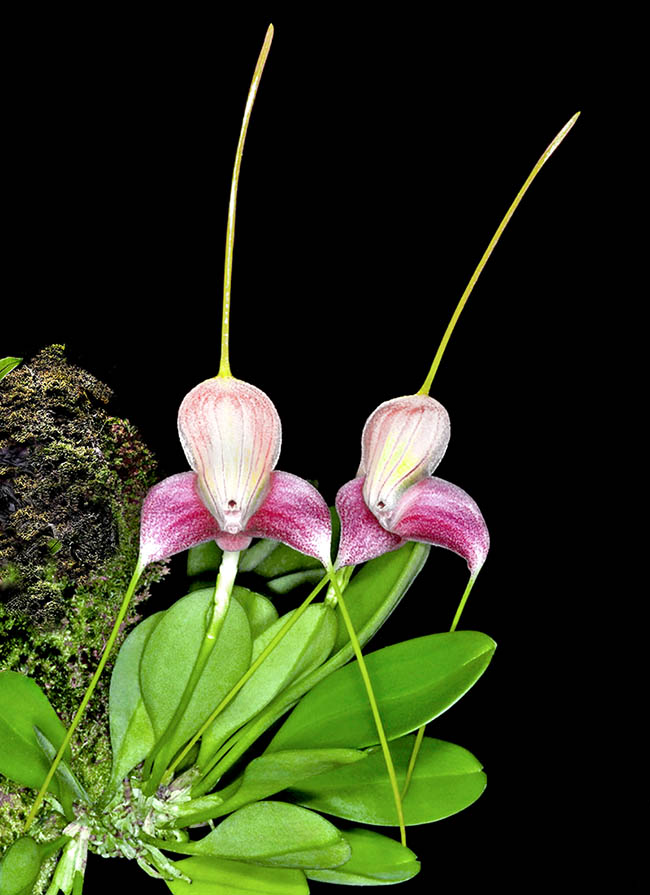
Masdevallia caudata is an orchid native to Colombia and western Venezuela humid nebular forests © Ron Parsons
Masdevallia caudata Lindl. belongs to the family Orchidaceae, subfamily Epidendroideae tribe Epidendreae, subtribe Pleurothallidinae, subgenus Masdevallia, section Masdevallia, subsection Caudatae.
The species has been described byJohn Lindley (1799-1865) English botanist and horticulturist famous for having described thousands of species and more than 120 genera. He has been professor at the University College London (UCL) and has published fundamental works for the plant taxonomy like The Vegetable Kingdom in 1846 and Sertum orchidaceum work subdivided in ten parts between 1838 and 1841.
Lindley has described this species in 1833 in Genera and Species of Orchidaceous Plants, London (Gen. Sp. Orchid. Pl. 193, 1833).
Masdevallia caudata is native to Colombia and to western Venezuela in the nebular forests at altitudes between 1800 and 3300 metres.
The name of the genus is in honour of José Masdevall Terrades, famous Spanish physician, botanist and scientist, an important figure in Spanish healthcare of the second half of the XVIII century.
The specific epithet comes from the Latin term “caudatus” (having tail) that in turn comes from cauda (tail) due to the long filiform appendages of the sepals that characterize the flower of this orchid.
The common name is “Masdevallia with long sepals”. In Colombia it is called “Colibri” due to the resemblance of the flowers to the small hummingbirds.
Masdevallia caudata is an epiphytic, caespitose, plant, up to 10 cm tall, with thin roots and ramified roots. It has erect and slender, 1-3 cm long, ramicauls that get out from the base of the plant wrapped at the base by 2 or 3 tubular sheaths. Every ramicaul bears one single apical leaf. The leaves are erect, coriaceous, elliptic, subacute to obtuse, 5-10 x 1-2 cm, with a petiole below. The inflorescence generates from the lower part of the ramicaul and is formed by one solitary, showy, flower, 8-1 cm tall with erect peduncle, 6-8 cm long. The ovary is white with small dark dots, 8 mm long.
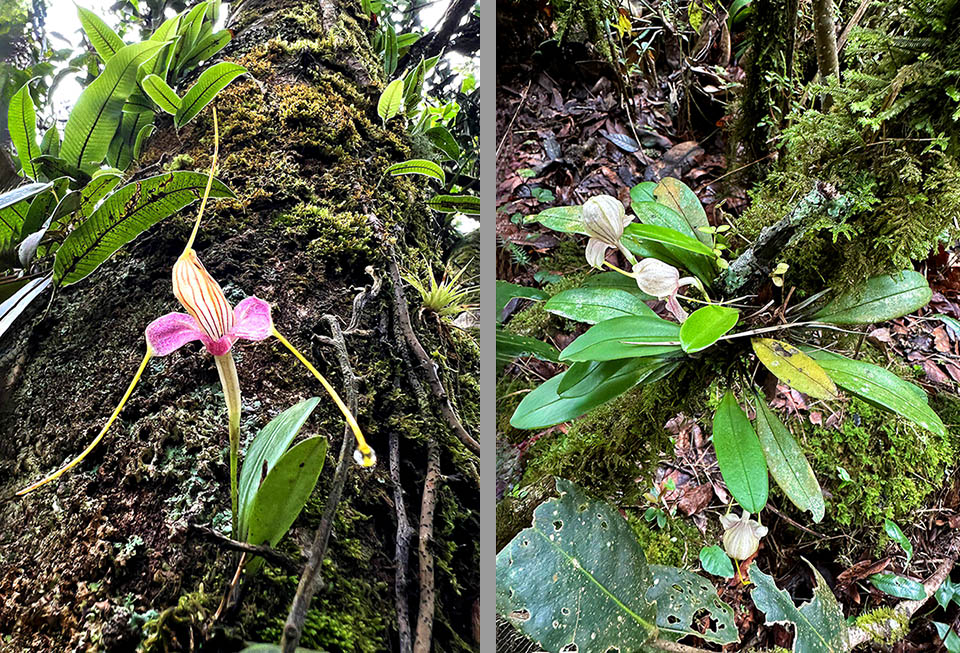
Epiphyte or terricolous with cespitose posture, it grows at 1800-3300 m of altitude reaching the height of 10 cm with erect, coriaceous, elliptic, subacute to obtuse leaves © Nicolás Baresch Uribe
The sepals are erect, contracted in thin tails, yellow, long 6,5-7 cm . The dorsal sepal is yellowish, concave and striped with seven to nine purple-brown lines. It has toothed margins, 27-30 x 17-20 mm, connate to the lateral sepals forming a little deep and open cup and with rounded apex. The lateral sepals are dotted with purple, ovate, oblique, 18-20 x 16-19 mm, connate per 5-8 mm to form a deep mentum under the foot of the column and they too with a long and thin yellow tail.
The petals are white, sub oblong, 5-5,5 x 2,5-2,5 mm, with truncated, tridentated apex.
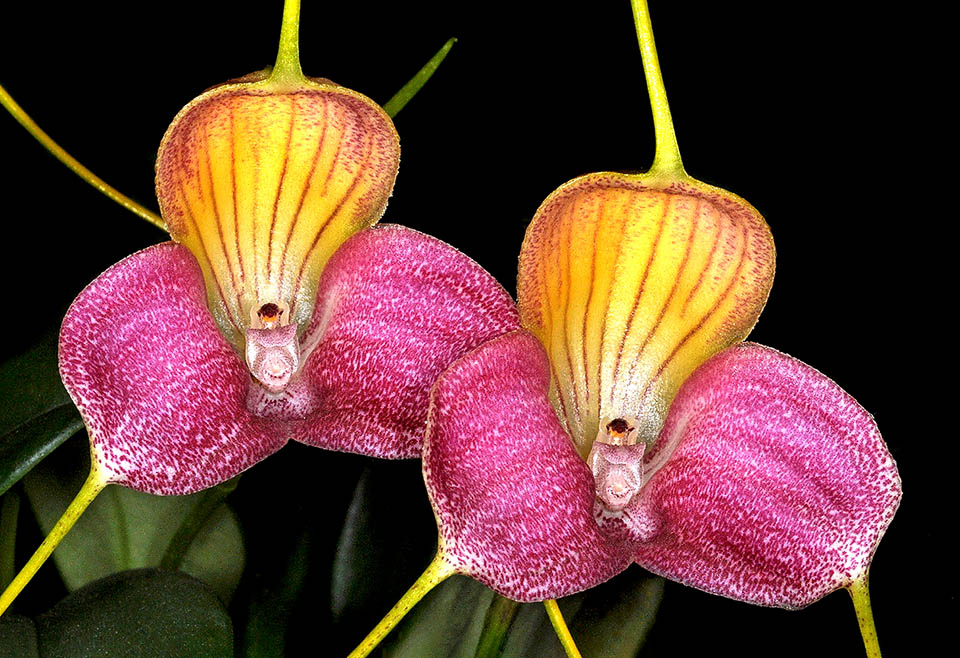
Cultivated, requires filtered light and high humidity with good airing. Having no pseudobulbs it cannot store water and the substratum must be humid without stagnations © Ron Parsons
The labellum is white and dotted with purple, elliptic-oblong, reflexed over the middle, 5,5 x 2,8 mm with rounded apex and with the disk having a pair of low and longitudinal calli and one single central callus distant from the apical margin. The column is white, white purple dots in the margins, 5,5 mm long. The anther has a reddish cap, 1,5 x 1 mm. The pollinia are two, yellow, 1 mm long.
Masdevallia caudata is one of the most spectacular and sought after species of the genus Masdevallia due to its coloured flowers with the characteristic long tails. It is included into the Appendix II of CITES that regulates its international trade in order to prevent overexploitation.
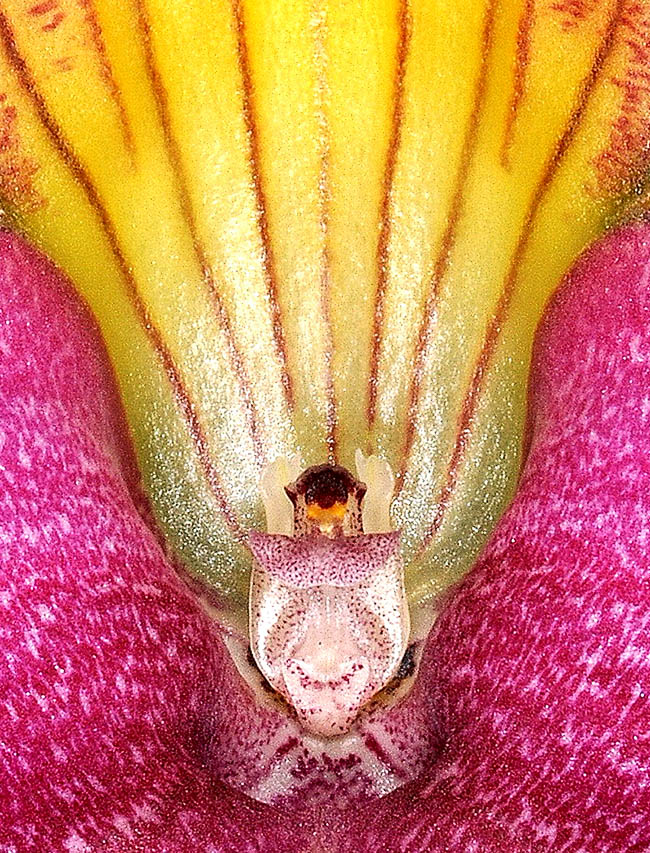
The white labellum, dotted with purple, is folded over middle. At the top you can see two petals with a truncated tridentate tip and an anther with a reddish cap. The pollinia are two, yellow, and 1 mm long © Ron Parsons
At the moment it is not included in the IUCN Red List of endangered species to establish conservation status at global level despite that several specialized studies consider this species to be in danger of extinction (EN).
Masdevallia caudata is an orchid sought after by the collectors because of its spectacular flowers with the long “tails”. It is a cold greenhouse plant because it loves cool temperatures and constant humidity.
The ideal temperatures stand between 12 °C and 18 °C but may tolerate up to 22-24 °C, whilst suffering with temperatures equal or over 25 °C.
It requires filtered light (12.000 – 20.000 lux). The direct sun burns the leaves rapidly. It needs a high environmental humidity between 60% and 80% and good ventilation to prevent rot in such humid conditions.
It may be cultivated in small plastic pots or in small baskets to favour root aeration. The most suitable substrate is the pure sphagnum or a mix of bark and perlite that holds the humidity even if guaranteeing the drainage. The substratum must remain constantly humid, but with stagnation.
As this species has no pseudobulbs for storing water, the substratum must never be completely dry. The rain or demineralized water is the best. For good growth, to the irrigation water can be added a balanced fertilizer for orchids in very diluted doses every two waterings during the growth period. The plant is to be repotted every 1-2 years, in early spring, before the substrate deteriorates too much.
Synonyms: Masdevallia caudata var. gudotii Rchb.f. 1889; Masdevallia caudata var. shuttleworthii (Rchb.f.) Rchb.f. 1889; Masdevallia caudata var. xanthocorys (Rchb.f.) A.H.Kent 1889; Masdevallia caudata f. xanthocorys (Rchb.f.) O.Gruss & M.Wolff 2007; Masdevallia cucutillensis Kraenzl. 1922; Masdevallia expansa Rchb.f. 1878; Masdevallia shuttleworthii Rchb.f. 1875; Masdevallia shuttleworthii var. xanthocorys Rchb.f. 1882; Masdevallia tricolor Rchb.f. 1850.