
Family : Pomacentridae

Text © Dr. Giuseppe Mazza

English translation by Mario Beltramini
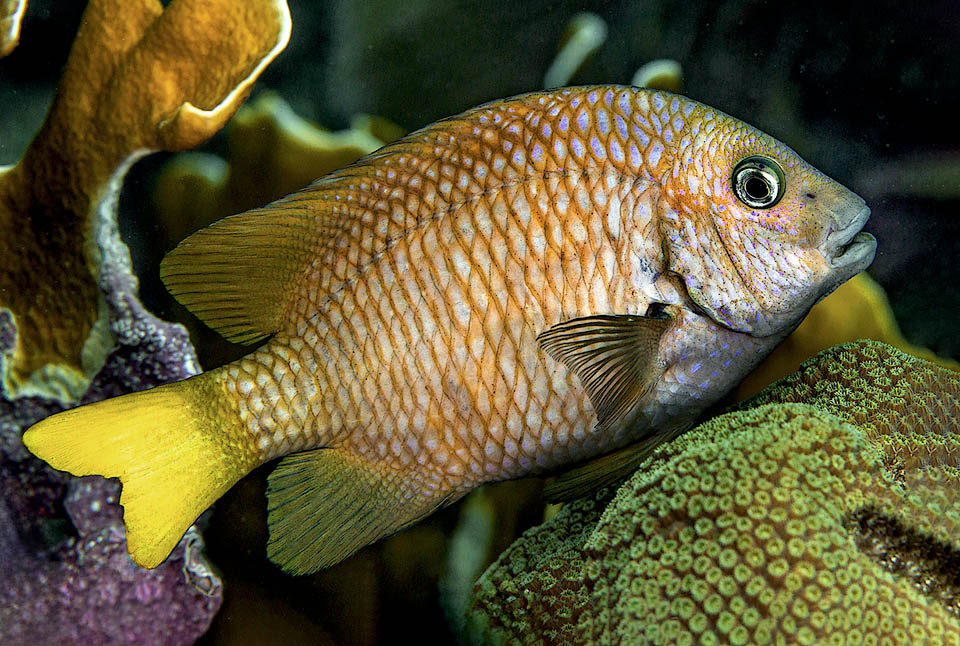
Microspathodon chrysurus is frequent from Florida and Bermuda to Mexico, Central America, Cuba and Antilles, and then, after a discontinuity, in Brazil up to Rio de Janeiro © www.carlosestape.photoshelter.com
The Yellowtail damselfish, Microspathodon chrysurus (Cuvier, 1830), belongs to the class of the Actinopterygii, the ray-finned fish, to the order of the Perciformes and to the family of the Pomacentridae, from the Greek “Poma”, operculum, and “centron”, spine, due to the presence of a characteristic spine on the gill operculum.
It is that of the damselfish and of the clownfish living in symbiosis with the anemonefish, like Amphiprion bicinctus or Amphiprion ocellaris, the famous protagonist of the animated movie “Nemo”. This is a quite colourful family counting about thirty genera and almost 400 species mainly present in the tropical seas, with the rare exceptions like Chromis chromis, the Clown anemonefish.
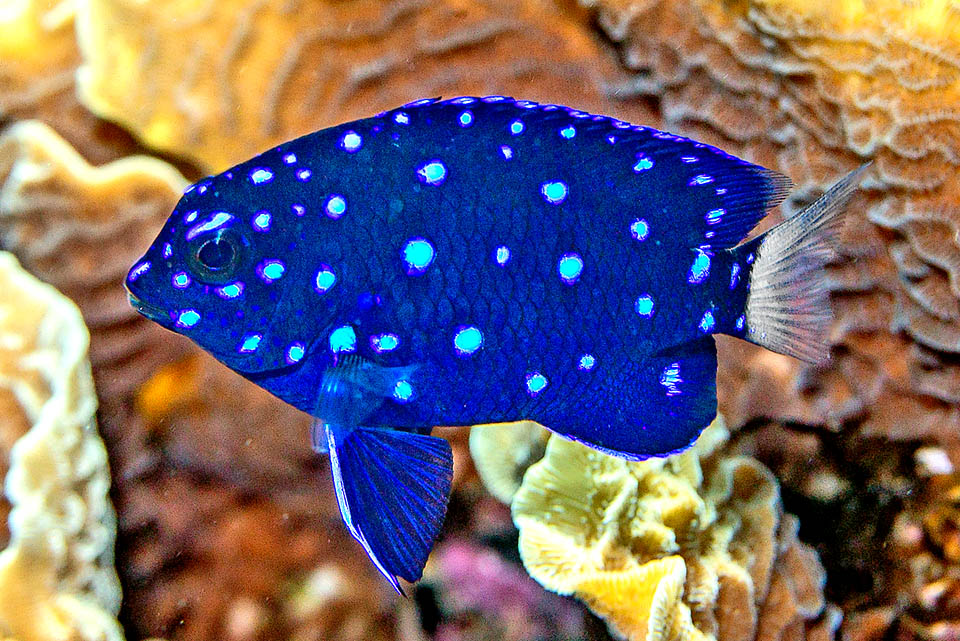
Juveniles has a fully different livery, dark blue with bright electric blue spots, so much that researchers thought it was matter of two different species © www.carlosestape.photoshelter.com
The scientific terms of the Yellowtail damselfish originate both formed by the Greek: Microspathodon, from “micro”, small, “spáthē”, sword, and “odon”, tooth, with allusion to the small teeth, and chrysurus from “chryso”, gold, and “oura”, tail, with reference to the yellow tail of the adults.
Zoogeography
Microspathodon chrysurus is frequent in the Caribbean, from southern Florida and Bermuda up to Mexico, Central America, Cuba and Antilles.
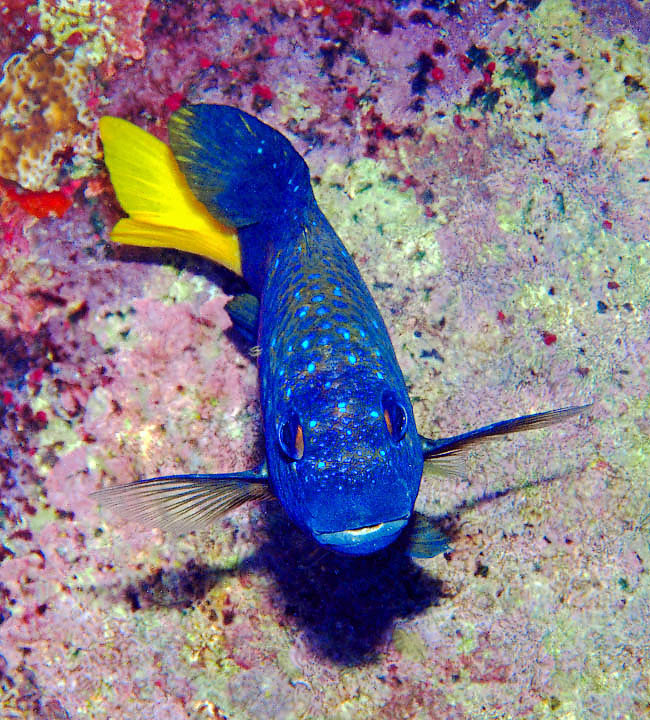
Then, growing, spots on the sides fade and appears the typical yellow tail that has given name to the species © Pauline Walsh Jacobson
Then, after a discontinuity zone between Venezuela and the Amazon basin, is found along the coasts of Brazil, up to Rio de Janeiro.
Ecology-Habitat
It is a territorial fish common in the ravines on the outer side of the reefs, mainly present in shallow waters up to 12 m of depth with a preference for the temperatures included between 26,1 and 28,2 °C, but it can exceptionally move up to 120 m.
Especially when young, we find it often among the ramifications of the Net fire coral (Millepora dichotoma Forskål, 1775) a hydrozoan that releases after having been touched, causing severe burning, toxins similar to those of the jellyfish to which the fish is immune.
Morphophysiology
Microspathodon chrysurus may reach the length of 21 cm, but the current length is about 15.
The body, partially scaleless, is tall and compressed on the sides.
The 20-22 scales lateral line is incomplete and ends under the extremity of the dorsal fin.
The head has a small protractile mouth, with a thick row of brush-like teeth on the upper jaw, and one row of robust incisors on the inferior.
There is one dorsal fin with 12 spiny rays and 14-15 soft; the analhas 2 spiny rays and 12-13 unarmed; the pectoral ones 20-22 rays; the caudal fin is blunt and forked, yellow in the adults and transparent in the juveniles. These have a completely different livery, so much so that the researchers thought that they were two different species. Whilst in the adults the brown colour predominates, the young are in fact dark blue with bright electric blue spots on the sides that fade as they grow.
Ethology-Reproductive Biology
Microspathodon chrysurus is omnivorous with a changing diet according to the age.
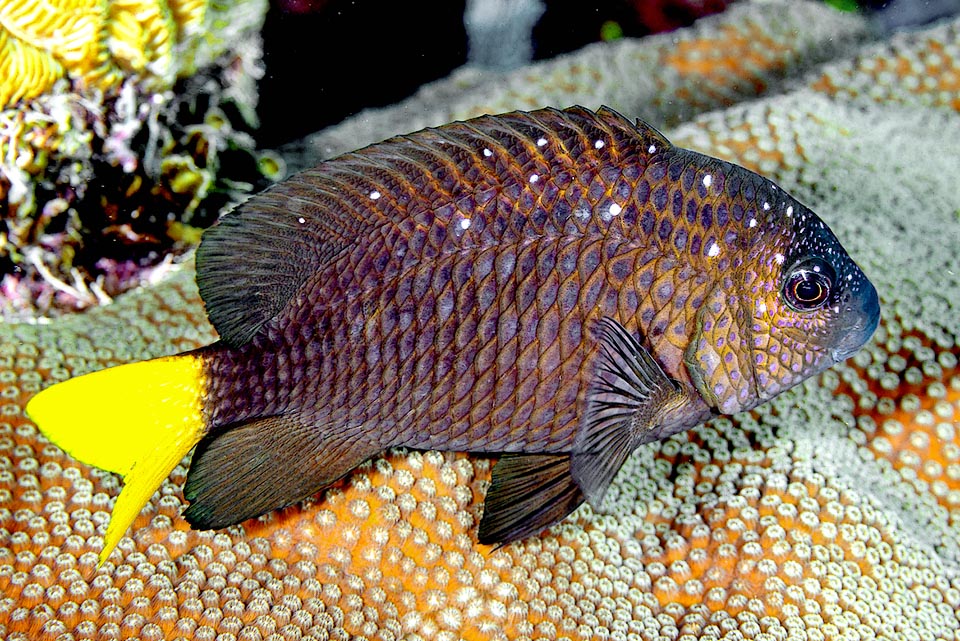
The adults mainly eat cyanobacteria, once called blue algae, and the young feed on the polyps of the Net fire coral, devouring stinging capsules and symbiont algae © www.carlosestape.photoshelter.com
The adults feed mostly on cyanophytes, once known as blue algae and nowadays more properly called cyanobacteria. The young, carnivorous, after having removed parasites in the cleaning stations, attack the Net fire coral, taking off the stinging capsules, called nematocysts, and the symbiotic microalgae, known as zooxanthellae.
For reproduction the males clean up at dawn a plot of dead coral where the female glues the eggs. A sort of nest surveyed and aerated by the male until hatching that occurs after 6 days of incubation. However it has been noted that every now and then the male suddenly devours the whole offspring, a strange brood cannibalism, more frequent in the small litters. Maybe it thinks that it is not worth the effort and that it is better and that it is worth eating to start again with a bigger nest.
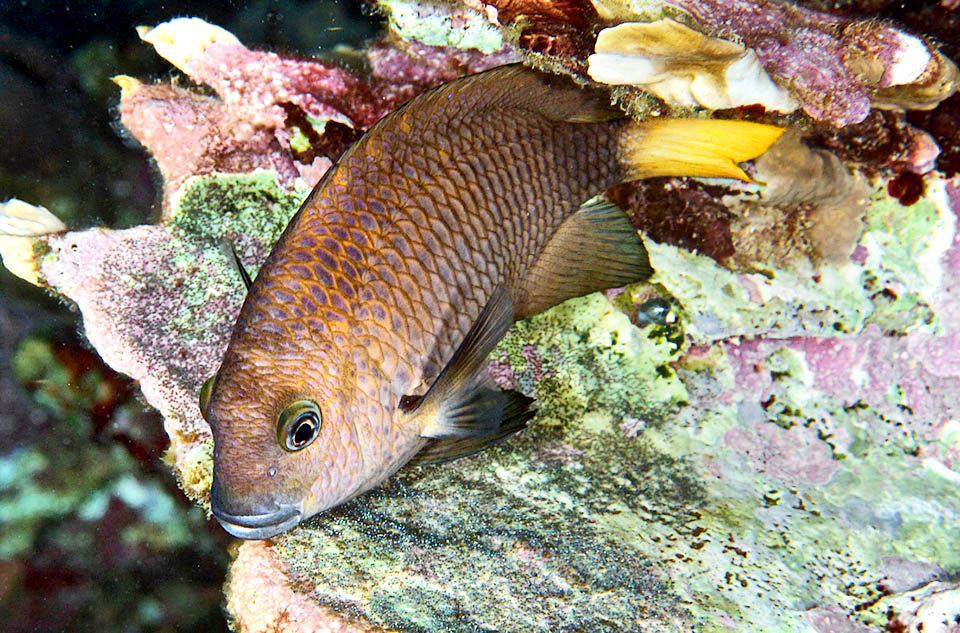
Males clean up at dawn a plot of dead coral, a sort of nest where the female will glue the eggs. Microspathodon chrysurus is not an endangered species © www.carlosestape.photoshelter.com
The resilience of Microspathodon chrysurus is mediocre, with a possible doubling of the populations in 1,4-4,4 years, and the fishing vulnerability, low, marks only 11 on a scale of 100. From 2015 therefore it appears as “LC, Least Concern”, in the IUCN Red List of the endangered species.
Synonyms
Glyphisodon chrysurus Cuvier, 1830; Glyphidodon rudis Poey, 1860; Pomacentrus denegatus Poey, 1860: Pomacentrus niveatus Poey, 1876.
→ Para obtener información general sobre los PECES, haga clic aquí.
→ For general information about FISH please click here.
→ For general information about BONY FISH please click here
→ For general information about CARTILAGINOUS FISH please click here.
→ To appreciate the BIODIVERSITY of BONY FISH please click here.
→ To appreciate the BIODIVERSITY of CARTILAGINOUS FISH please click here.