
Family : Chaetodontidae

Text © Dr. Giuseppe Mazza

English translation by Mario Beltramini
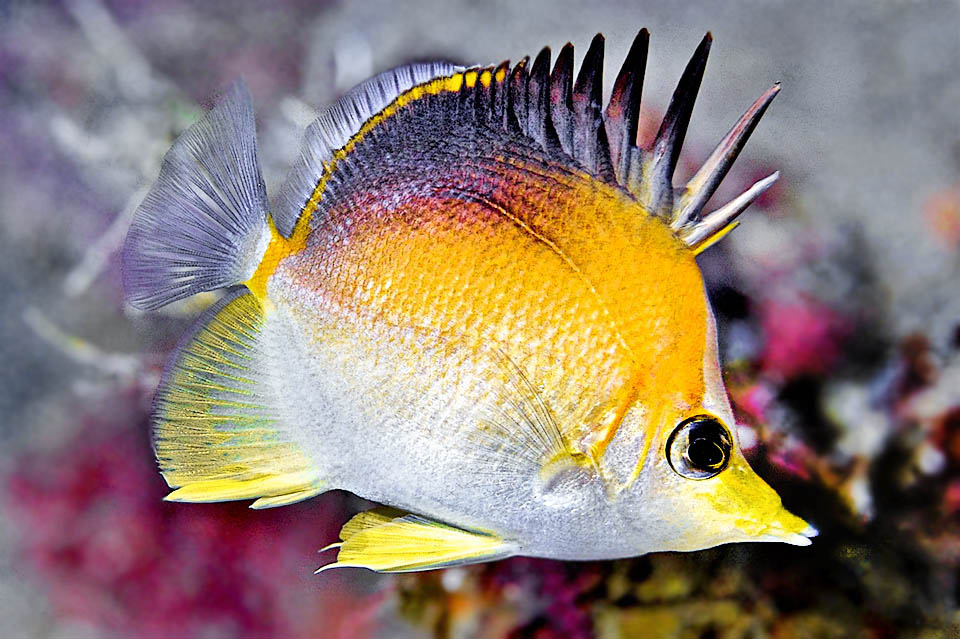
Common in tropical Indo-Pacific shallow waters, the butterflyfishes live also in the Caribbean with about twelve species of Prognathodes, up to 90 m of depth © www.carlosestape.photoshelter
When we think of butterflyfish, the mind immediately runs to the Indo Pacific crystalline waters, where dozens of brightly coloured species animate the coral reefs just a few metres deep.
What is less known is that the family of the Chaetodontidae, inserted in the order of the Acanthuriformes, is present also in the Caribbean with a dozen of deep water species belonging to the genus Prognathodes.
Created by Gill in 1862, the name comes from the Greek terms “pro”, ahead, “gnathos”, jaw, and “-oides”, having the shape of, with clear reference to the characteristic long snout of the species.
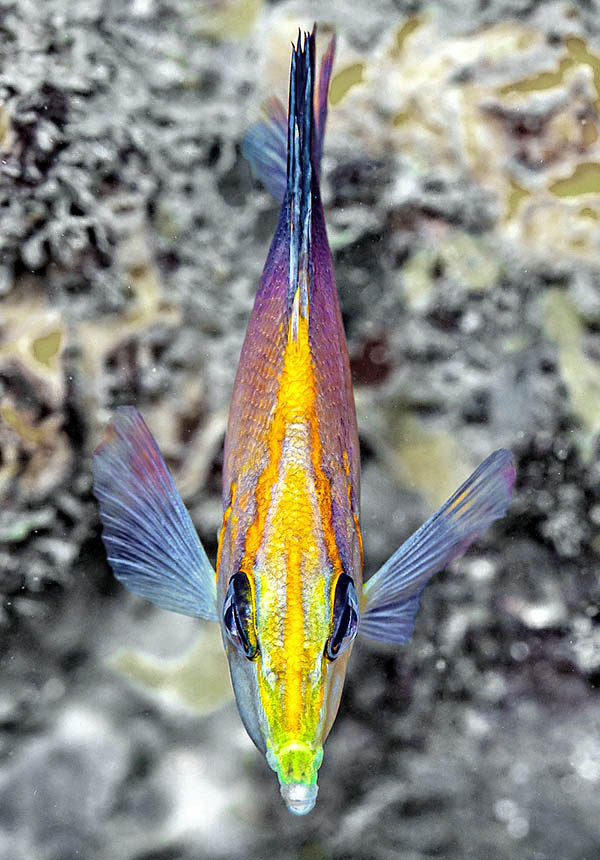
Prognathodes aculeatus can be 10 cm long at the utmost, with tall body, highly compressed on the sides © www.carlosestape.photoshelter
Unlike most butterflyfishes populating the shallow waters illuminated by the sun, these species live along the walls and the outer slopes of the coral reef, where for many years remained practically unknown to the scholars.
Described by Felipe Poey in 1860, Prognathodes aculeatus, so called because of the long and strong spines of the dorsal fin, is probably the most shy of the genus: an elegant denizen of the walls and the external slopes of the coral reef up to 90 m of depth, that only rarely allow the divers to sight it.
In fact, it remained for a long time a little-known species, studied most exclusively due to the specimens occasionally collected. Only during the last decades the technical diving with rebreathers and the employment of research submarines have allowed to document most continuously their behaviour in nature and to deepen their ecology.
Zoogeogra
It is present from the western side of the Gulf of Mexico and from Bahamas up to Venezuelan coasts.
Ecology-Habita
It is rare to meet Prognathodes aculeatus less than 20 m deep. It mainly frequents rocky walls, slopes and external slopes of the coral reef, where the light gets strongly weak and the currents keep the water clear and oxygen-ri
It prefers temperatures between 22,9 and 28 °C and environments dotted with cracks, small crevices and encrusting corals, that offer shelter and abundant food opportunities. Here it introduces its long snout into the cavities for seizing tiny crustaceans, polychaetes and other benthic invertebrates. It inspects not infrequently also the spines of the sea urchins, feeding on their pedicellariae and the small fauna living among the spines.
Life at these depths, characterized by a reduced brightness and by a less environmental variability than surface waters, explains, at least partially, the shy behaviour of the species and the relative scarcity of direct observations.
Morphophysiology
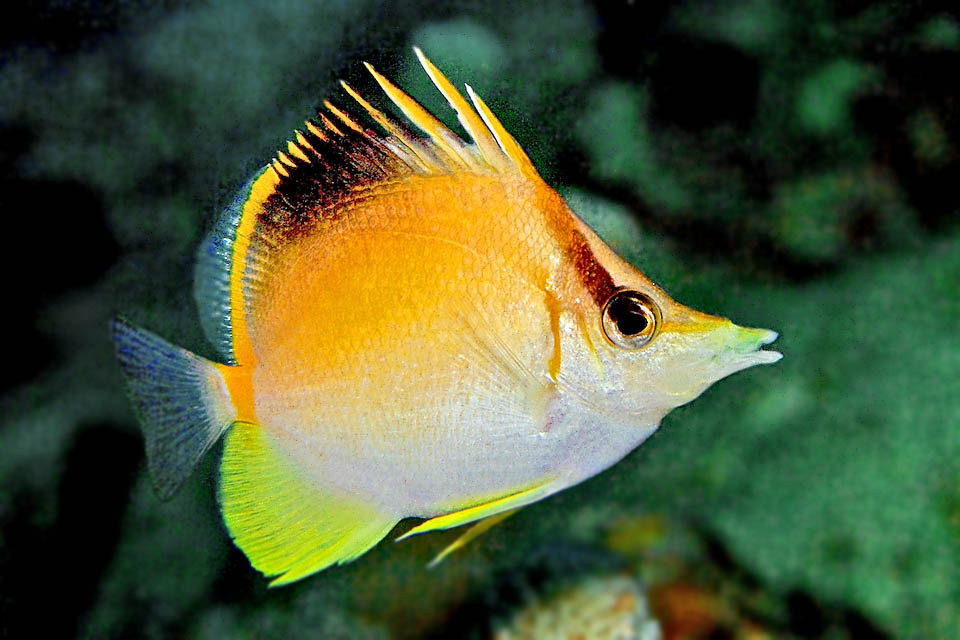
Livery shades from dorsal blackish to yellow-orange and to white. A band masks the eye. The third and fourth spiny rays are longer and the snout ends in tweezers © www.carlosestape.photoshelter
Prognathodes aculeatus attains a maximum of 10 cm, with a tall body, highly compressed on the sides and protected by ctenoid scales.
The lateral line counts 39-43 scales and the dorsal fin, with about 13-14 hard rays and 18-19 soft, presents longer third and fourth spines. The anal has 3 spiny rays and 14-16 soft; the pelvic ones are long and sharp, the pectorals have 12-14 rays and the caudal one is more or less truncated.
The snout, elongated like tweezers and equipped with a protractile mouth, is one of the most evident adaptations of the species. In fact, allows to reach tiny prey hidden into the cracks of the rock or among the organisms of the coral reef, exploiting food niches otherwise inaccessible to the fishes having a shorter snout.
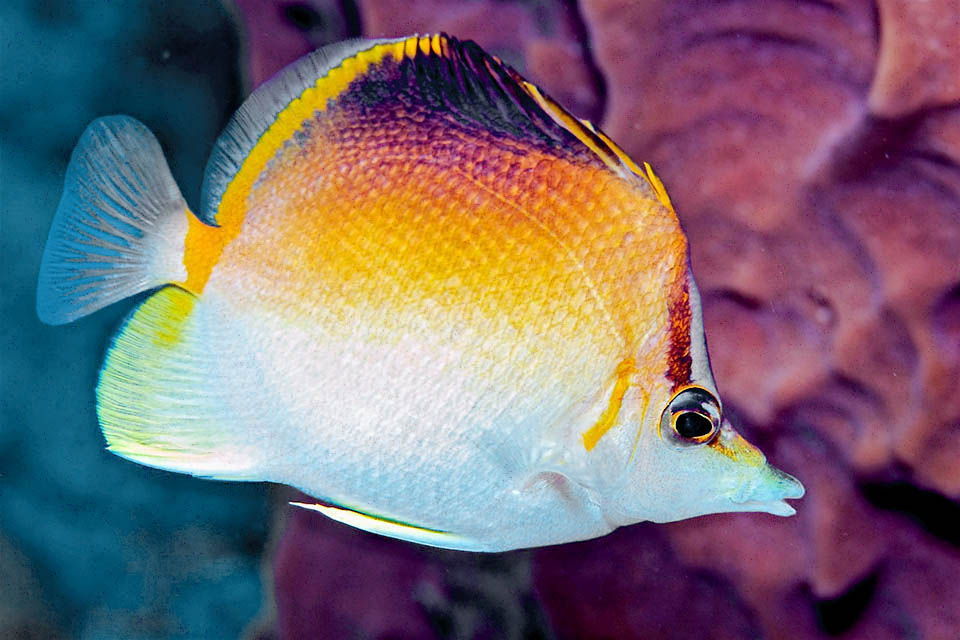
This allows it to reach with its protractile mouth tiny preys into the rocky crevices, exploiting food niches inaccessible to the short-snouted fishes © www.carlosestape.photoshelter
The upper half of the body fades from the dorsal blackish to the yellow-orange, whilst the lower part is white. Orange bands are present on the head and on the caudal peduncle, whilst a dark band masks the eyes, probably contributing in rendering less visible their position to the predators. In the juveniles this band is initially divided into two parallel strips that tend to merge while growing.
Overall, the livery, less flash than that of the butterflyfishes living in shallow waters, appears particularly suitable to the poorly lighted environment of the deep walls.
Ethology-Reproductive Biology
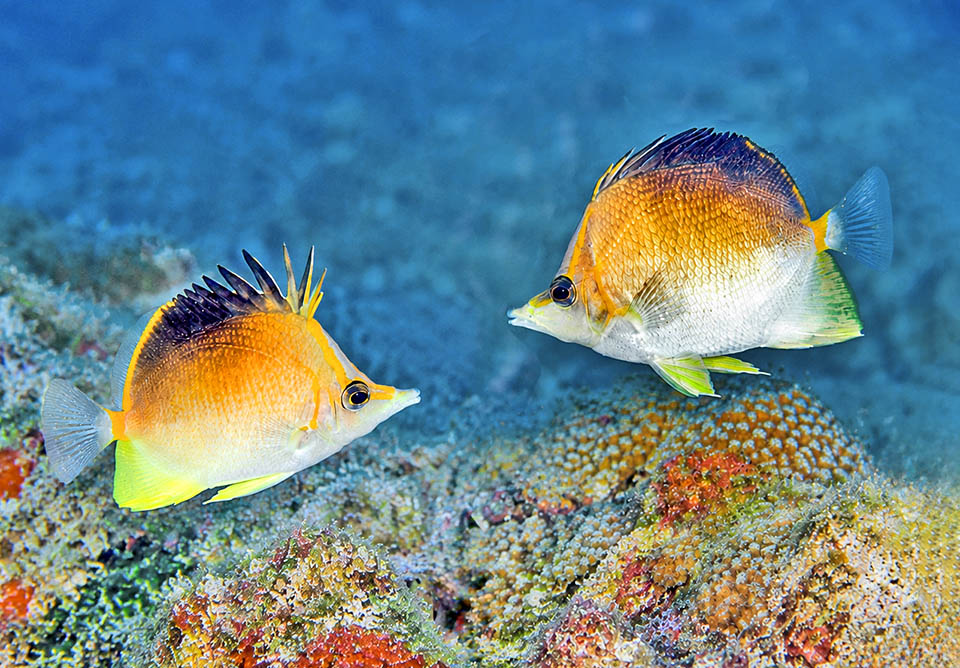
Prognathodes aculeatus lives alone or in pairs when reproducing. the fertilized eggs and the larvae are planktonic © www.carlosestape.photoshelter
Prognathodes aculeatus lives solitary or in stable couples during the reproductive period. Like the other Chaetodontidae, the eggs are fecundated in the water column and are entrusted to the sea currents who favour their dispersion.
The larvae are pelagic and cross the characteristic stage called “tholichthys”, during which the head is protected by thin bony plates, before reaching the seabed, progressively taking the shape and the livery of the adults.
Many aspects of the reproductive biology and of the social behaviour still remain little known, rightly because the species lives in depths rarely explored continuously.
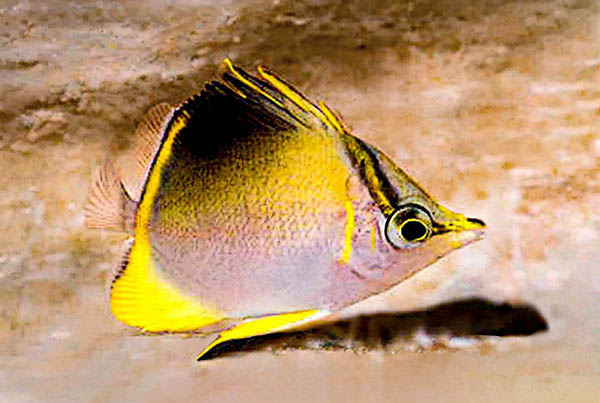
A young. The body, as can be seen from the big eye, has slightly different proportions than the adults. The blackish dorsal zone is already eident but the mimetic bar over the eye is broken in two © Barry B.Brown/coralreefphotos
The modern diving techniques are progressively filling these gaps, but several details concerning its natural history are still waiting to be fully clarified.
Resilience is high, with a minimum time for the populations doubling of less than 15 months, whilst the fishing vulnerability, very low, reaches only 10 on a scale of 100.
Considering its wide distribution and the relatively low fishing pressure on deep-water fish populations, Prognathodes aculeatus has been listed as “LC, Least Concern” in the IUCN Red List of Threatened Species since 2009, to this day.
Synonyms
Chelmon aculeatus Poey, 1860; Chaetodon aculeatus (Poey, 1860); Chelmon pelta Günther, 1860; Chaetodon unicolor Sauvage, 1880.
→ For general information about FISH please click here.
→ For general information about BONY FISH please click here
→ For general information about CARTILAGINOUS FISH please click here.
→ To appreciate the BIODIVERSITY of BONY FISH please click here.
→ To appreciate the BIODIVERSITY of CARTILAGINOUS FISH please click here.