
Family : Muraenidae

Text © Dr. Giuseppe Mazza

English translation by Mario Beltramini
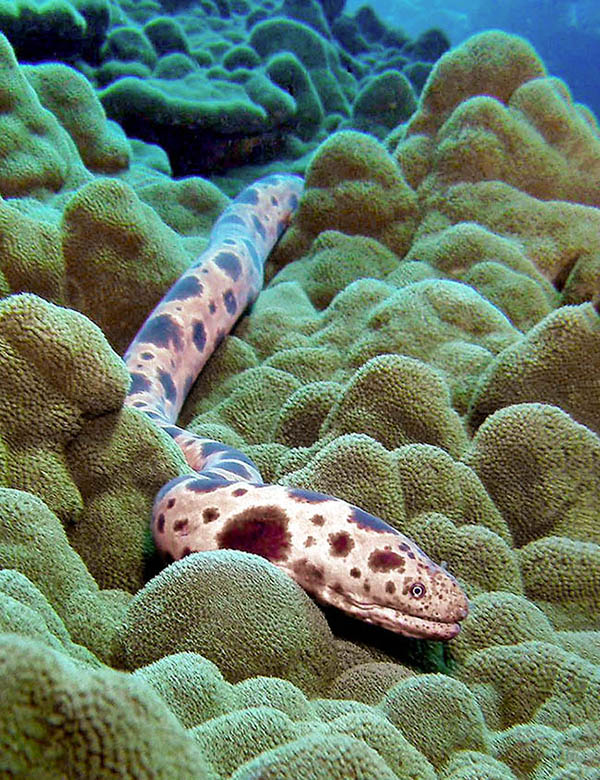
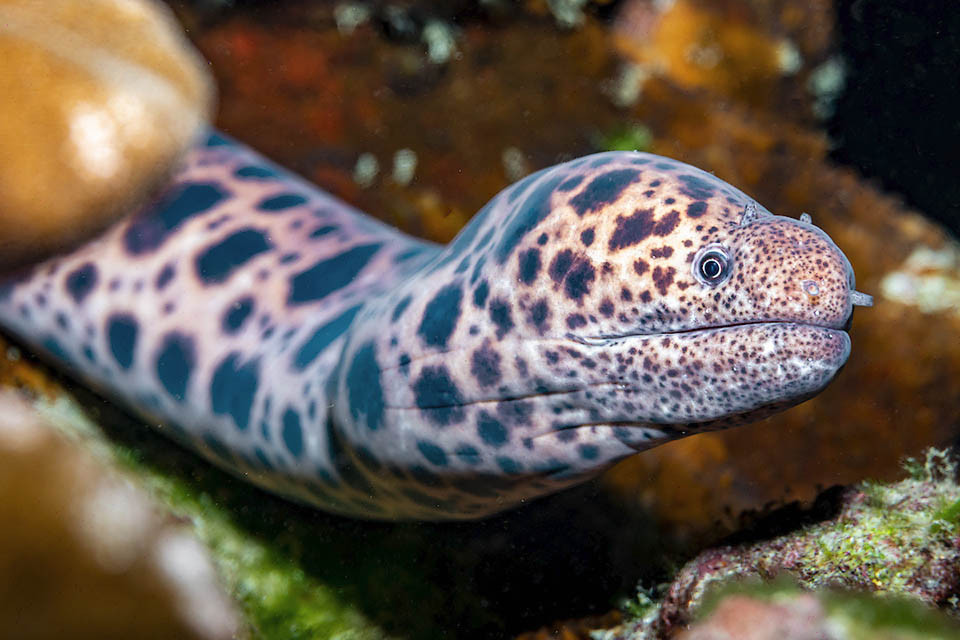
The Tiger-reef eel (Scuticaria tigrina) is an odd moray, long and thin, which has lost the fins © Barry Fackler
Among the tropical sea fishes having a serpentiform body we observe surprisingly different evolutionary solutions.
The large moray eels like Gymnothorax funebris or Gymnothorax javanicus are the most robust and powerful of this body conformation.
While retaining the typically elongated shape, they are predators exceeding two metres in length.
Their muscle mass and their strong jaws show how even an eel-like body adapts well to capture relatively big prey, dominating the cavities of the rocky coasts and of the madreporic formations.
Other smaller species, belonging to other taxonomic groups, hide and creep, thanks to their elongated shape, into the intricate and invisible system of the reefs tunnel system, at times taking shelter close to these also under the sandy seabed.
For instance, Stathmonotus hemphillii is a few centimetres Blenniiformes having bright camouflge colours that moves like a small snake among the colourful hard substrata; Ophichthus ophis is a snake eel belonging to the family Ophichthidae, that has the tail transformed into a shovel to disappear instantly, when needed, under the sand.
Heteroconger longissimus strategy is similar but different.
This Congridae is an anguilliform living in numerous schools, with most of the body sunken in a permanent den dug in the sandy bottom.
Swaying in the current like underwater blades of glass, the members of the colony intercept the passing-by plankton, retreating quickly into the sediment at the first sign of danger.
In such a scenery the Tiger reef-eel, Scuticaria tigrina (Lesson, 1828), occupies a particular position: though being in all respects a Muraenidae, it belongs to the subfamily Uropterygiinae, an evolutionary line almost without fins characterized by a long and thin body, flexible as a whip, capable to gain access into the narrow elbow slits of the reefs.
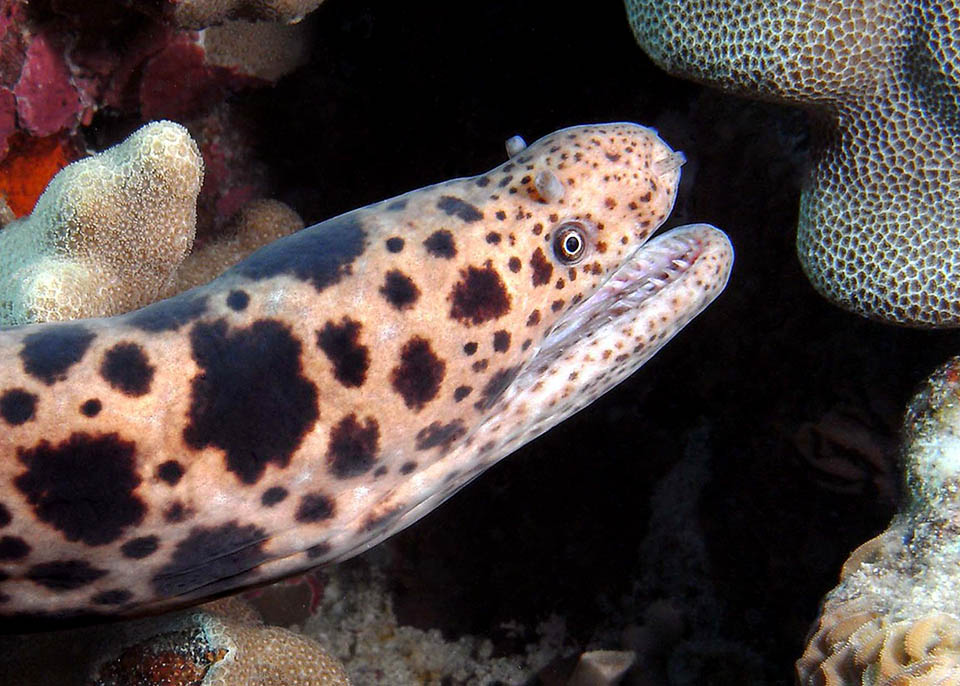
More than 1 m long but thin as a whip, has showy tubular nostrils to find the prey from the odour, also in dark and in the reefs meanders © Barry Fackler
To facilitate its tortuous paths, besides the pelvic fins, already absent in all anguilliformes, this species has lost almost entirely also the typical fin characteristic to the morays, that which, starting from the dorsal fin, merges, after the caudal, with the anal fin.
Survives, reduced to a fold of the skin, only in the final part of the body as states the old name of this genus:
Uropterygius, from the Greek “oura”, tail, and “pterygion”, small fin, name that has originated the one of the subfamily.
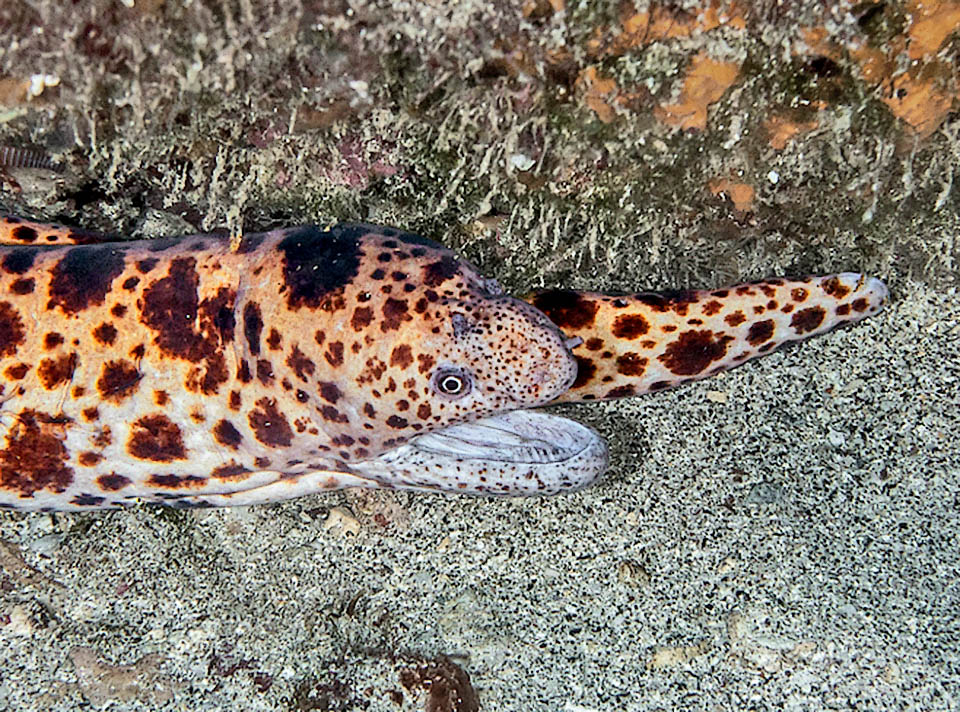
The eye is small, teeth are sharp, and we note only on the skin fold of the tail what remains of the characteristic morays continuous fin © www.carlosestape.photoshelter.com
The present genus Scuticaria, created by Jordan & Snyder in 1901, instead originates from the Latin “scutica”, whip, with the Greek suffix “-aria”, meaning “relevant to”, whilst the specific term tigrina reminds the characteristic tiger livery.
Zoogeography
Scuticaria tigrina lives in the Indo-Pacific, from the coasts of eastern Africa to the Society Islands pushing estwards up to the Hawaii and the eastern Pacific coasts of Mexico, Costa Rica and Panama. Northwards, it reaches the Philippines and Taiwan.
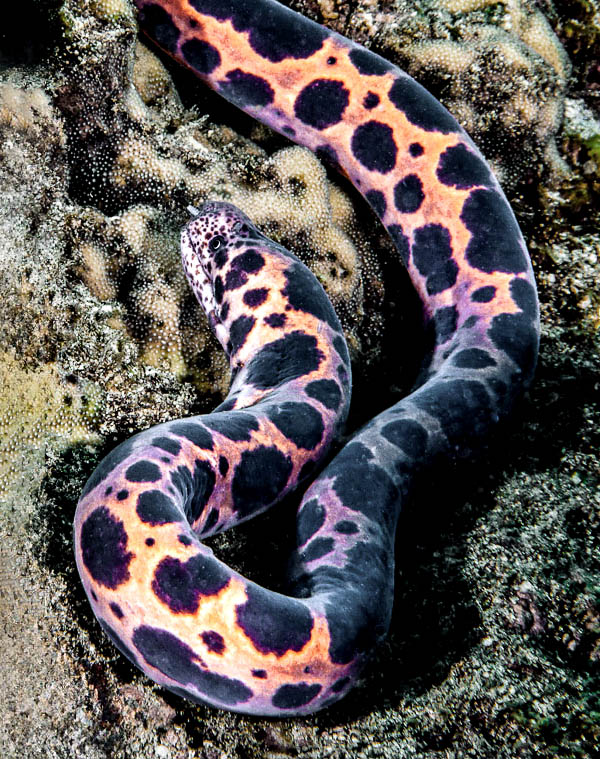
Looks like a snake, but little is known about this species, shy, mimetic and active usually at night © François Libert
Ecology-Habitat
Extremely secretive, this species is usually visible only at night, when it goes out hunting. It loves the warm waters with temperatures included between 25,9 and 29,3 °C, moving between 5 and 25 m deep, but also at the water’s edge, when in its tortuous paths, end up in a rock puddle.
Morphophysiology
Scuticaria tigrina may reach the length of 140 cm.
The skin, like moray eels, is scaleless.
The cylindrical body has a short head and snout, but a long mouth with rows of conical pointed teeth.
The eye is small and the showy anterior and posterior nostrils are cylindrical for a perfect sense of smell like in Myrichthys breviceps, a snake-eel displaying a livery similar at first sight, but with inverted colours, or the unbelievable Rhinomuraena quaesita which, living in analogous environments, has emphasized its odour perception with tubular, fan-shaped, nostrils.
Ethology-Reproductive Biology
Predominantly nocturnal predator, Scuticaria tigrina feeds on small fishes, crustaceans and mollusks often found in the ravines.
The reproductive modalities are still largely undiscovered. It is known that it is an oviparous species reproducing in couples with pelagic eggs.
The larvae wander for a long time in the open sea assuming the typical shape of the Anguilliformes, called leptocephalus, a transparent willow leaf with very small head and protruding needle-shaped teeth. The leptocephali do not seize zooplankton, like the normal fish larvae, but catch very small food particles transported by the currents.
They can also swim backwards thanks to fast wavy movements or curl assuming the look of a small wandering cylindre that renders them similar to unappetizing gelatinous masses like the jellyfish.
Reproduces in couples with pelagic eggs. The larvae, called leptocephali, remind a transparent willow leaf with very small head and needle-like protruding teeth © www.carlosestape.photoshelter.com
The resilience of Scuticaria tigrina is very low with a minimum time for doubling the populations of more than 14 years and the fishing vulnerability index, very high, marks 48 on a scale of 100. But even if at first glance one might think the opposite, it appears as “LC, Least Concern”, that is not endangered, in the 2011 IUCN Red List of the endangered species, considering the huge diffusion and the fact that no serious threat is known.
Synonyms
Ichthyophis tigrinus Lesson, 1828; Gymnomuraena tigrina (Lesson, 1828); Scuticaria tigrinus (Lesson, 1828); Uropterygius tigrinus (Lesson, 1828).
→ For general information about FISH please click here.
→ For general information about BONY FISH please click here
→ For general information about CARTILAGINOUS FISH please click here.
→ To appreciate the BIODIVERSITY of BONY FISH please click here.
→ To appreciate the BIODIVERSITY of CARTILAGINOUS FISH please click here.