
Family : Urotrygonidae

Text © Giuseppe Mazza

English translation by Mario Beltramini
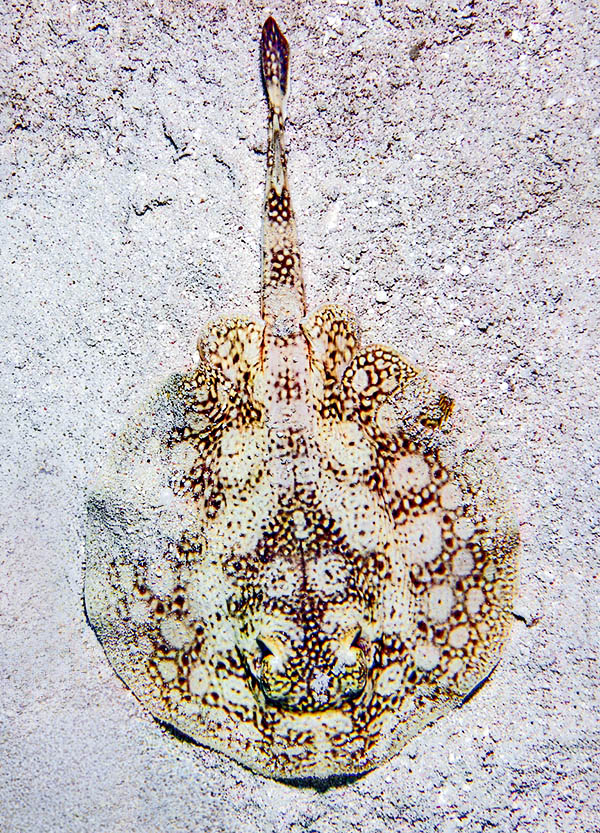
Known as the Yellow Stingray, Urobatis jamaicensis is a tropical and subtropical western Atlantic bottom-dwelling fish. Mainly active at night, it can reach 76 cm and rests hidden beneath the sand on the seabed © www.carlosestape.photoshelter
Evolution has found valid and surprising solutions for fishes that live resting on the seabed.
In species of the genus Bothus, for instance, the eyes move during growth towards the right side, as in the Caribbean Bothus lunatus and Bothus mancus. The same occurs in the small Mediterranean Bothus podas, whose eyes have elongated like periscopes, allowing it to better observe the colours and patterns of its surroundings and adjust, by acting on the chromatophores, its mimetic livery. The left side, facing the bottom, therefore remains without the migrated eye, although in nature the opposite also occurs, with species such as Gymnachirus nudus resting on their right side.
The Yellow stingray, Urobatis jamaicensis (Cuvier, 1816), which lives resting on the seabed, also has its eyes positioned on the upper surface and can thus monitor a horizontal field of view of approximately 360°. In this case, however, the flattening is not lateral but vertical: the eyes do not need to migrate because they are already positioned dorsally from birth.
It remains partially buried in the sand while waiting for prey such as Synodus intermedius, a lizardfish with an elongated, fusiform body, that is, anything but flat. It too uses the seabed for its ambushes: it remains motionless and inconspicuous before striking like lightning at passing prey.
But the eyes are not the only sentinels of Urobatis jamaicensis. Smell and electroreception also contribute to the search for prey.
The nostrils, located on the ventral surface, detect chemical signals dispersed in the water, while the ampullae of Lorenzini, concentrated in the cephalic region, detect extremely weak electric fields generated by the muscular and nervous activity of other animals.
This is a particularly effective system for a species that often has to locate prey hidden from view: when prey cannot be seen, smell may signal its presence and the electric field may reveal its position.
Sight, smell and electroreception thus form a kind of multi-level search system, in which the eyes monitor what protrudes from the seabed, the nostrils follow chemical signals and the ampullae of Lorenzini allow the fish to detect even what remains hidden.
The genus Urobatis, created by Garman in 1913, derives from “οὐρά” (ourá), meaning tail, and later “uro”, apparently referring to the blunt tail, whose length is equivalent to that of the body, and from “βατίς” (batís), the name of a flat fish used in antiquity to designate a ray.
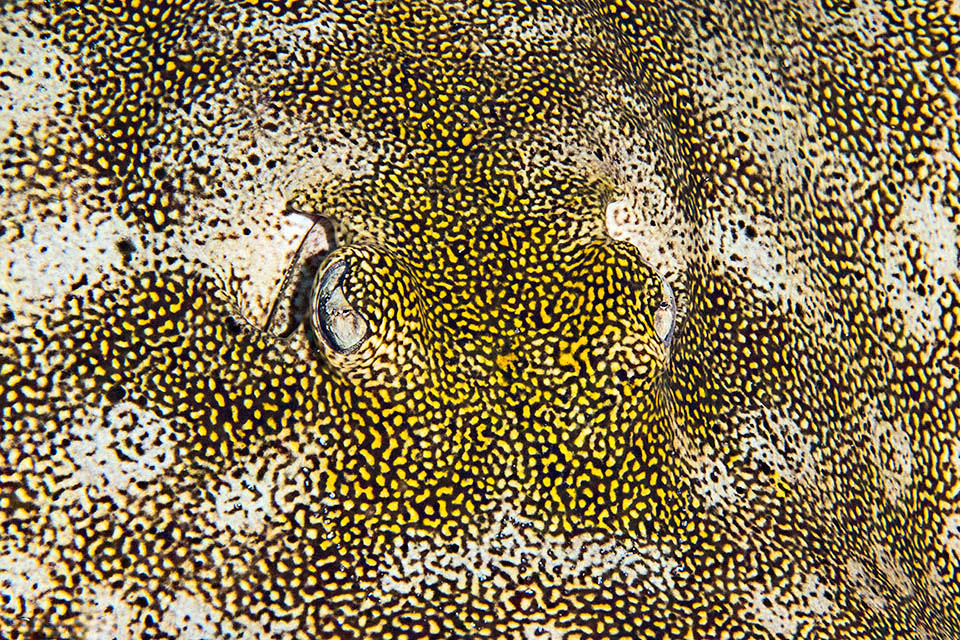
The livery of Urobatis jamaicensis, variable and mimetic, almost conceals the eyes positioned high on the body like sentinels on the back © Brian Cole
The specific name jamaicensis (Cuvier, 1816), with “-ensis”, the Latin suffix indicating a place, is a clear reference to Jamaica, its type locality.
A fish of the order Myliobatiformes, which includes numerous families of rays and stingrays, Urobatis jamaicensis belongs to the family Urotrygonidae, which comprises the American round rays, small batoids with strongly depressed bodies, with the eyes and spiracles on the dorsal surface, while the mouth and gill slits are located on the ventral side.
Zoogeography
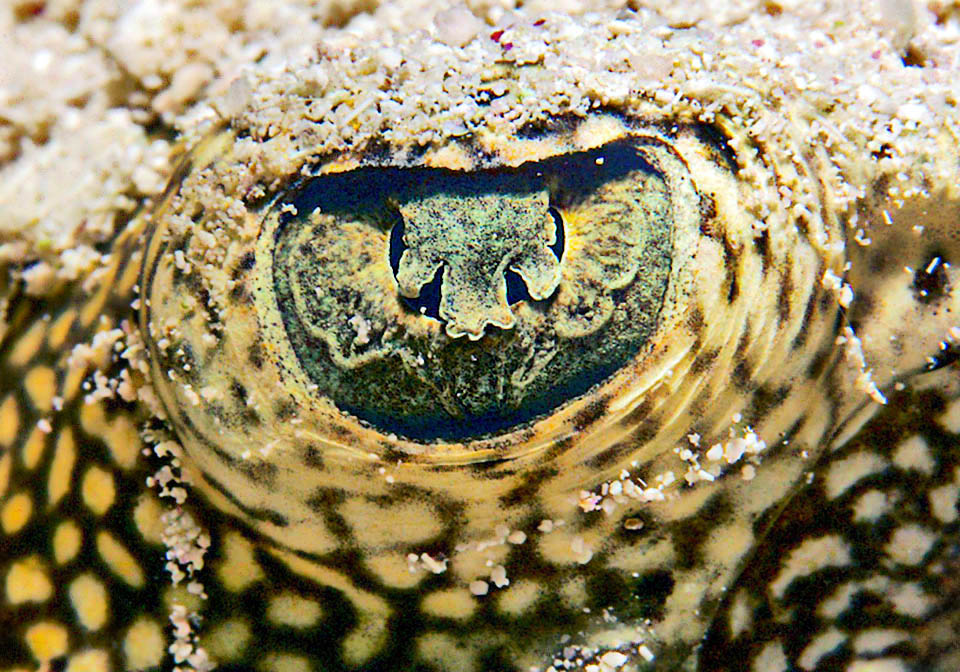
The pupil is not round but crescent-shaped, together with a particular iris structure, the “pupillary operculum”, a kind of flap that can partially cover its opening, protecting the retina from flashes of sunlight that could suddenly dazzle the fish in shallow water and still maintain clear vision in bright sunlight © www.carlosestape.photoshelter
Urobatis jamaicensis is present in the tropical and subtropical western Atlantic, from North Carolina to Florida, in the Gulf of Mexico, along Yucatán, in the Bahamas and throughout much of the Caribbean, reaching the northern regions of South America.
Ecology-Habitat
It is generally found between 1 and 30 m in depth, mainly in waters with temperatures ranging from 25.8 to 28.1 °C, over gravelly, sandy or muddy bottoms, near seaweed beds and madreporic formations, although it also frequents bays and estuaries. Specimens have also been recorded at greater depths, down to about 70 m.
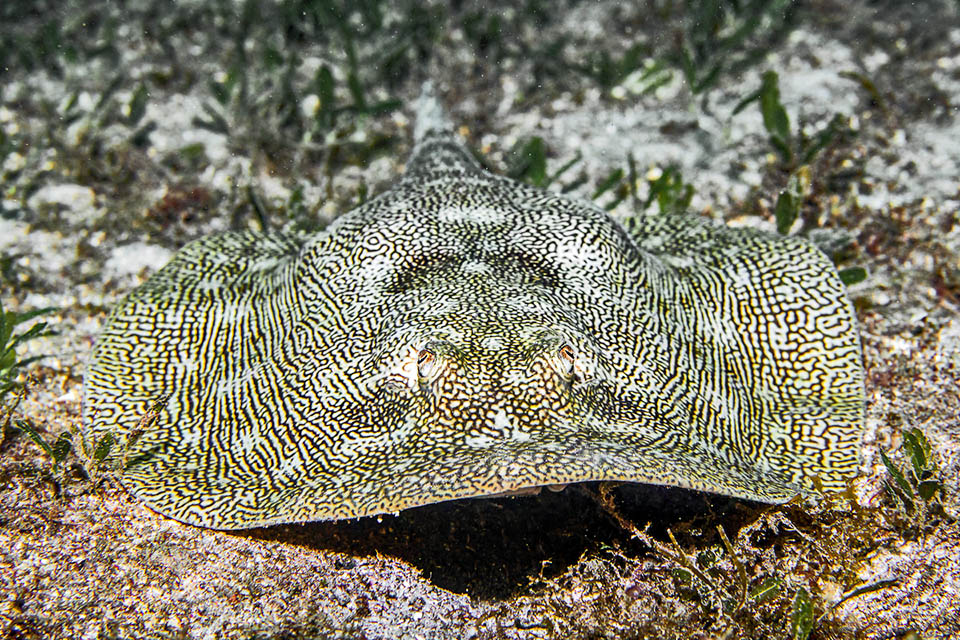
Urobatis jamaicensis feeds mainly on crustaceans, but its diet also includes small fish, molluscs and worms. A particularly interesting behaviour consists of raising the front part of the disc, simulating a small cave that intrigues small fish seeking food or shelter and leads them straight into the stomach © www.carlosestape.photoshelter
Especially active at night, Urobatis jamaicensis is a sedentary species that often spends the daytime buried in the sediment, with only its eyes protruding, like two small sentinels emerging from the seabed, followed by two openings, called spiracles, which draw in water and allow it to pass over the gills.
Morphophysiology
It can reach 76 cm in length, with a maximum disc diameter of 36 cm. The disc is oval or almost circular. The skin is smooth. The snout is rounded, with the mouth equipped with numerous small teeth arranged in bands.
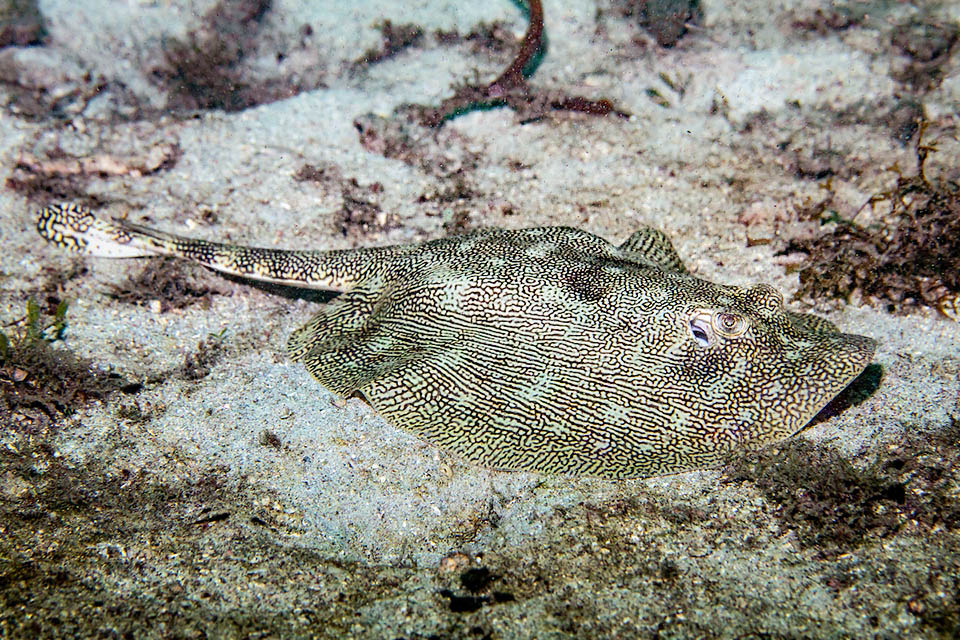
Here it is seen from the side. The tail, as long as the disc, ends in a double-serrated spine. A sting used only for defence, connected to a venom gland © www.carlosestape.photoshelter
It lacks a dorsal fin, and the edge of the disc has no angular projections. The well-developed caudal fin extends around the end of the tail, which terminates in a double-serrated spine. This spine, used for defence, is connected to a venom gland and can cause very painful wounds. The livery is highly variable depending on the environment. The upper surface displays striking light and dark spots or fine speckling that can form brownish and greenish patterns. The underside, which is rarely visible, is lighter, with yellowish tones.
The pupils are not round but crescent-shaped, accompanied by a particular iris structure, the “pupillary operculum”, a kind of membrane that can partially cover the opening, regulating the amount of light reaching the retina and helping to protect the eye.
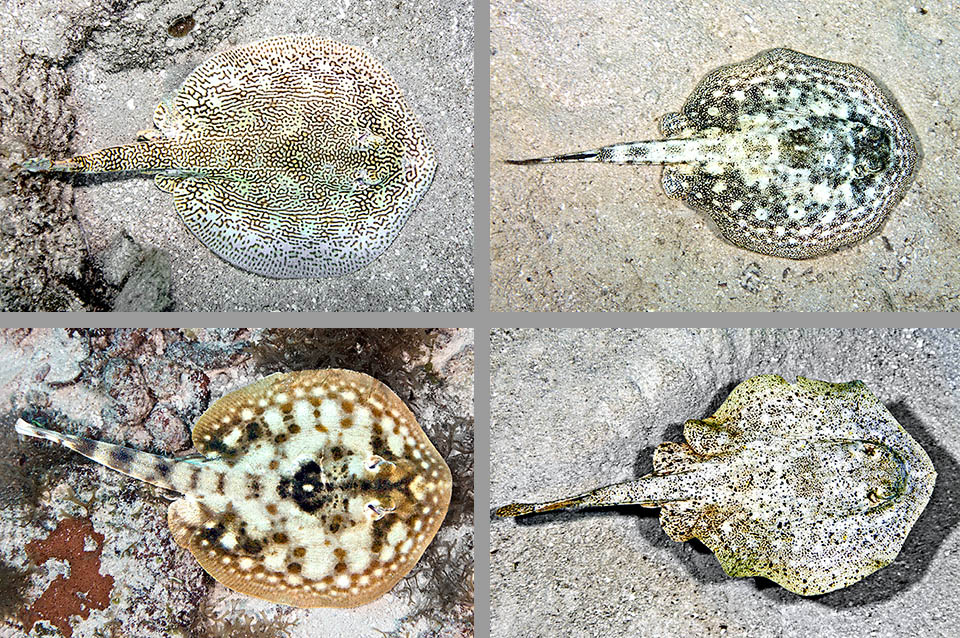
The dorsal surface, variable due to chromatophores depending on circumstances, shows striking spots or fine speckling that can create brownish and greenish patterns © www.carlosestape.photoshelter
Ethology-Reproductive Biology
The diet of the Yellow stingray is also closely linked to the seabed. It feeds mainly on crustaceans, although its diet also includes small fish, molluscs and worms. A particularly interesting behaviour consists of raising the front part of the disc, simulating a small cave to attract prey seeking shelter, which may thus come within reach of its mouth.
Urobatis jamaicensis is a viviparous species, with the embryos developing inside the maternal uterus and litters generally consisting of only a few young, ranging from 1 to 5 according to the sources.
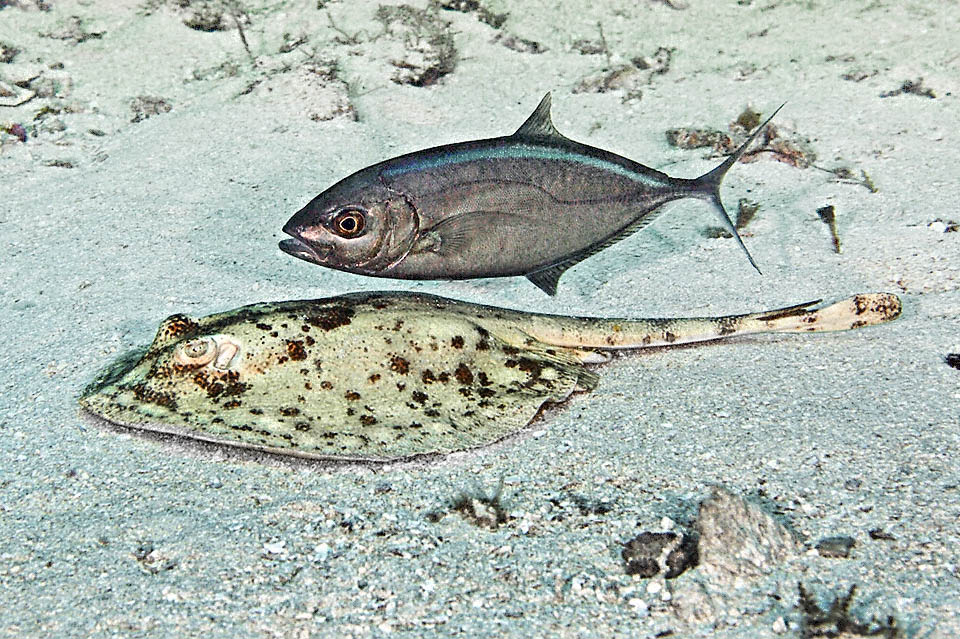
When Urobatis jamaicensis goes hunting, guided by sight, smell and the ampullae of Lorenzini, which detect the electric fields emitted by hidden prey, some fish such as this Caranx ruber follow it opportunistically to steal its food, taking advantage of benefits provided by its searching activity in the surrounding waters and nearby surroundings © www.carlosestape.photoshelter
As in Mobula birostris, during mating the male grasps the edge of the female’s pectoral fin with its mouth and then moves beneath her body until it assumes a belly-to-belly position, inserting one of its two pterygopodia into the female’s cloaca. The pair may be surrounded by other males swimming around and attempting to approach, and mutual biting of the pectoral fins has also been observed.
The reproduction of Urobatis jamaicensis has two reproductive periods during the year, so the species has a biannual reproductive cycle. The presence in embryos of a fleshy flap on the inner margin of the spiracle, a structure that disappears before or shortly after birth, has been interpreted as a possible adaptation to intrauterine nutrition: the membrane may help convey the uterine nutritional secretion, the so-called “uterine milk”, towards the spiracle.
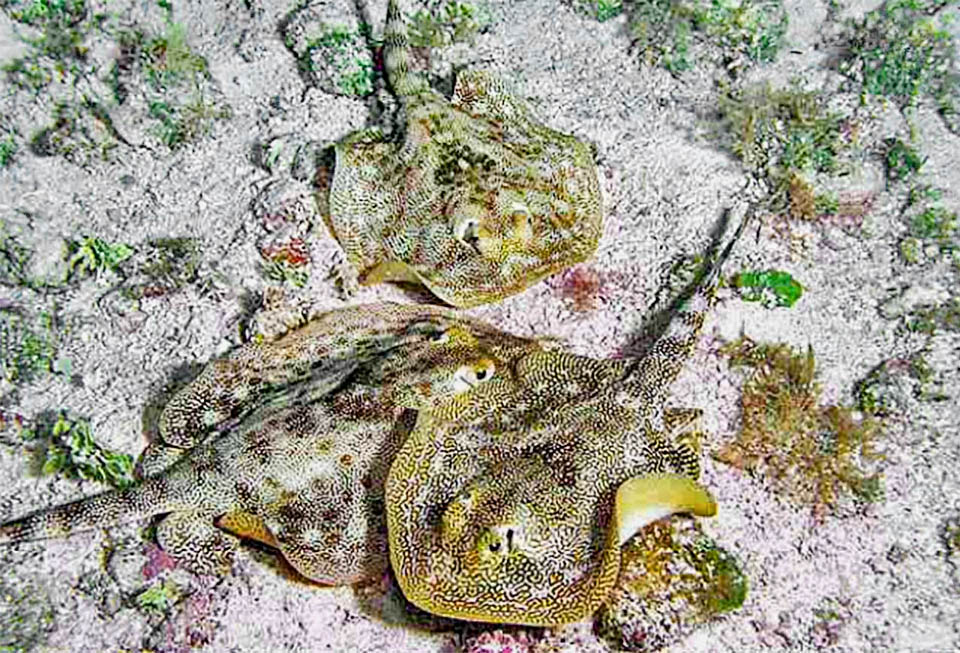
A larger female and two suitors. The one that first grasps the edge of the pectoral fin, positioning itself belly to belly, will complete the mating © Jim Lyle
The size at birth is approximately 15 cm, and maximum longevity is estimated at 14 years. Resilience is very low, with a minimum population doubling time of more than 14 years; fishing vulnerability is moderately high, with a value of 50 on a scale of 100. Nevertheless, populations are considered stable and Urobatis jamaicensis is therefore classified as “LC, Least Concern” on the IUCN Red List; the latest reported assessment dates from June 21, 2019.
Synonyms
Raia jamaicensis Cuvier, 1816; Urolophus jamaicensis (Cuvier, 1816); Trygonobatus torpedinus Desmarest, 1823; Urobatis sloani vermiculatus Garman, 1913.