
Family : Syngnathidae

Text © Dr. Giuseppe Mazza

English translation by Mario Beltramini
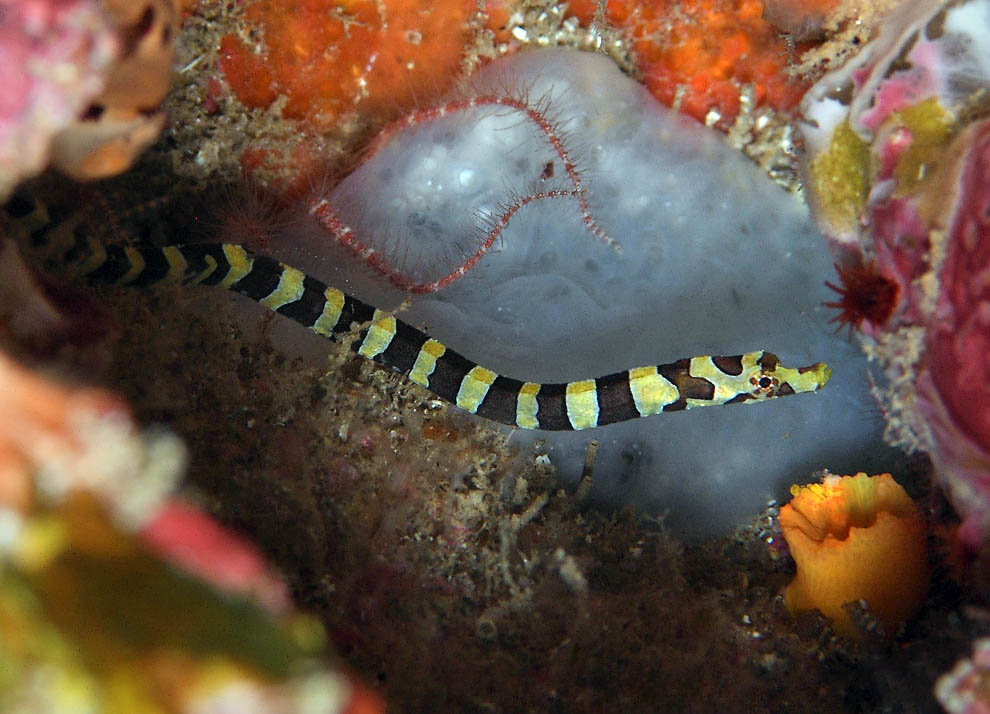
Maximum 15 cm long, the Banded pipefish (Micrognathus crinitus) is present in the West Atlantic tropical and subtropical waters © terence zahner
The multiform order of the Syngnathiformes, inserted in the class of the Actinopterygii, the ray-finned fish, counts more than 50 genera and 300 species.
They are grouped together il 5 families: the Aulostomidae, the weighty trumpetfish like Aulostomus chinensis with its protractile mouth that allows it to swallow even large prey, the Centriscidae, called razorfish like Aeoliscus strigatus, the Fistulariidae, with their elongated shape like Fistularia commersonii that has given them the name of cornetfish, the Solenostomidae, the incredible ghostfish like Solenostomus paradoxus, and the Syngnathidae, the large group of pipefish and of the seahorse that often flaunt bright colours like the colourful Hippocampus reidi.
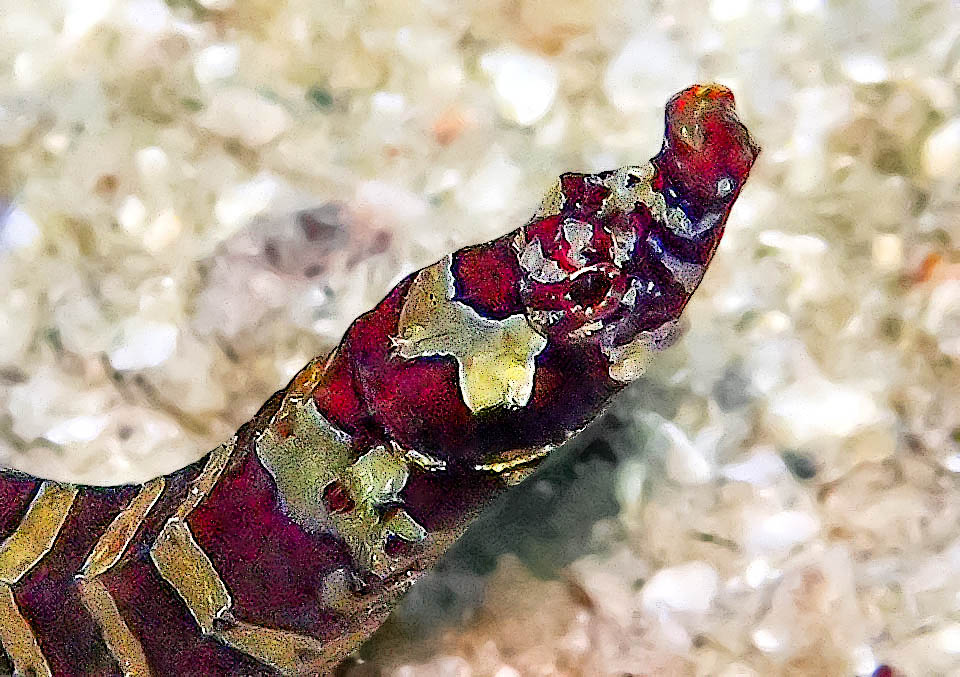
The snout is fairly short, as states the etymology of the genus Micrognathus meaning small jaw © www.carlosestape.photoshelter.com.
They are all marine species with some membre frequenting also the brackish waters like Hippocampus guttulatus, scaleless fishes subcutaneously protected by bony rings and characterized by elongated, tube-shaped snout, present in all species but the adults of the genus Bulbonaricus that like Bulbonaricus brauni have it only while young.
The Banded pipefish, Micrognathus crinitus (Jenyns,1842), bears the name of the genus created by Duncker in 1912, formed by the Greek “mikros”, small, and “gnathus”, jaw, alluding to the short snout, whilst the specific term crinitus, with the crest in Latin, is a possible reference to the prominent toothed crests between the rings.
Zoogeography
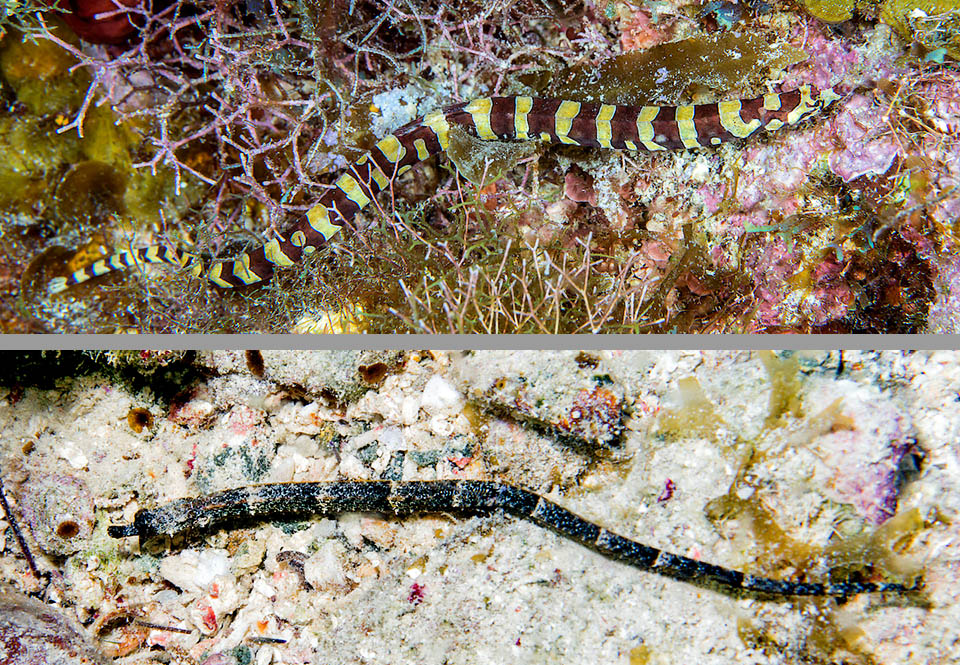
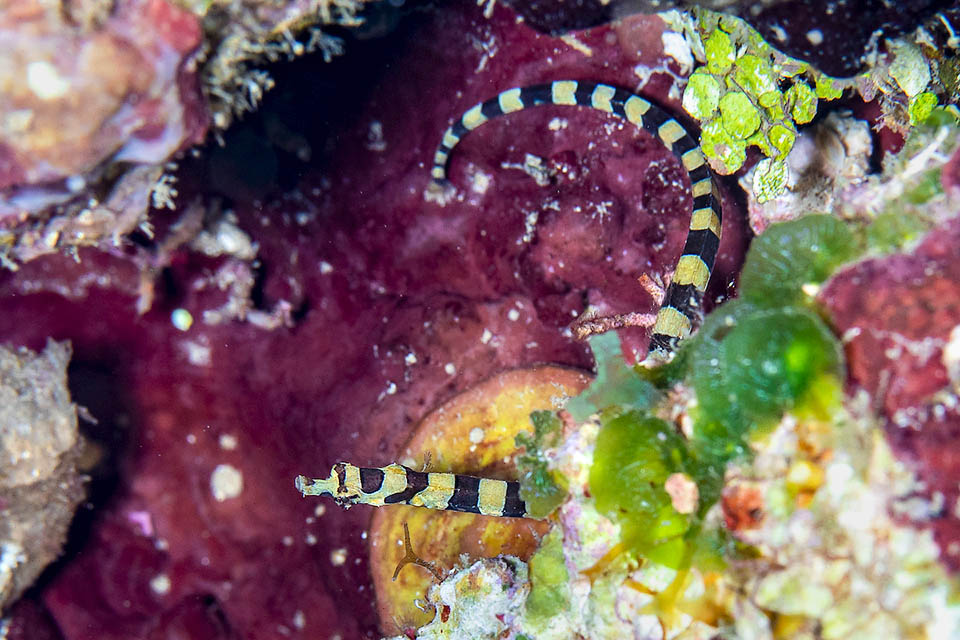
In the same range may appear with two forms of colour: the ensenadae, with yellowish and dark violet bars, and the crinitus, with 10 or more clearly dotted dark bands © www.carlosestape.photoshelter.com
Micrognathus crinitus lives in western Atlantic from the lower eastern coast of Florida, the. Bermudas and the Bahamas to Santa Catarina in Brazil, but surprisingly counts only one finding in the Gulf of Mexico at Cayo Arcas.
Ecology-Habitat
It is present between 1 and 21 m in depth, mainly at temperatures included between 25,8 and 28,2 °C, in coralligenous environment, rocky and with coarse sand but also sheltered by the submerged meadows of phanerogams.
Morphophysiology
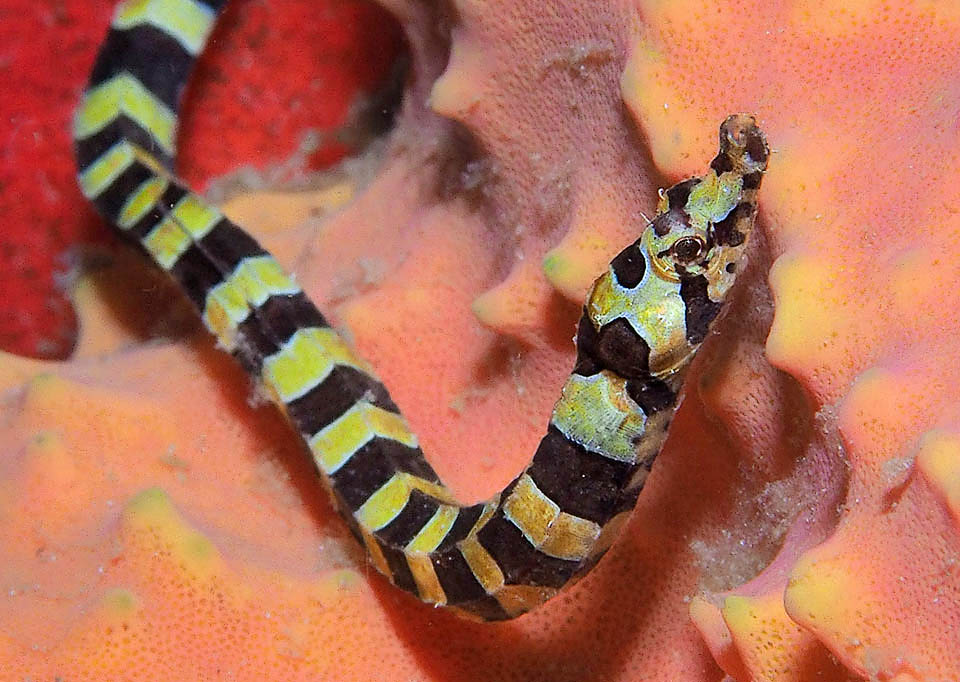
Some scholars talk already of two species, but in both cases the body is protected by 49-52 bony rings and have the same outgrowths © Mélodie Caussat
Micrognathus crinitus presents small cutaneous flaps scattered on the skin and may reach with its 49-52 rings the length of 15 cm. The pelvic fins are absent, and the dorsal, which ensures, undulating, the locomotion, counts 17-32 unarmed rays. The anal has 2-4 rays, the pectoral ones 12-14 and the caudal, rounded, usually 10.
It may be present in the same range with two different forms of colour: the ensenadae with wide and marked bars, white or yellow, contrasting others, dark violaceous, present also on the head, whilst the form crinitus, practically in white and black, catches the eye due to 10 or more dark bars with small clear dots placed at regular intervals along the crests of the body.
Naturally, some Authors maintain that they could be two distinct species, since that intermediate forms are not known, and research is underway.
Under the tail males have a brooding pouch where fecundation occurs. The eggs adhere to the tissue rich in capillaries that nourish and oxygenate the embryos © www.carlosestape.photoshelter.com
Ethology-Reproductive Biology
Micrognathus crinitus, feeds, like all seahorses and pipefishes on small invertebrates. They suck them in with their cylindrical snouts, employed like a pipette, almost non-stop because they do not have a stomach and their intestinal digestion is rapid and somewhat inefficient.
The Banded pipefish is an oviparous species and the fecundation takes place in the semi-open brooding pouch of the male, located under the tail, that occupies 10-17 rings.
The pear-shaped eggs are then incorporated by the epithelial tissue, rich in capillaries which feed and oxygenate the embryos.
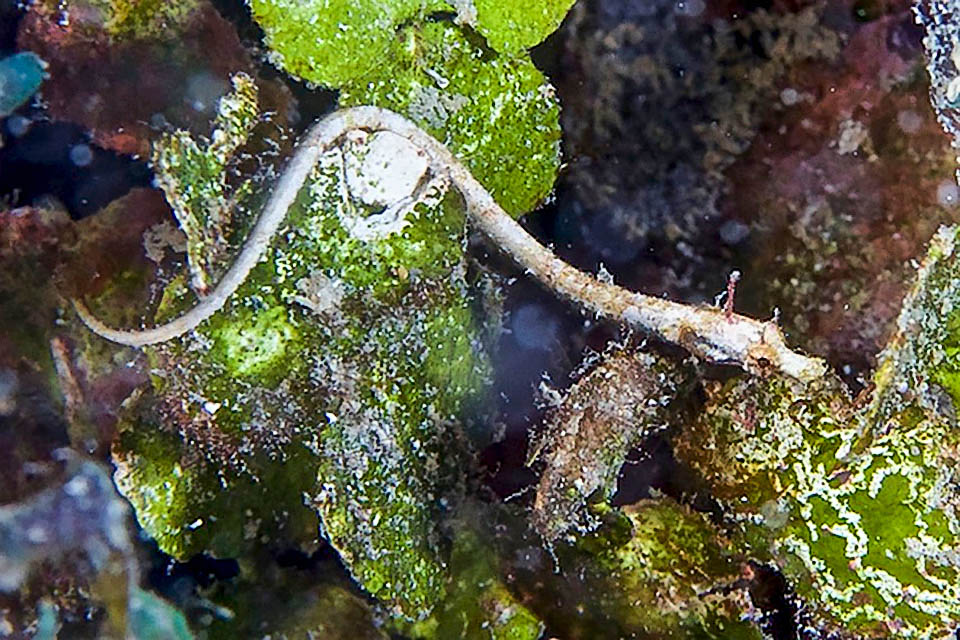
Juvenile. The high resilience and the very low fishing vulnerability place the Banded pipefish among the not endangered species of the IUCN Red List © www.carlosestape.photoshelter.com
The resilience is high with a minimum time for the doubling of the populations of less than 15 months and the fishing vulnerability, very low, marks only 10 on a scale of 100. Consequently, Micrognathus crinitus from 2014 appears as “LC, Least Concern”, in the IUCN Red List of the endangered species.
Synonyms
Syngnathus crinitus Jenyns, 1842; Halicampus crinitus (Jenyns, 1842); Corythoichthys vittatus Kaup, 1856; Micrognathus vittatus (Kaup, 1856); Syngnathus jonesii Günther, 1874; Micrognathus jonesii (Günther, 1874); Corythroichthys ensenadae Silvester, 1915; Micrognathus ensenadae (Silvester, 1915).
→ For general information about FISH please click here.
→ For general information about BONY FISH please click here
→ For general information about CARTILAGINOUS FISH please click here.
→ To appreciate the BIODIVERSITY of BONY FISH please click here.
→ To appreciate the BIODIVERSITY of CARTILAGINOUS FISH please click here.